Gold meltdown underway: What’s ahead as key $4,000 level looms
Gold has fallen over 20% since the beginning of this month, erasing all the gains seen earlier this year. The bearish pressure is unlikely to recede in the near future, as central banks have turned hawkish, which doesn’t bode well for the precious metal. Is the Gold Rush over?
Central banks turn hawkish on inflation fears
As the US-Iran conflict drags on further, higher Crude Oil prices have bolstered bets that central banks around the world will once again consider raising interest rates to curb inflation.
The main conclusion of all the central banks’ meetings last week is that policymakers are once again prioritizing the fight against inflation over economic growth. And this means keeping rates at the current levels for longer or even hiking them.
The Reserve Bank of Australia lifted the cash rate last week and forecasted inflation to stay above the target until 2027-2028, suggesting the potential for further hikes. The Bank of Canada also showed readiness to hike interest rates to combat a resurgence in inflation despite growing economic uncertainties.
Bank of Japan Governor Kazuo Ueda kept the possibility of an interest rate hike in April alive. The Bank of England also adopted a ready-to-act approach amid rising inflation fears, supply chain disruptions, and soaring energy prices from the Middle East conflict. Markets are now pricing in up to 80 basis points of BoE tightening by the year-end, which is the equivalent of around three 25-basis-point hikes, while a month ago the baseline scenario was to cut interest rates. What a turnaround.
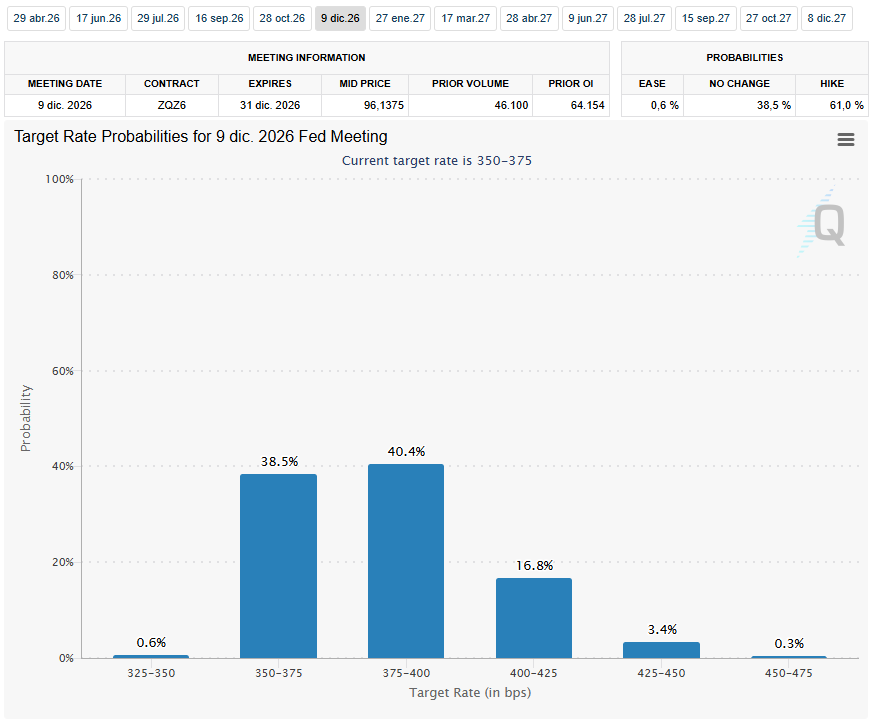
Similarly, the European Central Bank highlighted hawkish risks and the return of interest rate hikes in Q2-Q3 due to a surge in energy prices. The US Federal Reserve, on the other hand, raised its inflation forecasts, forcing investors to rapidly scale back rate-cut bets. The CME Group's FedWatch Tool indicates minimal to no chance of a rate cut by the end of this year.
Soaring bond yields counter geopolitical risks
What does all this mean for Gold? Well, this quick repricing in the expected interest-rate path has been felt in bonds, which are direct competitors of the precious metal when investors look for lower-risk assets.
The resultant dramatic rise in global bond yields has turned bonds more interesting, prompting heavy liquidation by large institutional players and leading to a steep fall in the Gold price.
This counters the traditional market behaviour, where the commodity typically rallies during uncertain times, suggesting that interest rate outlook and liquidity conditions are overpowering geopolitical tensions.
Gold Technical Analysis: Oversold conditions unlikely to stop the bleeding
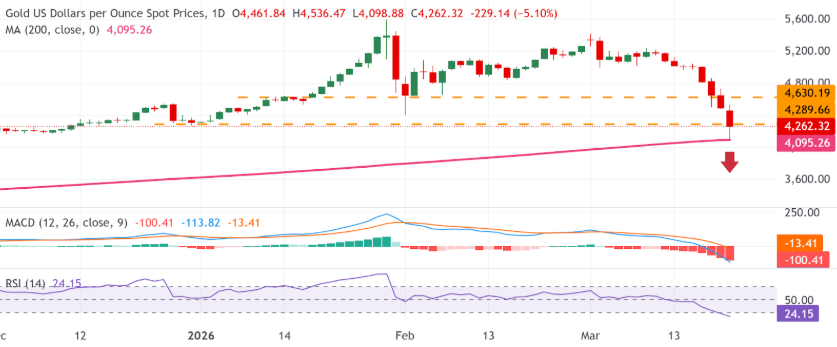
The recent slump in Gold appears to have found some cushion around the $4,100 mark, near the technically significant 200-day Simple Moving Average (SMA). The Relative Strength Index (RSI) on the daily chart has entered oversold conditions for the first time since October 2023. While this could signal some signs of relief ahead, its steady slide from above 60 in a matter of days indicates firm selling pressure rather than an immediate stabilization.
The Moving Average Convergence Divergence (MACD) indicator remains below the signal line and deep in negative territory, with an expanding negative histogram that reinforces persistent downward momentum.
A sustained recovery above $4,500 would be needed to ease the current bearish tone and open the way back toward $4,820, while failure to hold above the key 200-day SMA at $4,095 would keep the path open for deeper losses toward $4,000.
(The technical analysis of this story was written with the help of an AI tool.)
Author

Haresh Menghani
FXStreet
Haresh Menghani is a detail-oriented professional with 10+ years of extensive experience in analysing the global financial markets.