Gold is supposed to be a hedge against war and inflation – Not this time
Current global circumstances should be highly favorable for Gold, which functions as a safe-haven asset when geopolitical tensions arise and also acts as a store of value when fiat currencies decline during prolonged inflationary periods. That’s a nice theory, but this isn’t happening now.
My colleague Dhwani Mehta explains in the video above why Gold price stalls despite increasing global geopolitical tensions and volatile Oil prices.
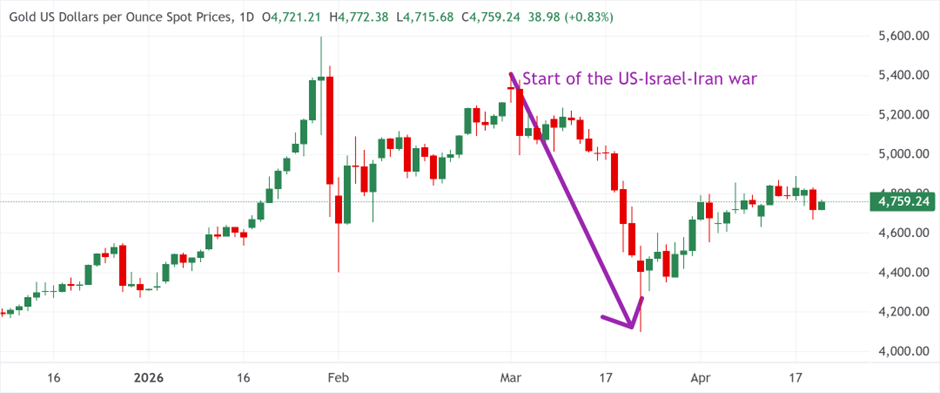
The bullion's status as a reliable short-term hedge against rising prices is increasingly questioned. Gold prices have been on a crashing spree, and the decline has been particularly noticeable since the start of the conflict involving the US, Israel, and Iran.
What’s going on?
The war has triggered a sharp spike in Crude Oil prices, which has led to a significant surge in global inflation and fueled speculations about a more hawkish stance from major central banks, including the US Federal Reserve.
Rising expectations for tighter central bank policies have driven real bond yields – nominal yields adjusted for inflation – higher. This raises the opportunity cost and further reduces the attractiveness of the non-yielding Gold as investors flock to other income-producing assets, like bonds. Basically, many investors looking for safety saw a better opportunity in bonds and abandoned Gold.
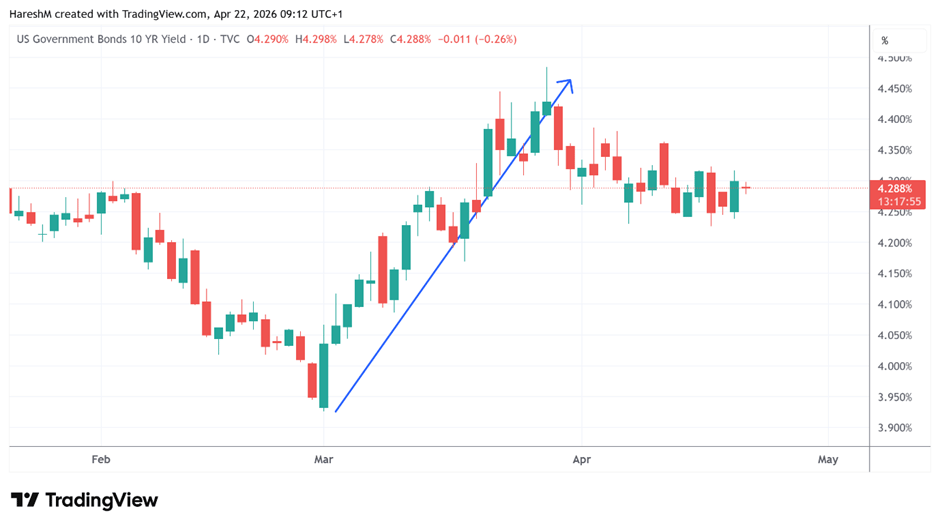
The rise in yields provided support to the US Dollar as well, as did the fact that the US is a net energy exporter and placed better than most of its peers, who are mostly Oil-importing nations.
As Gold is priced in dollars, the Greenback’s strength surely has also contributed to the precious metal’s decline. There’s a caveat, however: Gold’s price has also fallen when priced in other currencies, such as euros or pounds, meaning that the downfall can be more attributable to investors rejecting the metal rather than a simple effect from an inverse correlation.
To better understand what could have happened, it is good to look back. Gold reached a critical tipping point in early 2026, rising to a record high after a rally characterized as one of the most crowded trades in the world with excessive leverage. The rally had gone too far, too fast, and too many traders were on the same side of the trade.
Short-term pain, long-term gain?
Looking beyond the short-term, Gold’s outlook remains constructive. The US Dollar already experienced a notable decline in April as investors reduced exposure to geopolitical risk premiums despite the uncertainty over the US-Iran peace talks.
Diminishing Fed rate hike bets led to a revival in rate cut expectations, with traders placing a 45%-50% chance of a reduction by year-end and selling the USD. One of the main elements weighing on Gold, therefore, is starting to ease.
Moreover, a potential end of hostilities is projected to lower Oil prices and ease inflation concerns, prompting central banks to pivot toward a less hawkish stance, removing another major headwind for non-yielding Gold.
In summary, Gold’s upbeat outlook appears intact in the medium to long term. Structural factors, from central bank demand to systemic risks associated with high sovereign debt, remain supportive for the metal. The war hasn’t fared well for Gold, but this looks more like a short-term blip rather than a long-term shift of the recent uptrend.
Gold Technical Outlook: Resistance at $4,900 caps upside
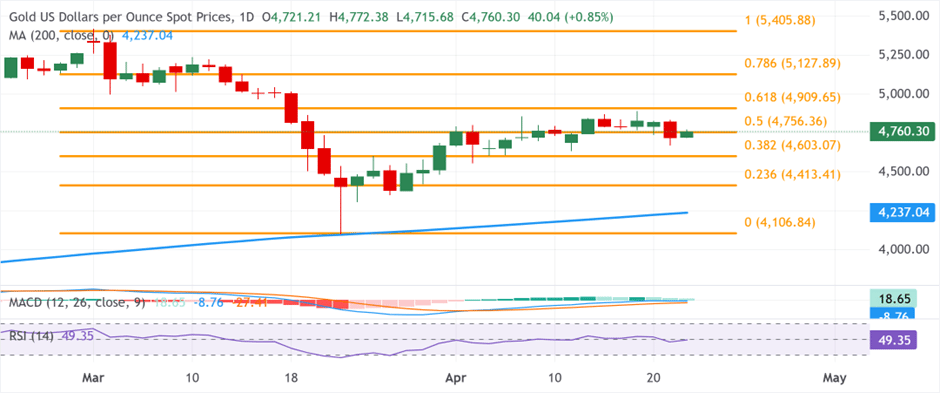
The recent goodish recovery from a technically significant 200-day Simple Moving Average (SMA), around the $4,100 mark, falters ahead of the $4,900 mark. The latter represents the 61.8% Fibonacci retracement level of the March downfall and should act as a key pivotal point for short-term traders. A subsequent move up should pave the way for additional gains towards the $5,000 psychological mark en route to the $5,100 round figure and the 78.6% Fibo. level, around the $5,127-$5,128 region.
Author

Haresh Menghani
FXStreet
Haresh Menghani is a detail-oriented professional with 10+ years of extensive experience in analysing the global financial markets.

















