Gold holds key threshold support ahead of Fed rate decision
- Gold remains under pressure, tests 4,000 ahead of an expected FOMC hold.
- Firmer dollar and elevated Treasury yields remain key headwinds for gold.
- Despite some easing, high oil prices continue to support inflation risks and year-end hike expectations.
- Signs of stabilisation point to a possible rebound if the Fed disappoints hawks.

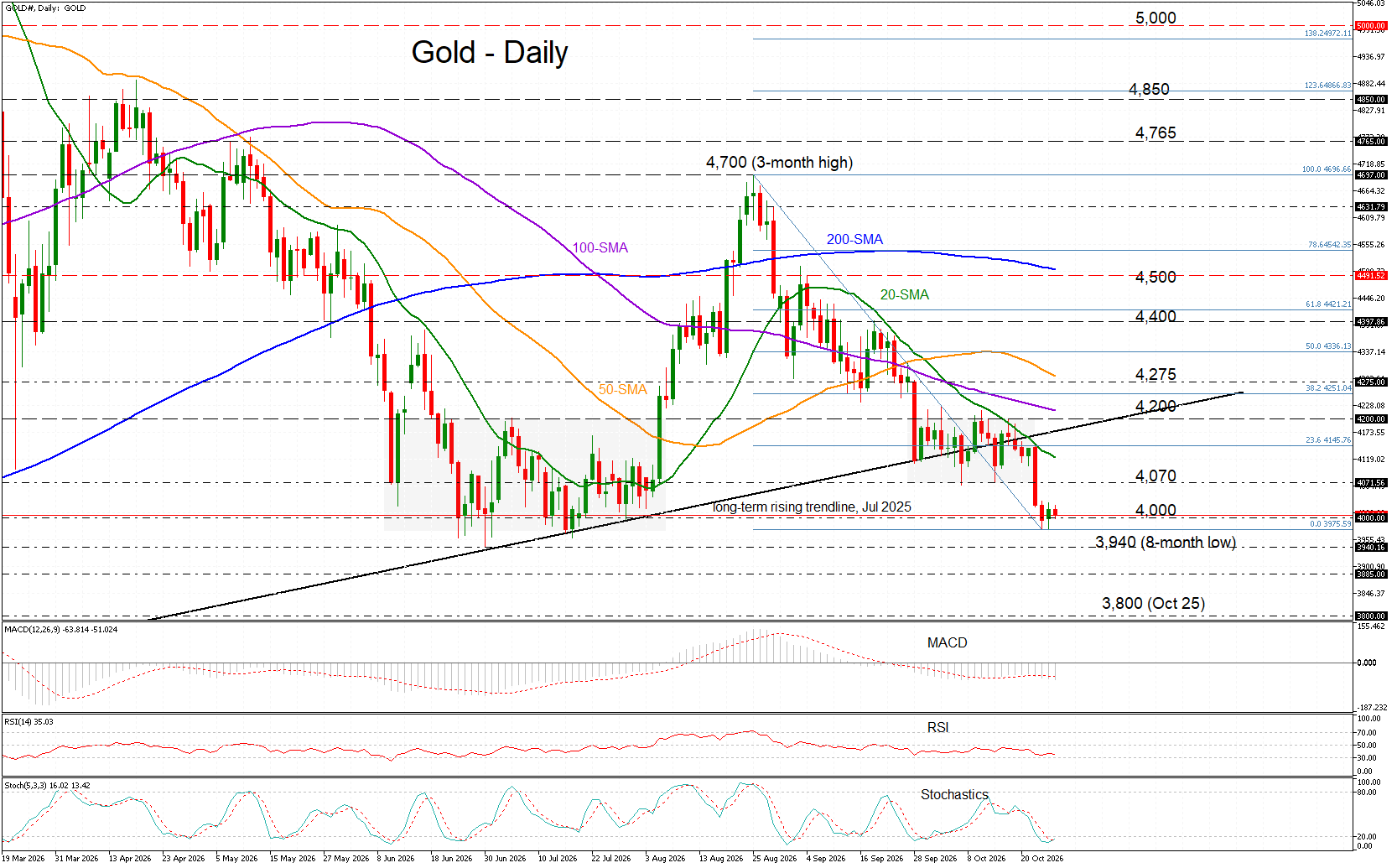
Gold is trading cautiously near the psychological 4,000 mark, stabilising for a third consecutive session after falling more than 4% last week, its worst weekly decline in around four months, to its lowest level since mid-July. Whether 4,000 holds will be key in determining the next directional move, which will likely be driven by Wednesday’s Federal Reserve interest-rate decision.
Although the central bank is widely expected to keep rates unchanged, markets continue to price in a meaningful chance of another increase before year-end. As a result, even if gold manages to defend this support area, the upside may remain capped as expectations of higher borrowing costs for longer continue to weigh on sentiment.
Thursday’s PCE report will also be closely watched, as it is the Fed’s preferred inflation gauge in assessing progress towards its 2% target. Should the data reinforce concerns that inflation remains sticky, it could act as a bearish catalyst for gold and challenge the metal’s recent stabilisation.
Further, on the geopolitical front, some easing in oil prices on hopes of diplomatic efforts to contain Middle East tensions has offered limited relief, with WTI crude remaining above $100 per barrel and keeping inflation risks firmly in focus. Elevated energy prices, together with lingering geopolitical uncertainty, continue to underpin expectations that policymakers may need to maintain a restrictive stance for longer.
Meanwhile, the US dollar has firmed near a two-week high, reducing the appeal of dollar-priced bullion for overseas buyers. At the same time, elevated Treasury yields continue to support the greenback, creating a challenging backdrop for gold and weighing on demand.
In the current environment, there are few immediate bullish catalysts for the precious metal. With the US 10-year Treasury yield holding near 5%, despite a modest retreat from recent highs, concerns over persistent inflation and tighter financial conditions remain intact. A break below the recent low near 3,975 could trigger a deeper decline towards the 3,800 region, which broadly aligns with September 2025 levels and would place the yellow metal back on its broader downtrend path.
However, should the Fed strike a softer tone and refrain from strongly signalling further tightening, gold could establish a floor around current levels and rebound towards its previous consolidation range between roughly 4,070 and 4,200. For a breakout above 4,200, it may take a dovish surprise from Fed Chair Warsh. A shift in focus towards labour market softening and growth risks could propel the metal towards the 50-day SMA near 4,287.
Technical indicators reflect the recent stabilisation efforts, pointing to a moderation in downside momentum. The RSI and stochastic oscillator have started to flatten, although they remain, alongside the MACD, in negative territory ahead of the week's key risk events.
Author

Nicole joined Trading Point as a Market Analyst in January 2025. She holds a BA in English Literature from Kingston University, London, and an MA in Applied Linguistics (Research Methodology) from the University of Southampton with distinction.