Gold at the inflection point: XAU/USD consolidates as Fed week and GDP data loom

Macro and fundamental backdrop
The bullish case
Sovereign demand remains gold's structural anchor. Central banks across emerging and developed markets — including China, Malaysia, and South Korea — continue expanding reserve allocations, providing price-insensitive demand that speculative shorts must absorb. De-dollarization flows and persistent geopolitical fragmentation sustain gold's institutional risk-premium in parallel.
The bearish case
The dominant near-term headwind is a hawkish Fed repricing. Rate cut probability for 2026 has collapsed from 45% to 27% in a single week, underpinning the US Dollar and suppressing gold's recovery. Strait of Hormuz disruptions are keeping energy prices elevated, feeding inflation expectations and further reducing the Fed's room to ease. Real yields remain a persistent drag on the non-yielding metal.
The tug-of-war
Structural bulls and cyclical bears are in direct conflict. Sovereign demand and geopolitical risk premium hold the floor. Dollar resilience and hawkish repricing cap the upside. Directional resolution awaits the April 29 FOMC decision and the Q1 GDP print on April 30 — the week's two defining catalysts.
Risk events/catalysts
- FOMC rate decision (April 29) — Highest-impact event of the week. Rates expected to hold at 3.50–3.75% with 99.5% probability. The market will trade tone and forward guidance, not the decision itself. Hawkish hold = dollar up, gold down. Dovish hold = gold relief rally.
- Q1 US GDP (April 30) — A weaker-than-expected print increases recession concerns, boosting gold as a safe haven. A strong print reinforces the hawkish case — bearish gold.
- Initial jobless claims (April 30) — Secondary indicator. Elevated claims reinforce the case for eventual rate cuts and provide a mild tailwind for gold.
- US–Iran/Strait of Hormuz (ongoing) — Intensifying tensions and lack of progress in peace talks keep investors on edge. Escalation = oil spike = inflation fears = hawkish tilt. De-escalation = safe-haven premium unwinds, but potentially dollar-negative.
- DXY positioning (ongoing) — The dollar's short-term trend directly dictates gold's ceiling. Watch 99.50–100.00 as the key DXY demand zone — a bounce caps gold
Technical structure — Four hour primary timeframe
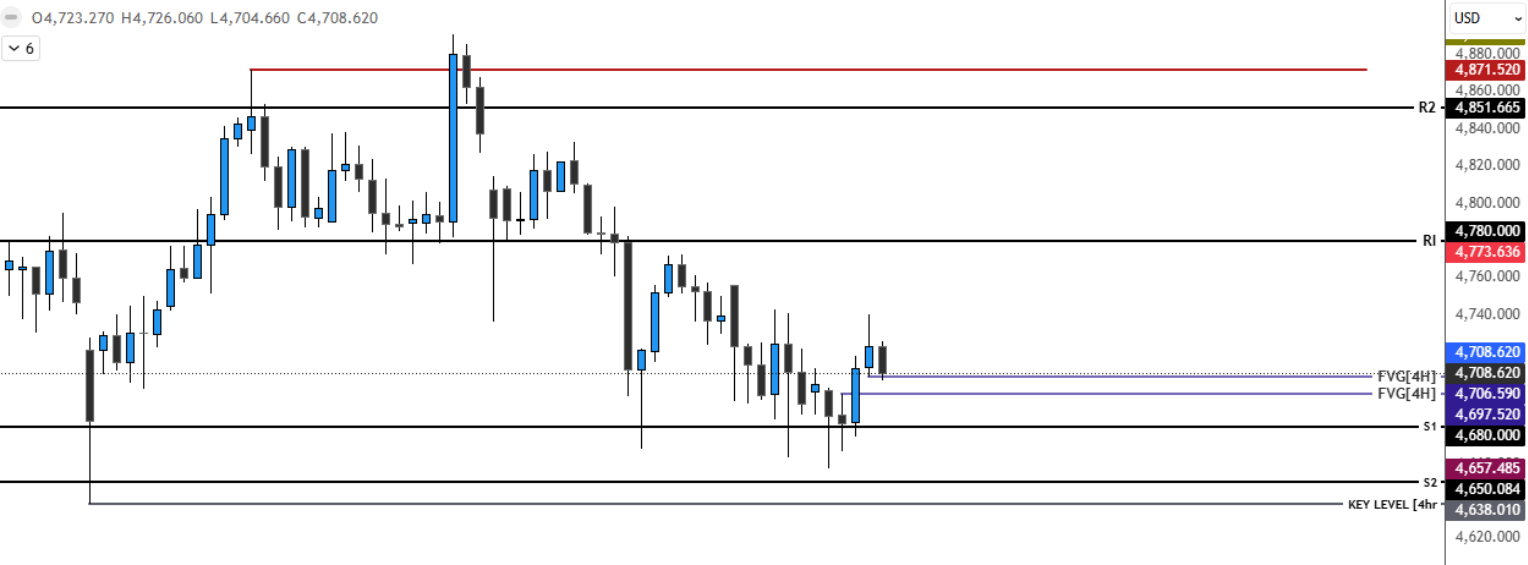
Market structure
On the 4H chart, XAUUSD has transitioned from a strong impulsive uptrend into a corrective distribution phase after printing a recent swing high near 4,871.5.
Price subsequently created a Lower High (LH) at approximately 4,833 and a sequence of Lower Lows, with the most recent low printed near 4,660 before a partial recovery. The current candle at 4,708.62 is consolidating directly on top of the 4H Fair Value Gap (FVG) at 4,706.59–4,708.62.
This is a critical Pivot. The market has retraced into the FVG after the selloff — this zone is either a launchpad for a reclaim of the R1/R2 structure, or a distribution point before the next leg lower.
What to watch:
- Bullish reaction: A 4H candle closing convincingly above 4,708.62 with rejection wicks below confirms demand absorption — target R1 (4,780)
- Bearish rejection: A 4H close back below 4,706 with bearish momentum confirms distribution — opens path to S1 (4,697) → S2 (4,680) → KEY LEVEL (4,650)
Indecision/compression: Price grinding laterally through the FVG without a decisive break indicates the market is waiting on a catalyst — in this case, the April 29 FOMC decision
Author

Martin Nwankwo
TradingPRO
Technical Market analyst with over a decade of forex experience, an ICT chartered student.