Gold and USD rallied together
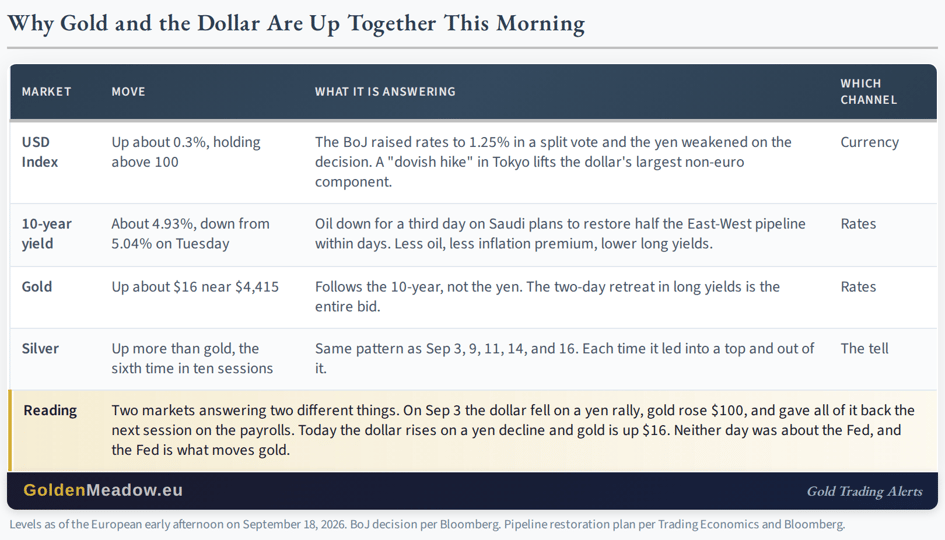
The Bank of Japan raised rates to 1.25 percent this morning in a split vote, and the yen weakened on the decision. The USD Index is up about a third of a percent and holding above 100. Gold is up about $16 near $4,415, with silver leading it for the sixth time in ten sessions. Oil is down for a third day on Saudi plans to restore half of the East-West pipeline within days, and the 10-year yield, which closed above 5 percent on Wednesday for the first time since 2007, is back near 4.93.
Gold and the dollar are rising together. That is worth a section of its own, because the first question it raises is whether it is bullish, and the honest answer is that it is not about gold at all.
Gold is rallying with the Dollar. Here is why, and why it is not bullish this time
On September 3, I wrote: "A dollar that falls because another central bank turns more hawkish is not the same as a dollar that falls because the Fed turns dovish." That day the yen rallied 2 percent on BoJ hike talk, the dollar fell, gold rose about $100, and every dollar of that gain was gone the next session when payrolls printed 162,000.
Today is the mirror image. The BoJ delivered the hike, the yen fell on the delivery, and the dollar is rising on a currency-market event in Tokyo rather than on anything in Washington. Gold is not reading the yen. Gold is reading the 10-year, which has given back about 11 basis points from Tuesday's high as oil fell for three sessions, and that retreat is the entire bid in the metal. Two markets, two drivers.
It is not bullish, for four reasons.
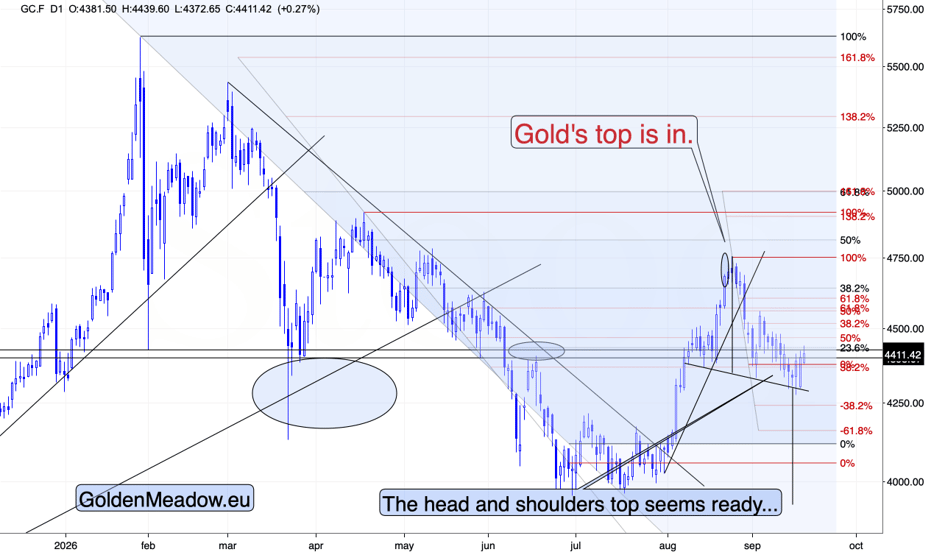
The move is $16, inside a two-week range between roughly $4,300 and $4,440 that is the right shoulder of the pattern I have been describing.
The dollar's rise is a yen story, which means it carries no information about US real rates, and US real rates are what set gold's trend.
The 10-year's dip is an oil story, and the oil story has reversed on every "restart in days" headline this month within a session or two.
And silver is leading again, up more than gold for the sixth time in ten sessions, on a day when the previous five all resolved the same way.
Gold rising with a dollar that is rising for US reasons would be a sign of strength, because it would mean the metal was shrugging off its main driver. Gold rising with a dollar that is rising for Japanese reasons is two markets answering different questions in the same hour. The reading is neutral at best, the tell inside it, silver, is the one that has been bearish each time, and the six-hike record in the next section says which way the neutral reading has resolved when the Fed was tightening.
Yesterday, I wrote that gold "is a market that took the dollar's move and has spent a day catching its breath." It is on its second day now, and it is still breathing.
The USD Index is up – currently trading close to its 2025 and 2026 highs (the March and April ones).
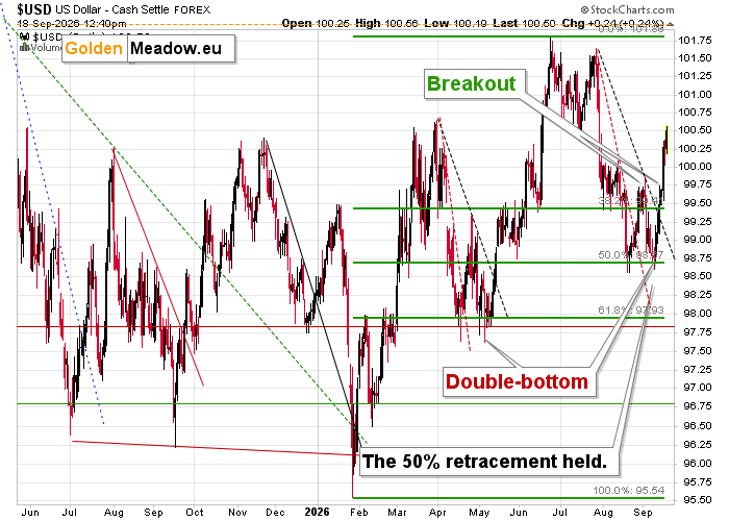
If the USDX keeps soaring, the precious metals market is likely to give in and fall.
Six BoJ hikes, and what Gold did after each
Today's hike is the sixth of this cycle, so there is a record to check. Here is what the yen did on each decision day, what the dollar and gold did over the following month, and, in the column that matters, where the Fed stood at the time.
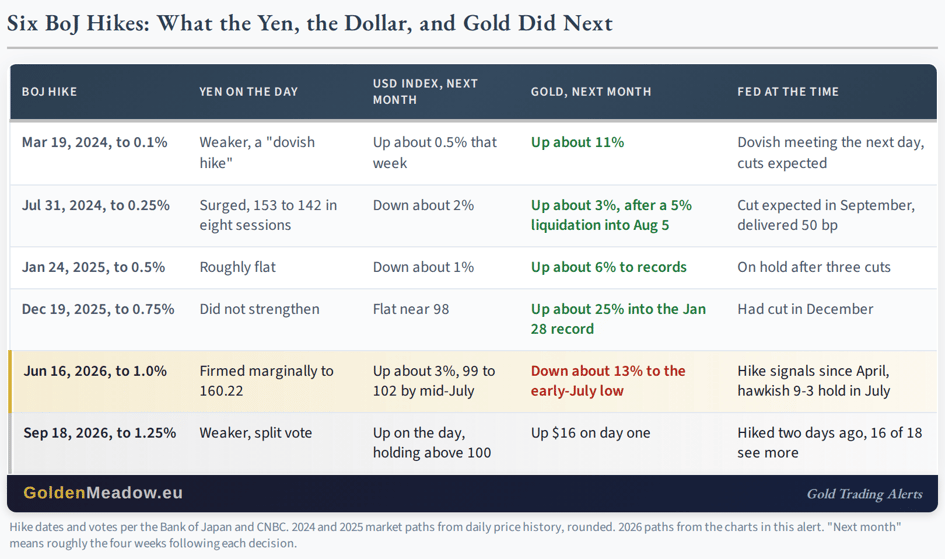
Gold rose in the month after four of the five previous hikes and fell after one. The four gains came when the Fed was cutting, pausing, or expected to cut: the dovish March 2024 meeting the day after, the 50-basis-point cut of September 2024, the hold after three cuts in early 2025, and the December 2025 cut that preceded the blow-off to the January record. The one decline came after the June hike, when the Fed had been signaling hikes since April and held with a hawkish 9-3 vote in July. Gold lost about 13 percent in the month after that one, and the dollar gained about 3 percent.
The BoJ, in other words, has never set gold's direction.
The Fed's stance at the time did, every time.
That leaves June as the only analog that applies to a Fed that hiked two days ago with 16 of 18 members expecting more, and June is the row in red.
Two further details from the record. On the three "dovish hike" days when the yen weakened on delivery, March 2024, December 2025, and today, the dollar rose on the day each time and gold ignored it each time. And the one hike that did hit gold directly, July 2024, did so through liquidation rather than through the dollar: the carry-trade unwind sold everything, gold included, while the dollar fell. That is the mechanism a yen shock carries for the metals, and it is a risk-off mechanism, which fits the setup I have been describing rather than arguing against it.
The closest analogy to September 3 is not on the table. It is August. Japan's record 15.4 trillion yen of intervention between July 30 and August 26 lifted the yen, took the dollar index from about 102 in mid-July to 98.8 on August 21, and gold rallied 10 percent that month. That was the one yen-driven dollar decline that gold did follow, and every bit of it reversed once the dollar broke out in late August.
The week of the hike
The Fed's first hike in three years is now behind us, with October about 50 percent priced for a second. Here is what the week did to the numbers that matter.
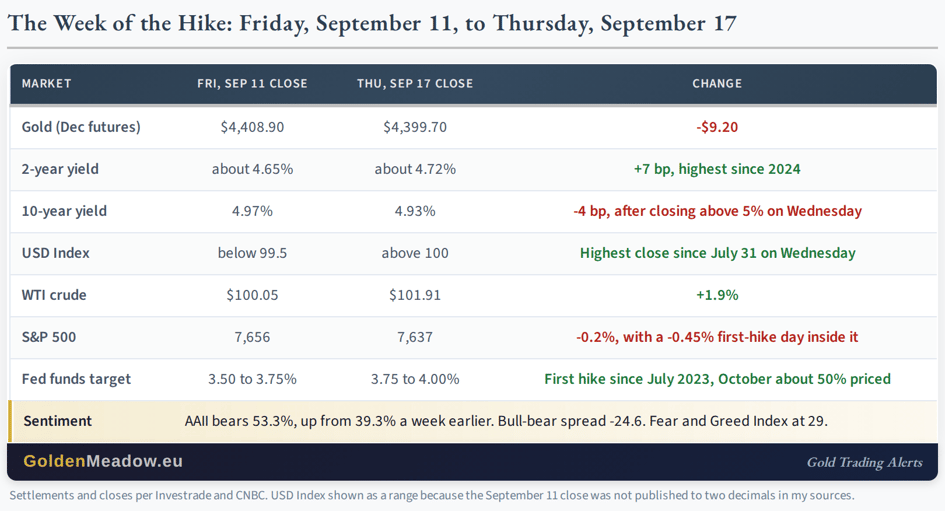
Gold finished the week of the hike $9 lower on the settlements, which is the calm version of a bearish week: no crash, no rally, and a dollar that moved from below 99.5 to above 100 while the two-year went to a two-year high. The 10-year's round trip through 5 percent, closing above it on Wednesday for the first time since 2007 and back to 4.93 by Thursday, is the long end pricing oil's three-day retreat, not the Fed. The Fed's channel is the two-year, and the two-year did not retreat.
The sentiment numbers belong in the same table because they explain this week's bounces. AAII bears jumped to 53.3 percent from 39.3, the bull-bear spread went to minus 24.6, and the Fear and Greed Index sat at 29. That much fear produces sharp relief rallies on any reason, which is what Thursday's 1.14 percent gain in the S&P 500 and 1.69 percent in the Nasdaq were: the best day since early August, on a 7-basis-point drop in the 10-year and a bullish outlook from Nvidia. It does not produce trend changes with the Fed still hiking, and the S&P 500 ended the week of the hike lower.
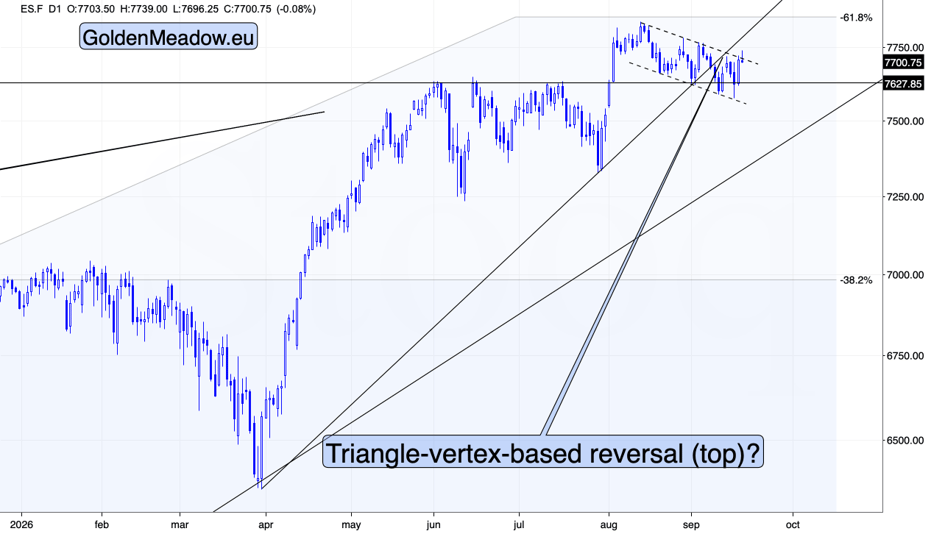
Technically, stocks tried to break above the trend channel and they failed. The move was immediately invalidated, thus creating a sell signal. If stocks finally fall – just as they are likely to before mid-term elections in the U.S. given what they’ve done historically – they are likely to take many markets with them – including precious metals and mining stocks.
Where this leaves us
Gold and the dollar are up together because Tokyo moved the dollar and oil moved the 10-year, and neither of those is the Fed. The metal remains inside the right shoulder, silver is leading for the sixth time, the two-year is at a two-year high, and October is half priced. The week of the first hike ended with gold $9 lower and the dollar above 100.
The dollar is answering Tokyo today. Gold is answering oil. In five previous BoJ hikes, the month that followed belonged to the Fed every time, and this is the first one in which the Fed is hiking.
Want free follow-ups to the above article and details not available to 99%+ investors? Sign up to our free newsletter today!
Author

Przemyslaw Radomski, CFA
Gold Price Forecast
Przemyslaw Radomski, CFA (PR) is a precious metals investor and analyst who takes advantage of the emotionality on the markets, and invites you to do the same. His company, Sunshine Profits, publishes analytical software that any














