Gold and silver might not be integrated into the BRICS+ common currency but are actively being accumulated by central banks
Despite gold’s and silver’s price correction, I still believe in their long-term upside potential thanks to the BRICS countries' interest in these two metals and the general de-dollarization trend. Both gold and silver act as hedges against inflation and fiat currency devaluation. Moreover, they have always played key roles in the global financial system, acting as money or, at the very least, being part of many nations’ strategic reserves. So, the falling demand for the dollar, which we are currently observing, may stimulate many countries, especially the BRICS+ members, to move away from the dollar while turning their attention to gold and silver. In this article, I will explain how.
Precious metals prices have corrected
Silver prices have substantially fallen from their all-time high of almost $122 per ounce reached in January this year. As I am writing this, the price for the grey, shiny metal is lingering below the $50 mark. Gold is also trading substantially below its all-time high of $5,600 per ounce, having fallen below the $4000 mark.
Gold prices
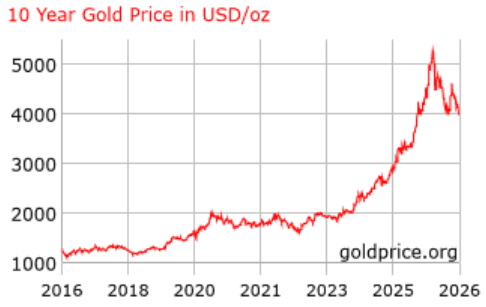
Source: goldprice.org
Silver prices
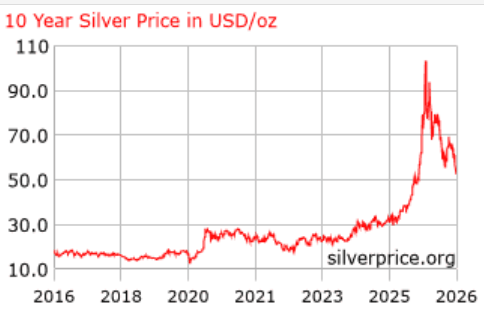
Source: silverprice.org
This has been due to the Federal Reserve’s monetary tightening. Obviously, the silver market reacted more violently than gold’s because the grey metal is more volatile. It could be argued that now might be the best time to take advantage of the temporary price correction. Many central banks are doing just that.
Central banks’ purchases
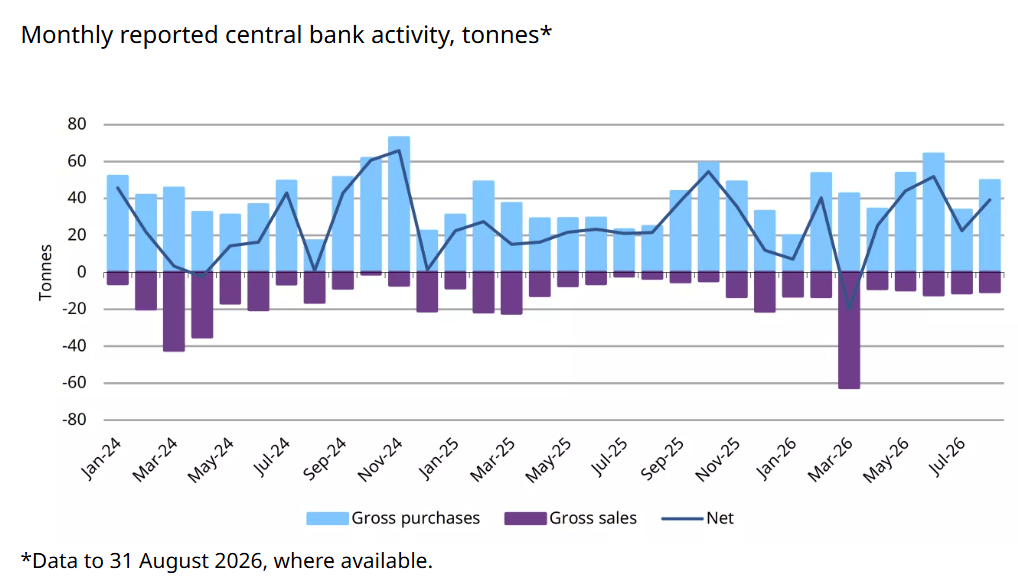
As can be seen from the diagram below, on average, central banks have actually increased their net gold purchases in the second half of 2026 after the sharp sell-off in March.
Central bankers’ net gold purchases
Source: World Gold Council
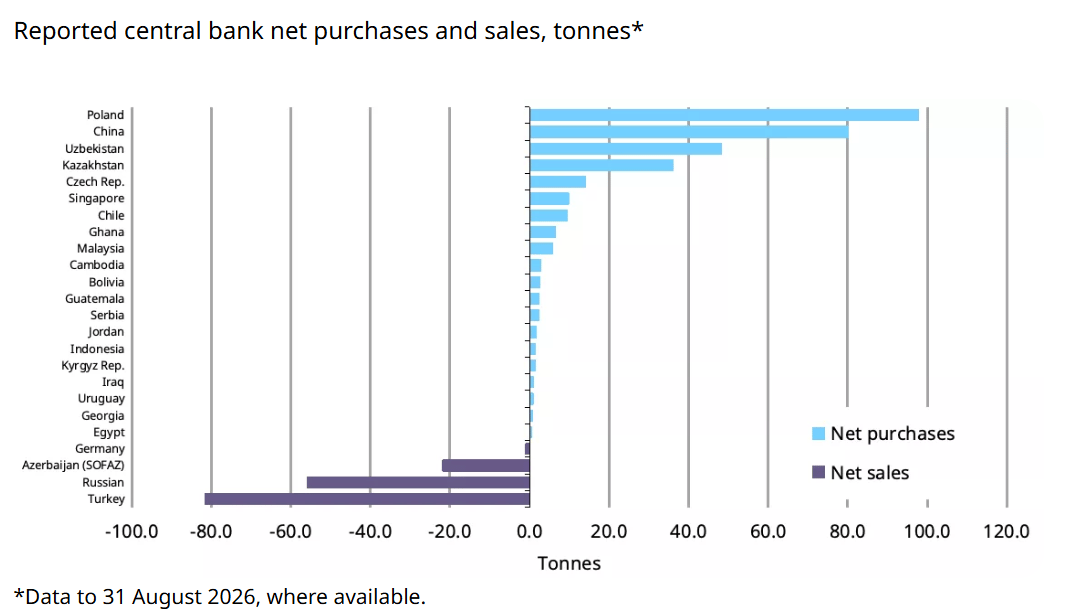
What countries have actually raised their gold reserves?
Central banks’ net gold purchases on a per-country basis
Source: World Gold Council
Among the countries that have substantially increased their gold holdings were Poland, China, Uzbekistan, and Kazakhstan. Among the net sellers of gold were Turkey, Russia, and Azerbaijan. But on average, most central bankers are building up their gold reserves in response to the precious metal’s price correction.
But what about silver reserves? As I have mentioned above, both gold and silver have been integrated into the world’s financial system for thousands of years. However, unlike gold—which is considered to be a sovereign reserve asset— the demand for silver is driven by its industrial usage. It is present in solar panels, EVs, modern electronics, and even AI infrastructure.
But still, here is a summary of major governments’ stance towards silver accumulation:
· The US: According to the US Geological Survey, silver has been added to the Final List of Critical Minerals in 2025. This shows that the US government considers silver to be of strategic importance for defense, green energy, and technology.
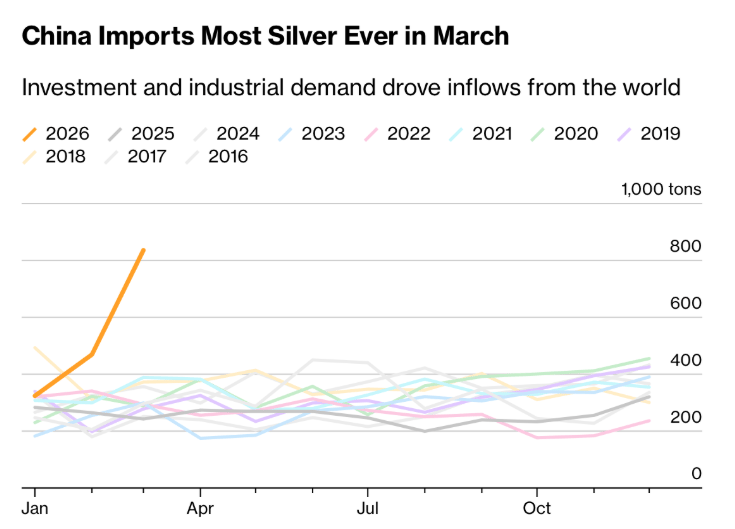
· China: The country restricted silver exports from 1 January 2026 onwards. Government permission is now required for considerable quantities of silver to leave China. In fact, China has even raised its silver imports to multi-year highs.
The diagram below shows how much silver China has recently imported. The year 2026 has been record-breaking over the past ten years.
Source: Phoenix Refining
· Russia: The government has started accumulating precious metals, including silver, to fill its state-level reserves. In other words, the grey shiny metal has officially become part of the country’s foreign reserves. Moreover, it has been reported in the second half of 2025 that Russia would substantially increase its holdings of gold, silver, platinum, palladium, and gemstones. The Russian government announced it would allocate 51.5 billion Rubles (USD 633,9 million) each year in 2025, 2026, and 2027. This is remarkable because silver has not been officially held as part of foreign reserves by any of the national governments. But as I have mentioned before, silver and gold used to play the role of money centuries ago. So, both gold and silver could also be accumulated by major governments and central bankers to stabilize their financial systems and to decrease their reliance on fiat currencies, especially the dollar.
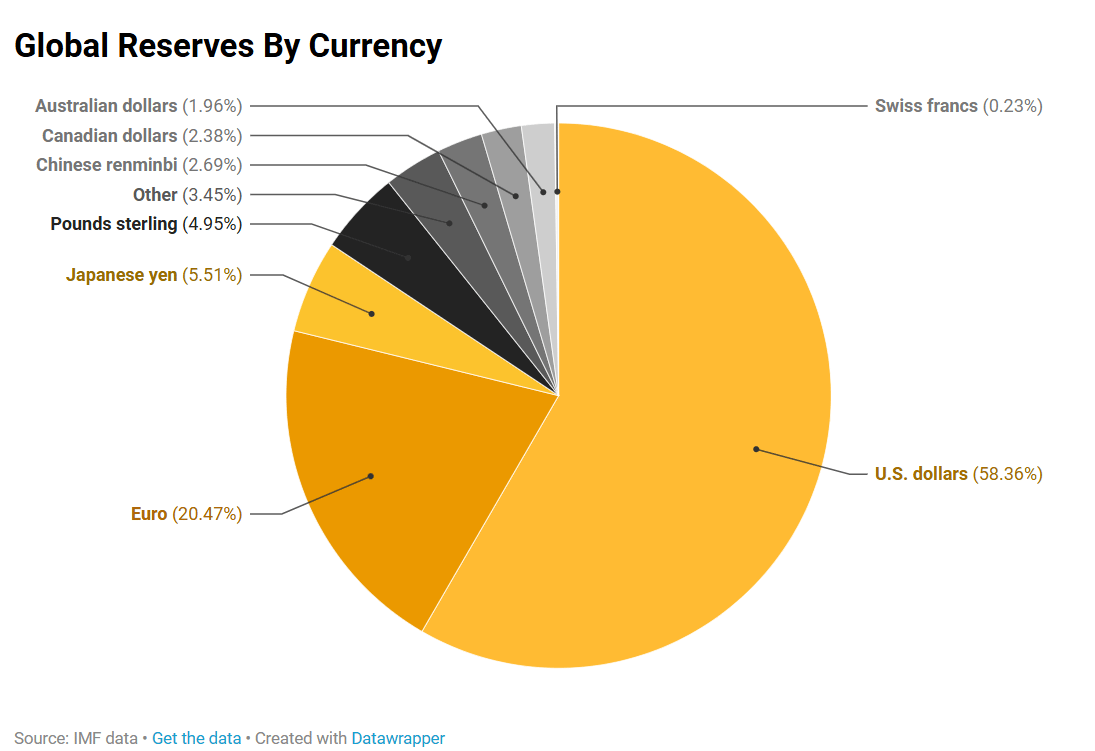
Why does it matter?
Source: SAN
Major analysts consider the BRICS’ de-dollarization threat to be a major challenge to Western financial dominance, and most importantly, America’s. This is particularly true because the BRICS accounts for about 45-50% of the global population and 37-40% of the world’s GDP, according to the purchasing power parity indicator. This is more than many Western blocs in terms of demographics and economics.
Indeed, President Trump is strongly against the creation of the BRICS+ common currency. As President Trump once famously wrote in one of his posts on Truth Social, “We require a commitment from these Countries that they will neither create a new BRICS Currency, nor back any other Currency to replace the mighty U.S. Dollar, or, they will face 100% Tariffs, and should expect to say goodbye to selling into the wonderful U.S. Economy”. That is because the demand for the US dollar would fall substantially, thus decreasing its value in relation to other currencies.
Also, in my opinion, the fact that the US dollar is a de facto global reserve currency saves it from depreciation in the US. It has been discussed many times by historians that uncontrolled money printing substantially devalues national currencies. The most obvious example was in the 1920s in Germany after the end of World War I, when the German government started printing money to pay for the reparations, a consequence of the Treaty of Versailles. This led to the German Mark, the country’s national currency, being devalued and to hyperinflation in Germany. This was due to the fact that the Mark was solely used in Germany and did not have the status of the world’s reserve currency, unlike the US dollar, which has been printed uncontrollably for decades in order to somehow compensate for the national budget deficits. But the dollar has enjoyed the status of the world's reserve currency since World War II, when the major powers signed the Bretton Woods agreement. This obviously led to the high demand for the US dollar and its accumulation in countries outside of the US, which decreased the USD money supply in the US, thus leading to moderate inflation readings. However, if the demand for the US dollar falls dramatically, Americans might face much higher inflation readings, similar to the ones recorded in 1920s Germany.
Is there any possibility that precious metals, namely gold and silver, would be integrated into the common BRICS+ currency?
Although the bloc has not launched its official common currency, the key BRICS members are actively finding ways to move away from the US dollar. For example, BRICS members, including Russia, China, and Iran, are trading in their national currencies, not the US dollar or the Euro. Also, IRIAS, a Russian research institute, has launched a prototype of a common BRICS currency. This prototype is called the «Unit» and is backed 40% by gold and 60% by BRICS currencies. The test units are not offered to the general public, not to mention that BRICS has not officially declared the introduction of a common currency backed by gold. The prototype remains a hypothesis, developed by an institute, not a currency.
Moreover, at the New Delhi Summit in September this year, BRICS leaders did not even declare the possibility that they would introduce a common currency or a legal tender backed by gold. Also, India's Secretary for Economic Relations has said that there is no proposal for a common BRICS currency. Instead, the bloc focuses on using national local currencies in international trade. However, I would take this statement with a pinch of salt. Although no official currency has been created or officially proposed yet, this does not mean that such a possibility is not actually being discussed by BRICS+ countries’ leaders. Moreover, there is no guarantee that such a currency would not eventually be officially created and launched in the future.
But let me assume that the BRICS would focus on trading in their national currencies, while slowly getting rid of the US dollar in their foreign reserves. Even if no BRICS currency gets created and neither gold nor silver gets integrated into the common currency, the de-dollarization trend would raise the demand for the USD, and therefore its value would fall, thus raising gold and silver prices in dollar terms, which is obviously bullish for precious metals investors in the long term.
Conclusion
While I do not believe that BRICS would treat both gold and silver as forms of payment in the near future, the nations are raising their precious metals holdings and are also moving away from the US dollar in their bilateral trade. Moreover, in my view, it is highly unreasonable for BRICS+ members to hold US dollars in their foreign reserves because the USD can be weaponized against any of the nations because of their political or economic stance. Obviously, the gradual de-dollarization trend is bullish for precious metals investors in the long run because the falling value of the dollar would increase the value of their gold and silver holdings in dollar terms.
Author

Anna Sokolidou
Independent Analyst
A research analyst, a freelance finance writer and an economics teacher looking for interesting investment opportunities. I have been investing for years. I am mostly interested in writing about commodities, precious metals and large corporations.