Anthropic IPO: The case for a trillion-Dollar valuation is taking shape


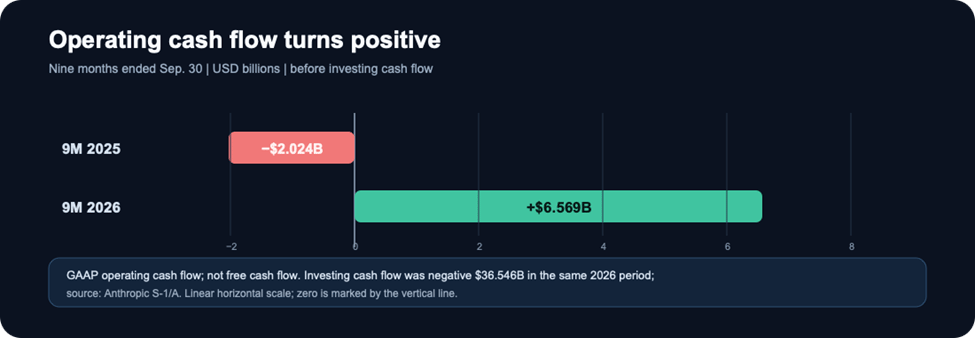
A trillion-dollar valuation demands more than a convincing AI story. Anthropic's case rests on $33.2 billion in revenue in the first nine months of 2026, more than 12 times the year-earlier figure, and $6.6 billion in positive operating cash flow. The business is growing rapidly. For investors assessing its public debut, the harder question is whether it can grow fast enough to justify the price.
By the end of October, Anthropic's annualized revenue run rate had reached $81 billion. This measures what recent customer activity would generate over a full year, rather than revenue already earned or a forecast.
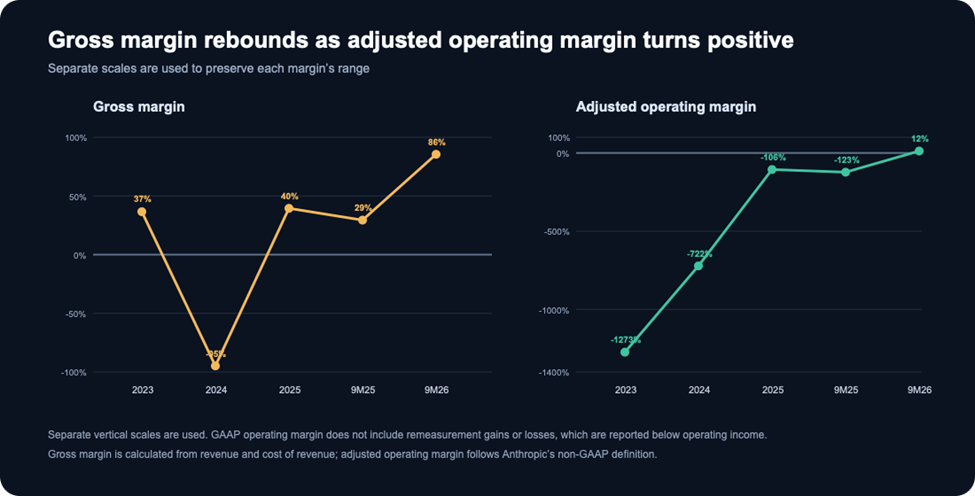
Gross margin expanded to 85.5%, while compute and infrastructure costs fell sharply as a share of revenue, suggesting that scale is improving operating efficiency. The margin reflects customer-serving costs, however, and excludes the substantial expense of developing new models.
The GAAP operating loss narrowed to $1.26 billion, while adjusted operating income turned positive at $4.08 billion. The $104 billion GAAP net loss was driven primarily by $94.3 billion of non-cash fair-value remeasurement expense; after adjustments, the company reported $5.59 billion of net income.
Anthropic remained loss-making under standard accounting measures. But revenue is now covering a much larger share of its costs, strengthening the argument that further growth could bring lasting profitability.
For traders, a stronger business doesn’t automatically mean a more attractive trade. Strong results could support further gains, but even impressive growth could disappoint if the share price already assumes more. With Exness introducing its Anthropic CFD alongside the IPO, traders can act on either assessment, taking long or short positions without owning the underlying shares.
Source: Exness FMS, Anthropic S-1 file
Enterprise adoption is broadening
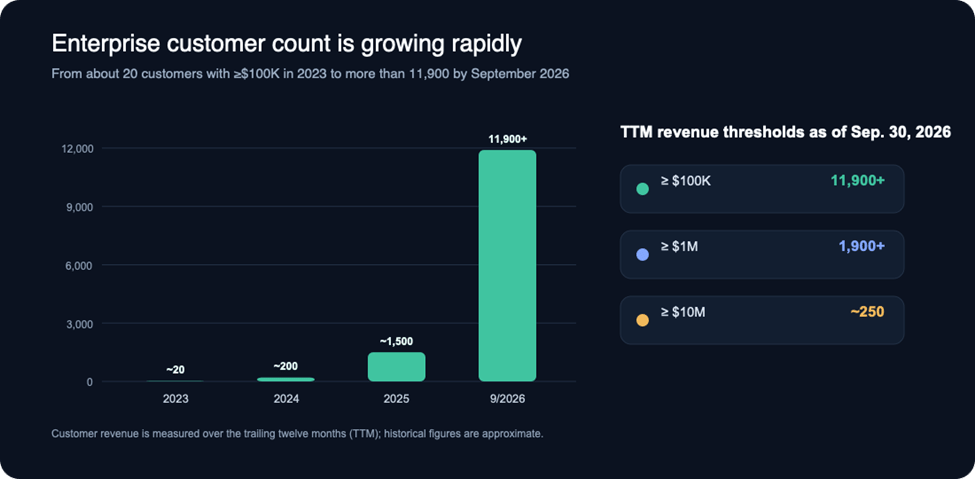
Businesses are putting larger budgets behind Claude. By September 2026, nearly 12,000 businesses had each spent at least $100,000 over preceding months and more than half of the Fortune 500 had reached that threshold.
Yet spending by those Fortune 500 customers remained small relative to their overall expenses, according to Anthropic’s filing. Wider deployment could bring further growth, although the company must continue demostrating that its products justify larger budgets.
The wider market is expanding quickly too. Menlo Ventures estimates enterprise AI deployment spending reached $176.8 billion by September 2026, 5.4 times the year-earlier level. Within enterprise large-language-model APIs, Anthropic accounted for an estimated 55% of spending, compared with 31% for OpenAI and 9% for Google.
Claude has established a clear lead in this fast-growing API segment, a meaningful commercial advantage as AI usage scales. The chart shows how growth spans larger customer cohorts as well.
Source: Exness FMS, Anthropic S-1 file
Funding the next stage of growth
Generating cash from operations gives Anthropic another source of funding beyond investors and lenders. But the scale of its expansion means external capital remains important.
Anthropic also reported $131.9 billion, while the IPO and concurrent private placement added over $107 billion.
Together with operating revenue and partner funding, those resources provide a funding base for long-dated compute commitments. The liquidity position, however, doesn’t represent surplus cash. The company’s convertible notes, capital expenditure, and other obligations also make demands on those resources.
Source: Exness FMS, Anthropic S-1 file
Compute demand is extending the AI infrastructure investment cycle
The SEC filing reports approximately $900 billion in compute, infrastructure and lease commitments. The scale reflects the capacity Anthropic expects will need to train models and serve AI customers.
Long-term agreements give Anthropic access to hyperscaler and neocloud capacity while creating orders for data centers, chips, networking, and power. That supports revenue and earnings opportunities across the supply chain and can help sustain growth in US equities, particularly AI and digital infrastructure stocks.
If AI usage and revenue continue to exceed expectations, existing capacity could be absorbed faster, strengthening the economic case for another round of infrastructure investment.
But spending commitments are a bet on future demand, not proof of it. They support expansion when capacity is used profitably and become a greater burden if demand falls short.
Valuation: What future is the market pricing in?
Following its February Series G round ($380 billion post-money), Anthropic was valued at $965 billion in its May Series H round, led by Altimeter, Dragoneer, Greenoaks and Sequoia, alongside other large investors. This shows how quickly investor expectations had risen before the listing.
The November 10 IPO filing proposed $70-$78 per share; the final offer price was $83.00. By 20 Nov 2026, the shares were trading at $97.17 (official closing price), implying a valuation of around $1.27 trillion.
For context, a $1.27 trillion valuation would equal approximately 15.7 times October's $81 billion annualized revenue run rate. That is a multiple of annualized recent activity, not recorded annual revenue or earnings.
Rapid growth and improving efficiency help explain the premium investors may be willing to pay. Sustaining it requires Anthropic to keep expanding demand while turning more revenue into profit and cash.
For traders, the hurdle is higher than simply identifying a successful business. Strong results could support further gains, but even impressive growth could disappoint if the share price already assumes more.
The gap between business performance and market expectations is what CFD traders will be watching as Anthropic releases new results. Through Exness Terminal, they can follow ANT’s price movements across timeframes, analyze developing trends with indicators and drawing tools, and manage positions as the outlook changes.
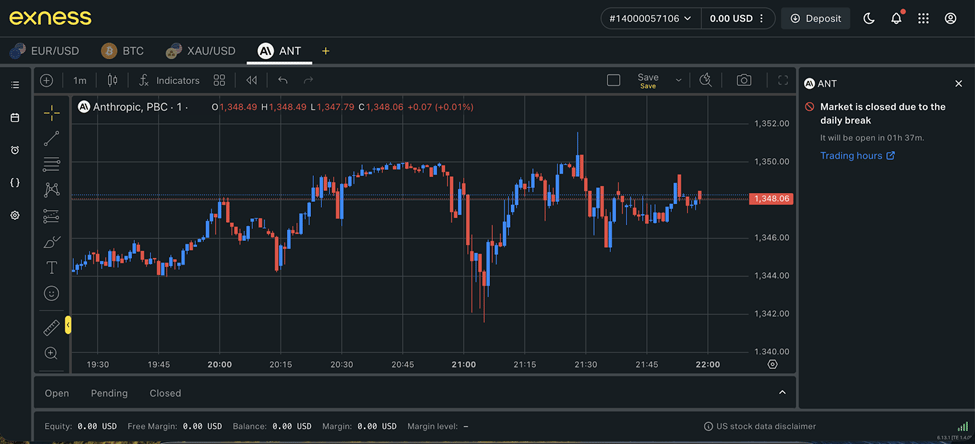
Source: Exness Terminal
And before opening a trade, the Terminal’s risk calculator can calculate trade size from the trader’s selected risk amount and stop-loss level. Then the CFD trader can review and manage their open positions with the same workspace.
And when an announcement prompts rapid repricing, the broker’s pricing infrastructure comes into focus. Exness combines data from multiple sources with its own pricing algorithms, tailoring quotes and spreads to each instrument rather than simply passing through a provider’s pricing. This control supports its efforts to keep spreads competitive and pricing responsive as markets change.
Could Anthropic lift the wider AI trade?
Enterprise AI is expanding rapidly, Claude has a prominent position in APIs, revenue is scaling at extraordinary speed, gross margin is improving, and adjusted operating income has turned positive.
The sharp decline in expense ratios suggests scale is helping Anthropic absorb costs more efficiently. If revenue continues to grow faster than newly deployed capacity, that operating leverage could deepen.
Bloomberg reported that demand for Anthropic’s IPO was said to be several times the number of shares on offer, evidence of strong investor interest and a sign that the listing could rank among the market’s most sought-after AI offerings.
Could the listing help drive another leg higher in US equities on the back of AI? It could provide a powerful sentiment catalyst and a new valuation benchmark for the AI sector, potentially drawing capital back into technology, semiconductors and cloud infrastructure.
The next phase will depend on post-listing performance and evidence that Anthropic and its AI peers can generate revenue, margins and cash flow sufficient to earn attractive returns on their enormous compute investments. The IPO could energize the AI investment narrative; realized earnings will determine whether that momentum can carry the broader market further.
Author
Van Ha Trinh
Exness
Bachelor’s in Finance & Banking – Ho Chi Minh University of Banking Passed CFA Level II – CFA Institute CFA Research Challenge participant Over 10 years of experience across banking, brokerage, and analysis