Nvidia's stock remains well below its October record despite Jensen Huang's return

Nvidia has reinstated Jensen Huang as chief executive, and its shares have recovered most of what they lost after he resigned. The stock was already 30% below its October record on the day he left, and his return does not change that.
The Jensen Huang-founded Nvidia (NVDA) had lost 30% of its share price by November 12, the day Huang resigned as chief executive. It lost another quarter in the six trading days that followed. The board voted him back in on Monday, and shares are trading about 30% higher, returning them to roughly where they stood when he left. That starting point was already well below the October 6 record, and the forces that put it there don't report to the chief executive.
The slide started before the scandal
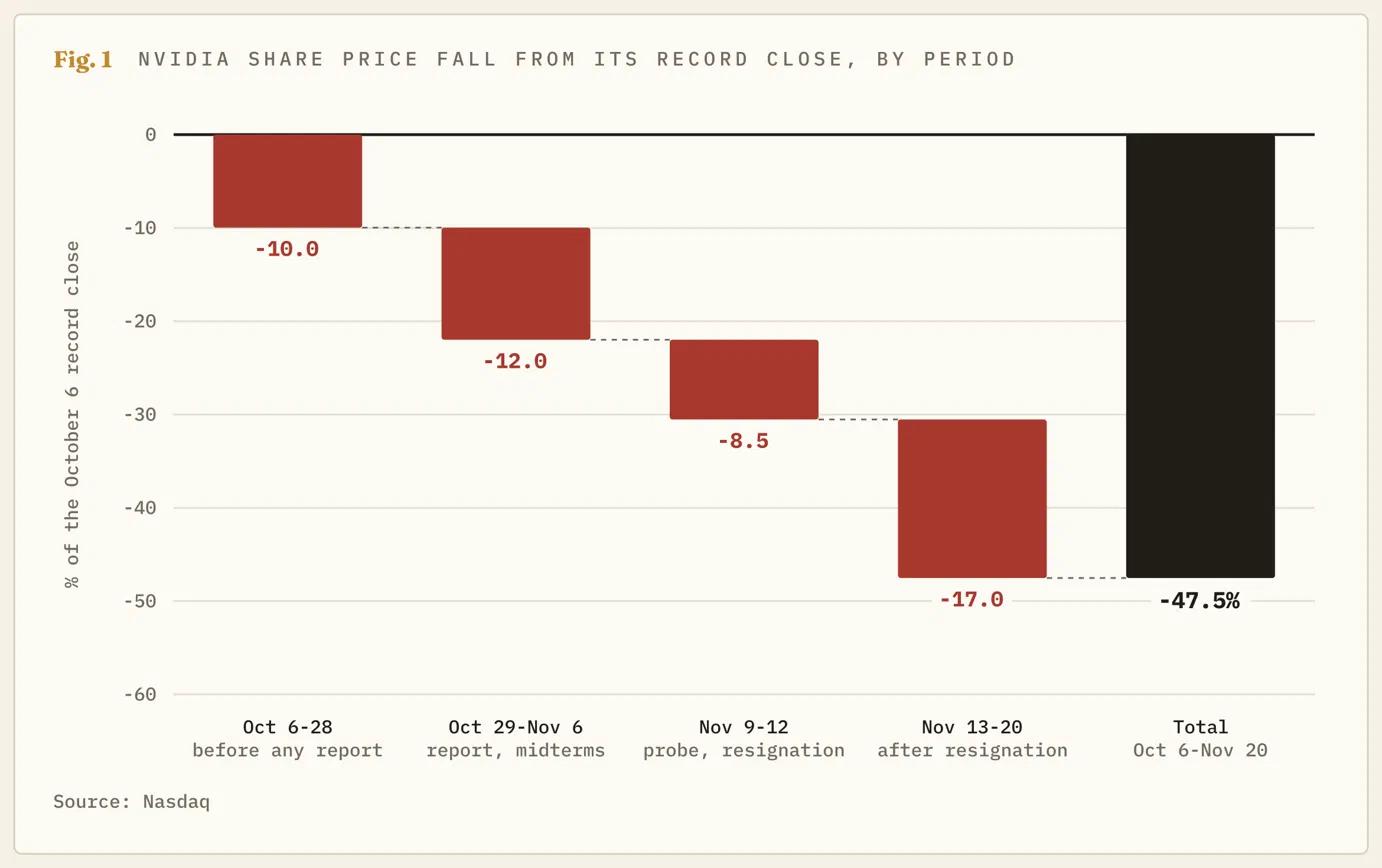
Nvidia set its record close on October 6, and by October 28 the shares were already 10% lower. The first press report on US officials' concerns about Huang's dealings with an executive at a customer appeared on October 29, so that first tenth belongs to something else. The likeliest candidate is the bond market. The 10-year Treasury yield reached 5.31% on October 5, and higher yields on government debt lower what investors will pay for profits still years away.
From there, politics took the next slice, after Democrats won both houses of Congress in the November 3 midterms. Nvidia fell 9.3% on November 5 as investors worried about stricter rules on artificial intelligence (AI) and slower permits for data centres. By November 6, the stock was 22% below its record, and the board hadn't yet opened its investigation into whether Huang had been targeted by a foreign intelligence effort.
Only then did the Huang story reach the share price in earnest. The board announced its investigation on November 8, Huang resigned on November 12, and over those four trading days the stock fell another 8.5% from its record value. Measured that way, the week of the investigation and the resignation took less from the stock than either of the stretches before it.
What bringing Huang back repairs
The steepest part of the fall came after Huang was gone. Chair Harvey Jones told investors on November 17 that the board did not intend to reinstate him, and the company hired a search firm to find a successor. By November 20, the shares had dropped 24.5% from their level on the day he resigned. A stock that falls 24.5% needs to rise 32% to get back, and Monday's jump of about 30% comes close to covering it.
In that sense, the board has bought back what its own decision cost. The unanimous vote ends the question of who runs the company, and the board says senior US government officials left it confident that Huang's return poses no national security risk. The search for a replacement lasted six days.
Even so, Monday's move overstates how much of the repair is Huang's doing. The Nasdaq Composite is up about 6% in the same session, and stocks were already pointing higher before Nvidia's announcement. Part of the 30% therefore belongs to a market-wide rebound from the index's worst week since March 2020. What his return restores is the company as it stood on November 11, when the shares were 27% below the record with Huang still in charge.
What still hangs over the stock
The first item is the regulator. The Wall Street Journal reported on November 17 that the Securities and Exchange Commission (SEC) had opened an investigation into Nvidia. Reuters followed on November 20 with a report that the agency's enforcement staff are examining the company's accounting, and the stock fell 14% that day. The SEC has not commented, and an accounting inquiry runs on its own clock whoever is chief executive.
Alongside that, Huang returns as a witness. The board's own investigation is continuing, and three House committees are due to interview him in private on December 1. The Senate Banking Committee has asked him to testify in public on December 3, and any of those can produce a headline about export rules or disclosure that lands on the share price.
Beyond Nvidia's own troubles, the two forces that started the slide are still running. Traders put the odds of a quarter-point increase from the Federal Reserve (Fed) on December 9 at about 98%, which keeps the 10-year yield near 5%. The cloud companies that buy Nvidia's chips, meanwhile, are spending nearly everything they earn. Five of the biggest, Microsoft (MSFT), Meta (META), Alphabet (GOOG, GOOGL), Amazon (AMZN) and Oracle (ORCL), kept $33 billion as free cash out of $607 billion in profit over the past year.
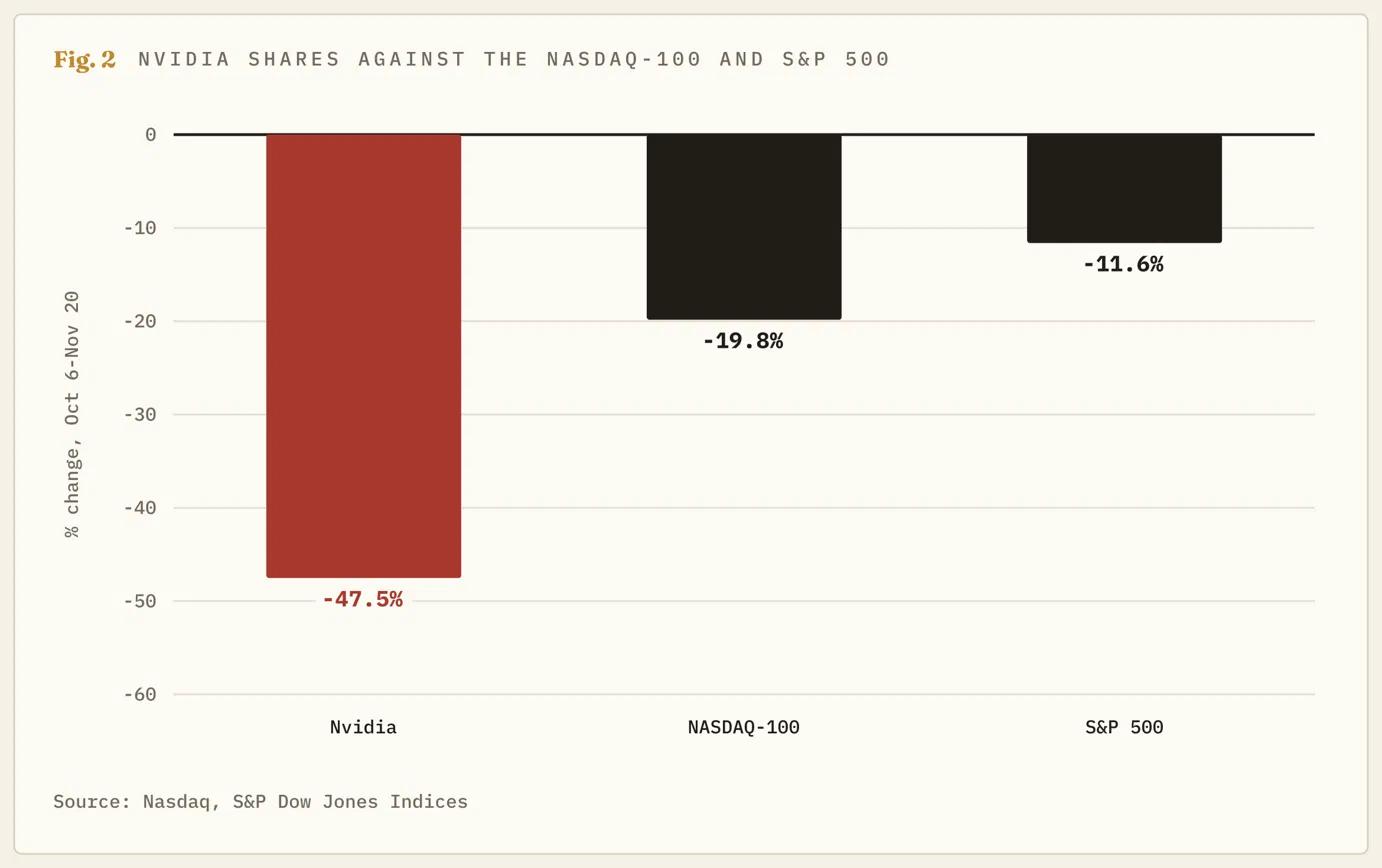
That works out to 5 cents kept from every dollar of profit, against 53 cents a year earlier. The selling, for its part, has been much wider than one company. From October 6 to November 20, the NASDAQ-100 fell 19.8% and the S&P 500 fell 11.6%, and a new chief executive at Nvidia, or the old one, changes neither number.
The case that the worst is over
The strongest objection is that the business hasn't slowed at all. Nvidia reported revenue of $115.8 billion on November 17, up 103% from a year earlier, and told investors to expect about $130 billion this quarter. At the November 20 close, the shares cost less than nine times the profit analysts expect over the next year. Monday's rise takes that to about 11 times, against a five-year average near 36.
On that reading, the fall was a panic about leadership, the leadership question is answered, and the gap to the record should narrow as the panic fades. Jonas Goltermann of Capital Economics takes the other side on the wider market, calling Monday's rebound largely mechanical and another large fall quite likely.
The trouble with the cheapness argument is what a price that low is saying. Investors who pay 11 times expected profit for a company doubling its revenue don't believe the forecast. That forecast depends on customers whose spare cash has nearly run out and on accounts the SEC is now reading. Nvidia reported doubled revenue on November 17 and had lost 23% of its market value by the end of that week.
What gets it back to October
From Monday's level, the stock would need to rise by almost half to see its record again, and Huang's return has already been spent on the first 30%. The rest depends on events with dates attached: the House interview on December 1, the Senate hearing on December 3, and the Fed's decision on December 9. The SEC's inquiry runs behind all three on no timetable at all.
From there, the hearings could pass without new limits on chip exports and the Fed could raise by a quarter-point without promising more. In that case, the discount would likely shrink slowly, because the cash squeeze at Nvidia's customers takes quarters to ease and not days. If the SEC's inquiry widens instead, or the board's investigation turns up something the directors haven't yet seen, the stock would likely head back toward its November 20 low with Huang in the chair.
For now, the lean is that the easy part of the recovery is done. The lean is wrong if the shares climb back past where they stood before the board's investigation, 22% below the record, while the SEC inquiry is still open and the Fed is still raising. A move like that would say the whole fall was about one man after all. Short of it, the board has returned Nvidia's stock to the day Huang left, and it was the five weeks before that day that did the damage still showing.
Author
Joshua Gibson
FXStreet
Joshua joins the FXStreet team as an Economics and Finance double major from Vancouver Island University with twelve years' experience as an independent trader focusing on technical analysis.