Global macro transmission monitor – Week ending May 29, 2026

How macro shocks propagated through FX, commodities and rates last week.
Executive transmission map
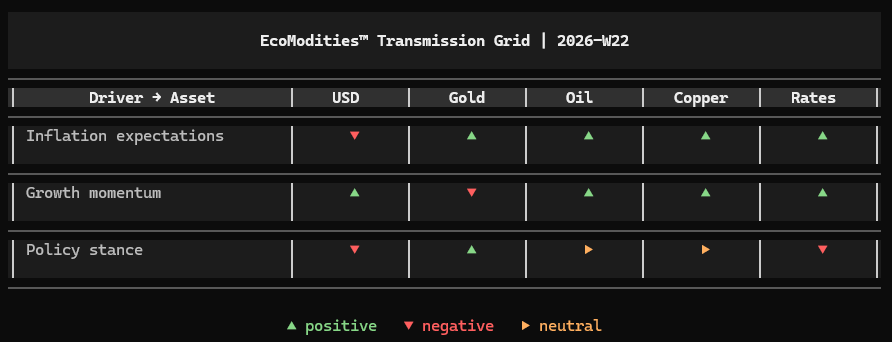
The macro transmission chain shifted further toward disinflation last week as softer inflation readings emerged across both Australia and the United States. Markets responded by reducing inflation-premium pricing, weakening support for the USD and improving conditions across precious metals and commodity markets.
Growth signals remained mixed. US GDP improved relative to the previous quarter but failed to reach expectations, while Canadian growth contracted unexpectedly. The result was a market environment characterized by softer inflation pressure alongside slowing, but not collapsing, economic momentum.
Policy transmission remained relatively contained as the RBNZ maintained rates unchanged and major central banks continued emphasizing a data-dependent approach. Cross-asset alignment improved relative to previous weeks, with inflation, commodities and rates increasingly reflecting the same macro direction.
1. Macro shock layer
A. Inflation shock
What moved
Inflation data softened across major developed economies.
- Australia CPI m/m: 0.4% vs 0.6% expected.
- Australia CPI y/y: 4.2% vs 4.4% expected.
- US Core PCE m/m: 0.2% vs 0.3% expected.
Why it matters
The data reinforced the view that inflation pressure continues moderating across multiple regions. Markets interpreted the releases as supportive for a slower policy normalization path and reduced inflation repricing risk.
Transmission path
- USD lost inflation-driven support.
- Gold benefited from softer inflation expectations.
- Oil and copper received support through improved financial conditions.
- Rates pricing became less aggressive.
FX transmission
USD weakened as inflation expectations moderated. Commodity-linked currencies stabilized while precious-metal-sensitive assets benefited from softer real-rate pressure.
B. Growth shock
What moved
Growth data remained mixed across North America.
- US GDP q/q: 1.6% vs 2.0% expected
- Previous: 0.7%
- Canada GDP m/m: -0.1% vs 0.1% expected
Why it matters
Economic activity continues expanding, but at a slower pace than markets had anticipated. The data reduced confidence in a strong acceleration scenario while avoiding a broader recession narrative.
Transmission path
- Oil maintained resilience despite softer growth signals.
- Copper remained supported through industrial demand expectations.
- Rates held relatively firm.
- USD retained partial support from relative growth differentials.
FX transmission
Growth-sensitive currencies remained selective. CAD underperformed following weaker domestic growth data, while broader risk sentiment remained relatively stable.
C. Policy shock
What moved
The Reserve Bank of New Zealand left the Official Cash Rate unchanged at 2.25%, maintaining a cautious and data-dependent stance.
Why it matters
Central banks continue signaling patience as inflation moderates and growth remains uneven. Markets interpreted the decision as confirmation that policymakers remain focused on incoming data rather than predetermined policy paths.
Transmission path
- USD lost part of its policy-driven support.
- Gold benefited from a less restrictive policy outlook.
- Oil and copper remained largely unaffected.
- Rates volatility remained subdued.
FX transmission
Carry trades remained relatively stable while central-bank communication continued anchoring broader FX positioning.
3. Market alignment check
Cross-asset alignment improved during the week.
Softer inflation readings weakened USD support while providing a more favorable environment for gold, oil and industrial commodities. Growth indicators slowed but remained sufficiently resilient to prevent a broader defensive rotation.
The inflation and policy layers increasingly point in the same direction, while growth transmission remains positive but less dominant than earlier in the quarter.
4. Forward pressure points
USD
Pressure remains concentrated around further inflation moderation and potential policy repricing.
Gold
Gold remains highly sensitive to additional declines in inflation expectations and real yields.
Oil
Oil continues balancing softer macro momentum against resilient demand and positioning dynamics.
Copper
Copper remains dependent on industrial activity and global manufacturing expectations.
Rates
Rates markets remain vulnerable to further disinflation signals and policy repricing.
One-line takeaway
The macro transmission chain continued shifting toward disinflation last week, with softer inflation readings weakening USD support while commodities and precious metals benefited from increasingly accommodative financial conditions.
Author

Luca Mattei
LM Trading & Development
Luca Mattei is a market analyst focusing on FX, metals, and macroeconomic trends. He develops trading tools for retail and professional traders, coding indicators and EAs for MT4/MT5 and strategies in Pine Script for TradingView.

















