Global macro transmission monitor – Week ending July 24, 2026

Executive transmission map
The macro transmission chain shifted toward a combination of softer inflation and resilient growth last week as Canadian and UK inflation continued moderating while labor-market data remained constructive across Australia.
The USD retained relative support through stronger growth expectations despite easing inflation pressures. Gold remained constrained as improving labor-market conditions sustained confidence in the broader macro backdrop, while oil and copper benefited from resilient cyclical momentum.
Policy transmission remained largely unchanged as the ECB maintained its policy settings, allowing inflation and growth dynamics to remain the dominant drivers of cross-asset pricing.
1. Macro shock layer
A. Inflation shock
What moved
Inflation data continued pointing toward gradual disinflation across several developed economies.
- Canada CPI m/m: -0.4% vs -0.2% expected.
- Canada Median CPI y/y: 1.9% vs 2.1% expected.
- Canada Trimmed CPI y/y: 1.8% vs 2.0% expected.
- UK CPI y/y: 2.6% vs 2.7% expected.
- New Zealand CPI q/q: 1.5% vs 1.4% expected.
Why it matters
The data reinforced the view that inflation pressures continue easing across North America and the UK, although New Zealand showed that regional inflation dynamics remain uneven.
Transmission path
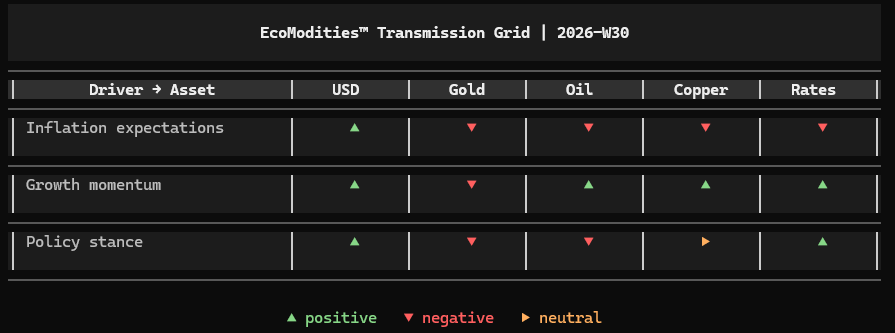
- USD retained relative support despite softer inflation.
- Gold received limited support from lower inflation expectations.
- Oil and copper remained primarily driven by growth dynamics.
- Rates pricing stayed relatively contained.
FX transmission
Currency markets differentiated between regional inflation trends, with the USD remaining resilient as softer inflation did not materially alter expectations for the Federal Reserve.
B. Growth shock
What moved
Growth and labor-market indicators surprised positively.
- Australia Employment Change: 76.3K vs 16.4K expected.
- Australia Unemployment Rate: 4.4% vs 4.4% expected.
- UK Claimant Count Change: 6.7K vs 29.4K expected.
Why it matters
The stronger labor-market data reinforced confidence in underlying economic resilience despite continued progress on disinflation.
Transmission path
- USD benefited from resilient global growth expectations.
- Oil gained support from constructive demand prospects.
- Copper remained supported by industrial activity.
- Gold attracted less defensive demand.
- Rates remained firm.
FX transmission
Growth-sensitive currencies outperformed following stronger labor-market releases, while risk sentiment remained broadly constructive.
C. Policy shock
What moved
The European Central Bank maintained the Main Refinancing Rate at 2.40%, while policy communication remained broadly consistent with previous guidance.
Why it matters
With no significant policy surprises, markets continued focusing on macroeconomic fundamentals rather than central-bank repricing.
Transmission path
- USD retained policy support.
- Gold remained under pressure.
- Oil stayed broadly neutral to policy developments.
- Copper remained neutral.
- Rates pricing changed only modestly.
FX transmission
Policy differentials remained largely unchanged, allowing growth and inflation data to drive currency performance.
2. Cross-asset transmission grid – 2026-W30
3. Market alignment check
Cross-asset alignment remained broadly consistent throughout the week.
Disinflation continued progressing across several developed economies without undermining confidence in global growth. Strong Australian employment data reinforced support for cyclical assets, while the ECB's steady policy stance limited broader repricing across rates markets.
The macro chain currently reflects resilient growth as the dominant transmission layer, with inflation continuing to moderate in an orderly manner.
4. Forward pressure points
USD
Pressure remains concentrated around the balance between moderating inflation and resilient growth.
Gold
Gold remains highly sensitive to real-yield dynamics and evolving policy expectations.
Oil
Oil continues benefiting from resilient demand expectations and stable macro conditions.
Copper
Copper remains supported by industrial activity and global growth resilience.
Rates
Rates markets remain focused on the pace of disinflation and future policy adjustments.
One-line takeaway
The macro transmission chain remained balanced last week, with moderating inflation and resilient labor markets supporting cyclical assets while allowing the USD to retain broad macro leadership.
Author

Luca Mattei
LM Trading & Development
Luca Mattei is a market analyst focusing on FX, metals, and macroeconomic trends. He develops trading tools for retail and professional traders, coding indicators and EAs for MT4/MT5 and strategies in Pine Script for TradingView.