Global macro transmission monitor – Week ending July 17, 2026

Executive transmission map
The macro transmission chain shifted decisively toward disinflation last week as US inflation data surprised to the downside across both consumer and producer prices. Softer CPI and PPI readings reduced inflation-premium pricing, weakening the USD and improving conditions across gold and commodity markets.
Growth signals remained constructive despite slowing inflation. UK GDP returned to positive territory while the Bank of Canada maintained rates unchanged, reinforcing confidence that economic activity continues expanding without generating renewed price pressures.
Policy transmission remained secondary to the inflation narrative. Markets increasingly focused on the implications of moderating inflation for future central-bank decisions rather than on immediate policy changes. Cross-asset alignment strengthened as inflation, commodities and market pricing moved in the same direction.
1. Macro shock layer
A. Inflation shock
What moved
US inflation data surprised consistently to the downside.
- Core CPI m/m: 0.0% vs 0.2% expected
- Core CPI y/y: 2.6% vs 2.8% expected
- CPI m/m: -0.4% vs -0.1% expected
- CPI y/y: 3.5% vs 3.8% expected
- Core PPI m/m: 0.2% vs 0.3% expected
- PPI m/m: -0.3% vs 0.0% expected
Why it matters
The data reinforced the view that underlying inflation pressures continue easing across the US economy. Markets responded by increasing expectations that future monetary policy could become less restrictive.
Transmission path
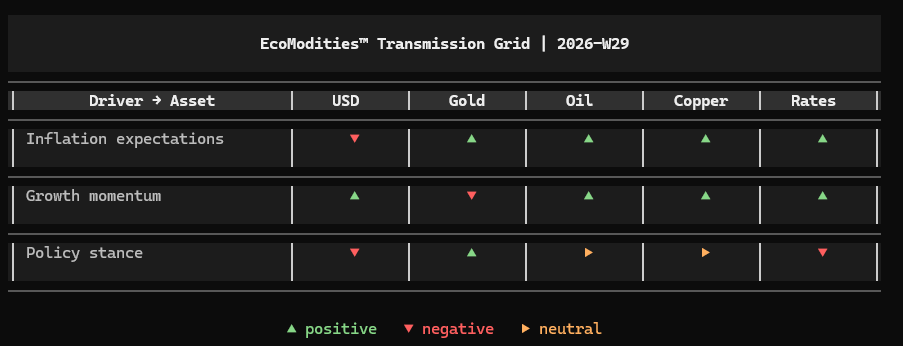
- USD weakened through softer inflation expectations
- Gold benefited from declining real-yield pressure
- Oil and copper improved alongside easier financial conditions
- Rates pricing shifted toward a less restrictive outlook
FX transmission
The USD weakened broadly as softer inflation reduced support from real-rate differentials and encouraged greater participation in commodity-linked currencies.
B. Growth shock
What moved
Growth indicators remained resilient despite moderating inflation.
- UK GDP m/m: 0.1% vs 0.0% expected
- Previous: -0.1%
Why it matters
The combination of moderating inflation and resilient activity reinforced confidence that economic growth continues without generating renewed inflationary pressure.
Transmission path
- Oil benefited from improving demand expectations
- Copper remained supported by resilient activity
- Gold faced limited pressure from stronger growth
- Rates remained stable
FX transmission
Growth-sensitive currencies remained relatively well supported as markets interpreted the data as consistent with continued economic expansion.
C. Policy shock
What moved
The Bank of Canada left its Overnight Rate unchanged at 2.25%, while Fed communication continued emphasizing a data-dependent policy approach.
Why it matters
Markets viewed policy decisions as broadly consistent with expectations, allowing inflation data to remain the dominant macro driver throughout the week.
Transmission path
- USD lost part of its policy advantage
- Gold benefited from easing policy expectations
- Oil and copper remained broadly neutral to policy developments
- Rates volatility stayed contained
FX transmission
Central-bank communication generated limited repricing as investors focused primarily on softer US inflation and its implications for future policy.
2. Cross-asset transmission grid | 2026-W29
3. Market alignment check
Cross-asset alignment strengthened meaningfully during the week.
Softer US inflation weakened support for the USD while improving conditions across gold, oil and industrial commodities. Growth remained sufficiently resilient to reinforce the broader macro backdrop, allowing commodity markets to participate without renewed inflation concerns.
The macro chain currently reflects disinflation as the dominant transmission layer, while growth continues providing support for cyclical assets.
4. Forward pressure points
USD
Pressure remains centered on further disinflation and evolving Fed policy expectations.
Gold
Gold remains highly sensitive to additional declines in real yields and inflation expectations.
Oil
Oil continues balancing resilient demand expectations against the evolving monetary-policy outlook.
Copper
Copper remains supported by resilient industrial activity and improving financial conditions.
Rates
Rates markets remain vulnerable to additional downside inflation surprises and policy repricing.
One-line takeaway
The macro transmission chain shifted decisively toward disinflation last week, weakening the USD while supporting gold, commodities and expectations for a less restrictive policy environment.
Author

Luca Mattei
LM Trading & Development
Luca Mattei is a market analyst focusing on FX, metals, and macroeconomic trends. He develops trading tools for retail and professional traders, coding indicators and EAs for MT4/MT5 and strategies in Pine Script for TradingView.