Weekly Forecast: US data, geopolitical tensions to drive Cable amid light UK economic calendar
- GBP/USD corrected from two-week highs amid resurgent US Dollar demand.
- Top-tier US economic data to grab attention in the upcoming week.
- Pound Sterling buyers could regain control amid bullish technicals.

The Pound Sterling (GBP) gave in to the resurgent US Dollar (USD) this week, motivating GBP/USD sellers to fight back control, as the tempered rate cut outlook from the US Federal Reserve (Fed) bolstered the sentiment around the US Dollar.
US Dollar regained poise, hurt the Pound Sterling
The US Dollar recovery regained momentum, as strong US Retail Sales and Jobless Claims data led investors to scale back their expectations that the Fed will cut interest rates in March. Retail sales in the US increased 0.6% last month, buoyed by a pickup in clothing and accessory stores as well as online nonstore businesses. The data exceeded the market forecast for a 0.4% rise. Meanwhile, weekly Initial Jobless Claims fell to their lowest level in nearly 1-1/2 years, suggesting tighter labor market conditions.
Further, the recent hawkish chorus from the Fed officials also reduced aggressive Fed rate cut bets. Fed Governor Christopher Waller walked back on his previous view on the dovish policy pivot, noting that while inflation was approaching the central bank's 2.0% target, the Fed should not rush to cut interest rates until lower inflation can clearly be sustained. Atlanta Fed President Raphael Bostic said that the “baseline is for rate reductions sometime in Q3, but care is needed to not cut soon or risk a refreshed price spiral.”
The probability of a March Fed rate cut dropped below 60%, the CME Group’s FedWatch Tool showed, as against a roughly 75% chance seen at the start of the week. The US Dollar clinched fresh five-week highs against its major counterparts, sending GBP/USD as low as 1.2595 during the week.
Escalating Middle East geopolitical tensions kept investors on the edge, supporting the safe-haven bids for the US Dollar at the expense of the high-beta Pound Sterling. The US carried out five strikes against Houthi rebel targets in Yemen, as President Joe Biden acknowledged that the rebels' continued attacks on Red Sea shipping persist despite the bombings. In retaliation, Iran-backed Houthi terrorists continued to launch anti-ship ballistic missiles on the Greek-operated vessels. Markets remained worried that the Red Sea escalation could translate into a wider regional conflict.
On the other hand, Pound Sterling found some solace in the surprisingly hot UK Consumer Price Index (CPI) inflation data for December, especially after the British wage growth slowed in the quarter to November. The CPI rose at an annual rate of 4.0% in December, up from a 3.9% increase seen in November, data published by the Office for National Statistics (ONS) showed Wednesday. The market consensus was for a growth of 3.8%. On Tuesday, data showed that the annual growth in earnings, excluding bonuses, arrived at 6.6% in the September to November period, easing from a 7.2% rise in the three months through October.
Hot UK inflation data helped GBP/USD find a floor but the US Dollar eked out gains for the second straight week, setting a negative week for the Pound Sterling. Further, weak UK Retail Sales data also added to the weight on the pair. The Retail Sales volume shrank 3.2% between December and November, registering the biggest drop since January 2021 and much below the expected -0.5%.
The week ahead: Top-tier US data on tap
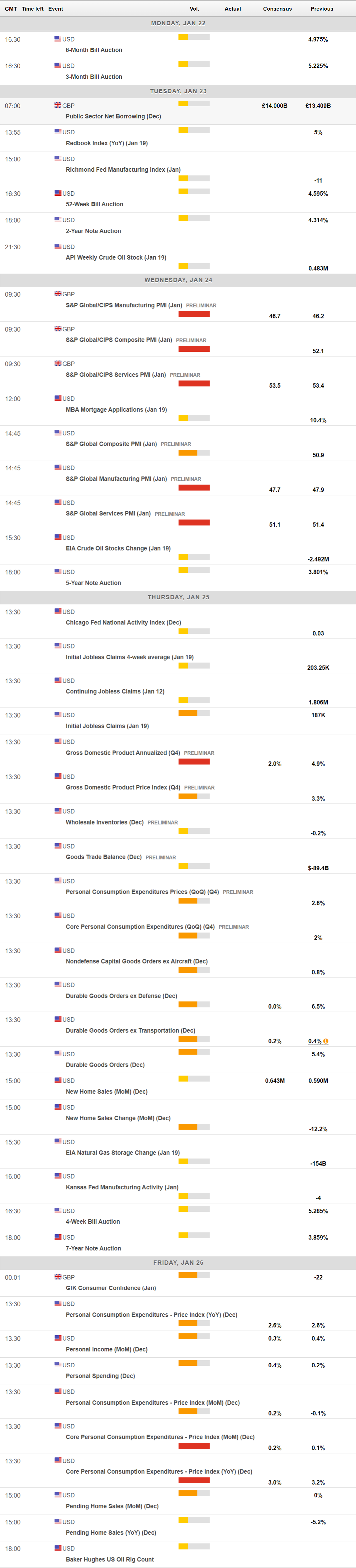
With the key UK employment and inflation data out of the way, Pound Sterling traders shift their focus toward a bunch of high-impact data releases from the US, with the advance fourth-quarter Gross Domestic Product (GDP) data likely to hog the limelight.
Besides, the global preliminary PMI data and US PCE inflation data will be also closely scrutinized.
The Fed calendar will be devoid of any speeches, as the US central bank enters the ‘blackout period’ on Saturday ahead of the February 1 policy meeting.
Geopolitical developments concerning the Red Sea confrontations could also be of utmost significance in the upcoming week.
GBP/USD: Technical Outlook
-638412762211697178.png)
GBP/USD has been trading within a month-long descending triangle formation, with static support seen near the 1.2600 neighborhood.
The 14-day Relative Strength Index (RSI) has recaptured the 50 level, suggesting that the recent upswing in the Pound Sterling could have legs going forward.
The pair needs a weekly closing above the 21-day Simple Moving Average (SMA) at 1.2712 where it is now struggling.
The next upside target is envisioned at the descending trendline resistance at 1.2767. A sustained break of the latter will confirm a triangle breakout, triggering a fresh uptrend toward the four-month top of 1.2828.
If the upside momentum picks up pace, a test of the 1.2900 level cannot be ruled out.
If Pound Sterling buyers fail to sustain at higher levels, a fresh pullback could be initiated toward the 1.2620 demand area, where the 50-day SMA and the triangle support coincide.
A daily close below the key support could validate a downside break of the triangle, calling for a test of the horizontal 200-day SMA at 1.2551. Deeper declines will likely challenge the December 13 low of 1.2500.
Pound Sterling price this week
The table below shows the percentage change of Pound Sterling (GBP) against listed major currencies this week. Pound Sterling was the strongest against the New Zealand Dollar.
| USD | EUR | GBP | CAD | AUD | JPY | NZD | CHF | |
| USD | 0.57% | 0.45% | 0.41% | 1.57% | 2.03% | 2.11% | 1.79% | |
| EUR | -0.59% | -0.14% | -0.18% | 0.98% | 1.45% | 1.54% | 1.21% | |
| GBP | -0.46% | 0.15% | -0.05% | 1.12% | 1.59% | 1.67% | 1.34% | |
| CAD | -0.41% | 0.20% | 0.05% | 1.16% | 1.63% | 1.71% | 1.39% | |
| AUD | -1.59% | -0.98% | -1.12% | -1.20% | 0.48% | 0.56% | 0.23% | |
| JPY | -2.07% | -1.46% | -1.74% | -1.66% | -0.47% | 0.09% | -0.24% | |
| NZD | -2.16% | -1.59% | -1.71% | -1.75% | -0.56% | -0.10% | -0.34% | |
| CHF | -1.82% | -1.24% | -1.37% | -1.41% | -0.23% | 0.24% | 0.33% |
The heat map shows percentage changes of major currencies against each other. The base currency is picked from the left column, while the quote currency is picked from the top row. For example, if you pick the Euro from the left column and move along the horizontal line to the Japanese Yen, the percentage change displayed in the box will represent EUR (base)/JPY (quote).
Author

Dhwani Mehta
FXStreet
Residing in Mumbai (India), Dhwani is a Senior Analyst and Manager of the Asian session at FXStreet. She has over 10 years of experience in analyzing and covering the global financial markets, with specialization in Forex and commodities markets.