GBP/USD Weekly Forecast: Pound Sterling awaits direction from key US inflation data
- Pound Sterling rebounded firmly against the US Dollar from 11-week lows near 1.3250.
- US and UK CPI inflation reports come to the fore amid divergent Fed-BoE monetary policy expectations.
- Technically, the tide seems to turn in favor of GBP/USD buyers as the daily RSI recovers above the midline.

The Pound Sterling (GBP) found fresh buyers once again near the 1.3250 area when compared with the US Dollar (USD), pushing GBP/USD higher toward the 1.3500 threshold.
Pound Sterling capitalizes on USD’s downfall
GBP/USD buyers returned with a bang in the past week after an initial struggle, as the USD lost its upside momentum and incurred heavy losses against its major currency rivals.
Earlier in the week, the Pound Sterling faced headwinds from renewed US-China trade tensions-led risk aversion and weak UK employment data.
The Office for National Statistics (ONS) showed on Tuesday, the UK Unemployment Rate rose to a four-year high of 4.8% in the three months to August, up from 4.7% in July. The Average Earnings growth fell to 4.7% in the three months to August.
Commenting on the jobs data, Bank of England (BoE) Governor Andrew Bailey noted: “Today's labor market data backs my view of a softening labor market.”
However, the tide turned in favor of the pair midweek after the Greenback gave in to fresh concerns surrounding a protracted US-China trade row and the US government shutdown.
Moreover, doubling down on dovish Federal Reserve (Fed) expectations exacerbated the USD’s pain.
US President Donald Trump slapped an additional 100% tariffs on all Chinese imports and introduced strict export controls on US-made critical software starting November 1.
This came in response to China tightening its export controls on rare earths and related technologies, while barring its citizens from participating in unauthorized mining overseas.
Later in the week, China accused the US of exaggerating its rare earth export controls to stir panic, rejecting calls to roll them back.
Meanwhile, Fed officials, including Chairman Jerome Powell, continued to caution on the weakening US labor market, bolstering expectations that the Fed will lower rates twice by the year-end.
Markets priced in roughly a 95% probability of rate cuts at the Fed’s October and December monetary policy meetings, the CME Group’s FedWatch Tool shows.
Week ahead: Inflation reports to revive data drought
Following weeks of a data-dry spell from the United States (US) due to a protracted government shutdown, the focus will be back on the economic data as the Fed enters its ‘blackout period’ ahead of the October 28-29 monetary policy meeting.
The US Bureau of Labor Statistics (BLS) is set to release the September Consumer Price Index (CPI) data on Friday.
In the lead-up to the crucial US inflation data, investors will gain trading incentives from Monday’s Chinese third-quarter Gross Domestic Product (GDP) data and the British CPI report on Wednesday.
Thursday will feature the US Existing Home Sales, followed by Friday’s S&P Global preliminary Purchasing Managers' Index (PMI) data from both sides of the Atlantic.
However, the main market mover on Friday will be the US consumer inflation data publication, which could provide hints on whether the Fed will deliver another rate cut this year after the expected October reduction.
Meanwhile, the delayed data from the US Department of Labor (DoL), BLS and the Census Bureau could be released in the upcoming week if the US funding is restored.
Besides, traders will continue to closely watch for incoming geopolitical and trade-related updates before placing fresh bets on GBP/USD.
GBP/USD: Technical outlook
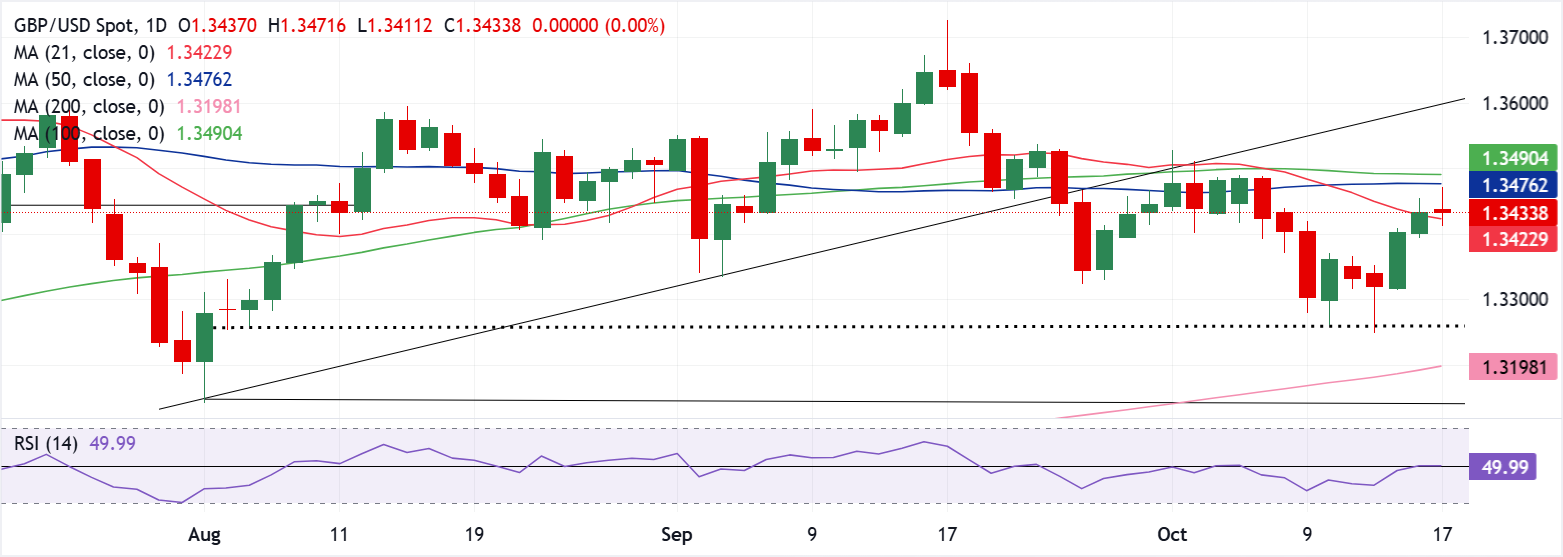
GBP/USD buyers found strong support near the 1.3250 region and staged a solid comeback to challenge the critical resistance near 1.3500 once again.
In doing so, the pair recaptured the key 21-day Simple Moving Average (SMA) at 1.3424 on a daily closing basis on Thursday.
Meanwhile, the 14-day Relative Strength Index (RSI) crossed above the 50 level, pointing higher toward 52, at the time of writing.
These technical indicators suggest that the GBP/USD recovery is likely to extend in the upcoming week, with the rising trendline support-turned-resistance at 1.3600 in focus on acceptance above the 1.3490 supply zone. In that area, the 50-day SMA and the 100-day SMA close in.
Further north, the July 4 high of 1.3681 will be tested, followed by the September 17 high of 1.3763.
Conversely, a sustained break of the 1.3250 demand zone will call for a test of the 200-day SMA at 1.3198.
The August low of 1.3142 will be a line in the sand for GBP optimists.
Pound Sterling FAQs
The Pound Sterling (GBP) is the oldest currency in the world (886 AD) and the official currency of the United Kingdom. It is the fourth most traded unit for foreign exchange (FX) in the world, accounting for 12% of all transactions, averaging $630 billion a day, according to 2022 data. Its key trading pairs are GBP/USD, also known as ‘Cable’, which accounts for 11% of FX, GBP/JPY, or the ‘Dragon’ as it is known by traders (3%), and EUR/GBP (2%). The Pound Sterling is issued by the Bank of England (BoE).
The single most important factor influencing the value of the Pound Sterling is monetary policy decided by the Bank of England. The BoE bases its decisions on whether it has achieved its primary goal of “price stability” – a steady inflation rate of around 2%. Its primary tool for achieving this is the adjustment of interest rates. When inflation is too high, the BoE will try to rein it in by raising interest rates, making it more expensive for people and businesses to access credit. This is generally positive for GBP, as higher interest rates make the UK a more attractive place for global investors to park their money. When inflation falls too low it is a sign economic growth is slowing. In this scenario, the BoE will consider lowering interest rates to cheapen credit so businesses will borrow more to invest in growth-generating projects.
Data releases gauge the health of the economy and can impact the value of the Pound Sterling. Indicators such as GDP, Manufacturing and Services PMIs, and employment can all influence the direction of the GBP. A strong economy is good for Sterling. Not only does it attract more foreign investment but it may encourage the BoE to put up interest rates, which will directly strengthen GBP. Otherwise, if economic data is weak, the Pound Sterling is likely to fall.
Another significant data release for the Pound Sterling is the Trade Balance. This indicator measures the difference between what a country earns from its exports and what it spends on imports over a given period. If a country produces highly sought-after exports, its currency will benefit purely from the extra demand created from foreign buyers seeking to purchase these goods. Therefore, a positive net Trade Balance strengthens a currency and vice versa for a negative balance.
Author

Dhwani Mehta
FXStreet
Residing in Mumbai (India), Dhwani is a Senior Analyst and Manager of the Asian session at FXStreet. She has over 10 years of experience in analyzing and covering the global financial markets, with specialization in Forex and commodities markets.

















