GBP/USD rises as markets await crucial UK budget

The GBP/USD pair extended its gains, reaching 1.3189, as investors await details of the UK budget, to be presented today, 26 November. All attention is on Chancellor Rachel Reeves and her strategy to close the fiscal deficit while adhering to the government's self-imposed budgetary rules. This challenge requires finding tens of billions of pounds in savings or revenue. Market volatility has been stoked by reports suggesting the government may avoid immediate tax increases.
The fiscal backdrop is deteriorating. According to media reports, the Office for Budget Responsibility (OBR) is preparing to lower its growth forecasts for 2026 and beyond. This revision could widen the budget deficit by £20–30 billion, intensifying the long-term pressure for tax rises.
Recent macroeconomic data underscores the economy's fragility. Public sector borrowing remains at record highs outside of the pandemic period, business activity is slowing, retail sales have contracted sharply, and consumer confidence is waning.
Amid this weak economic landscape, October's inflation reading fell to 3.6%, solidifying expectations for monetary policy easing. Markets are now pricing in an 80% probability of a 25-basis-point rate cut from the Bank of England in December.
Technical analysis: GBP/USD
Four-hour chart
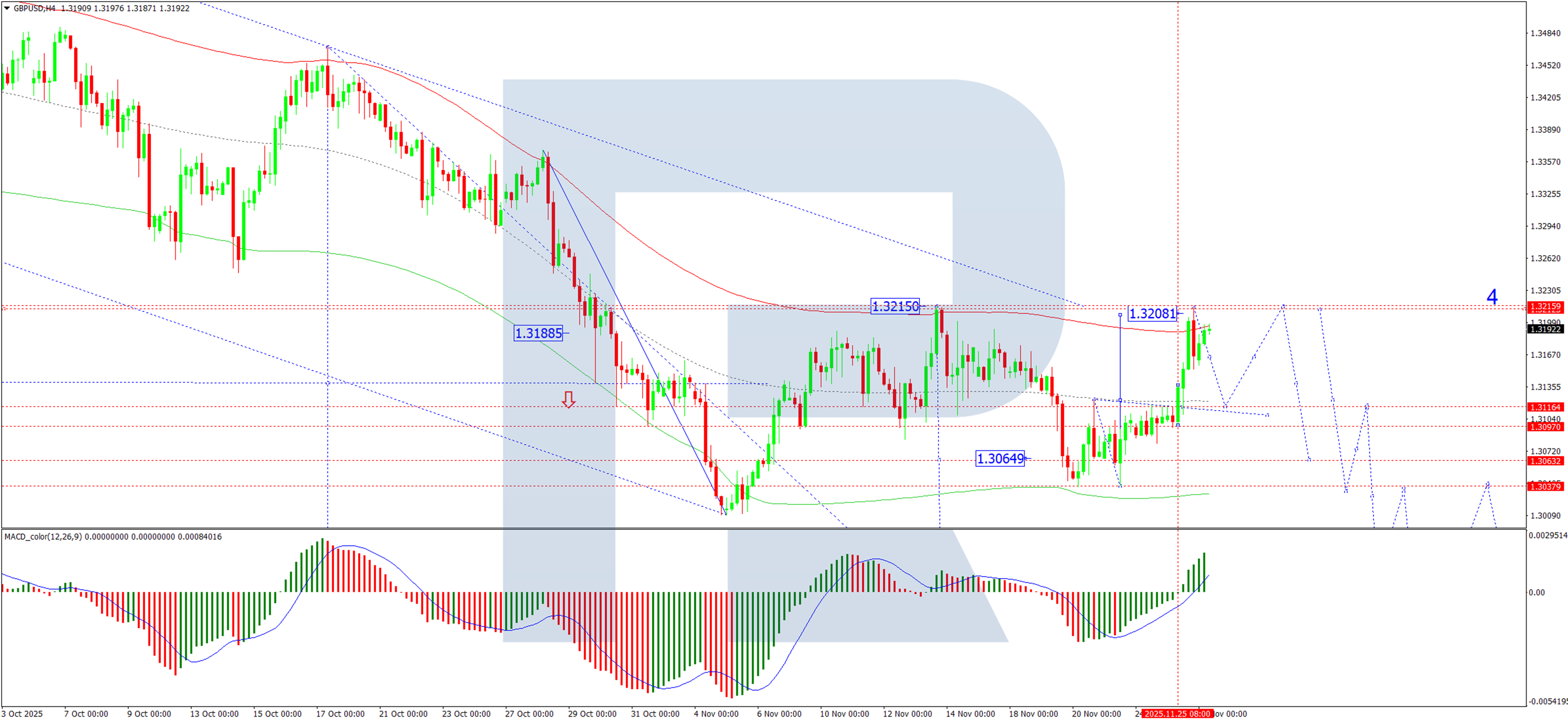
On the H4 chart, GBP/USD broke decisively above 1.3116, completing a corrective wave structure to 1.3210. We now anticipate a pullback to retest the 1.3116 level from above. Following this retest, a final leg of the correction could push the pair towards 1.3215.
Once this corrective phase is complete, the primary downtrend is expected to resume. The next key target for the subsequent wave of selling is at 1.2911. The MACD indicator supports this view; its signal line is above zero and pointing upwards, confirming the current corrective strength is likely a prelude to a new downtrend.
One-hour chart
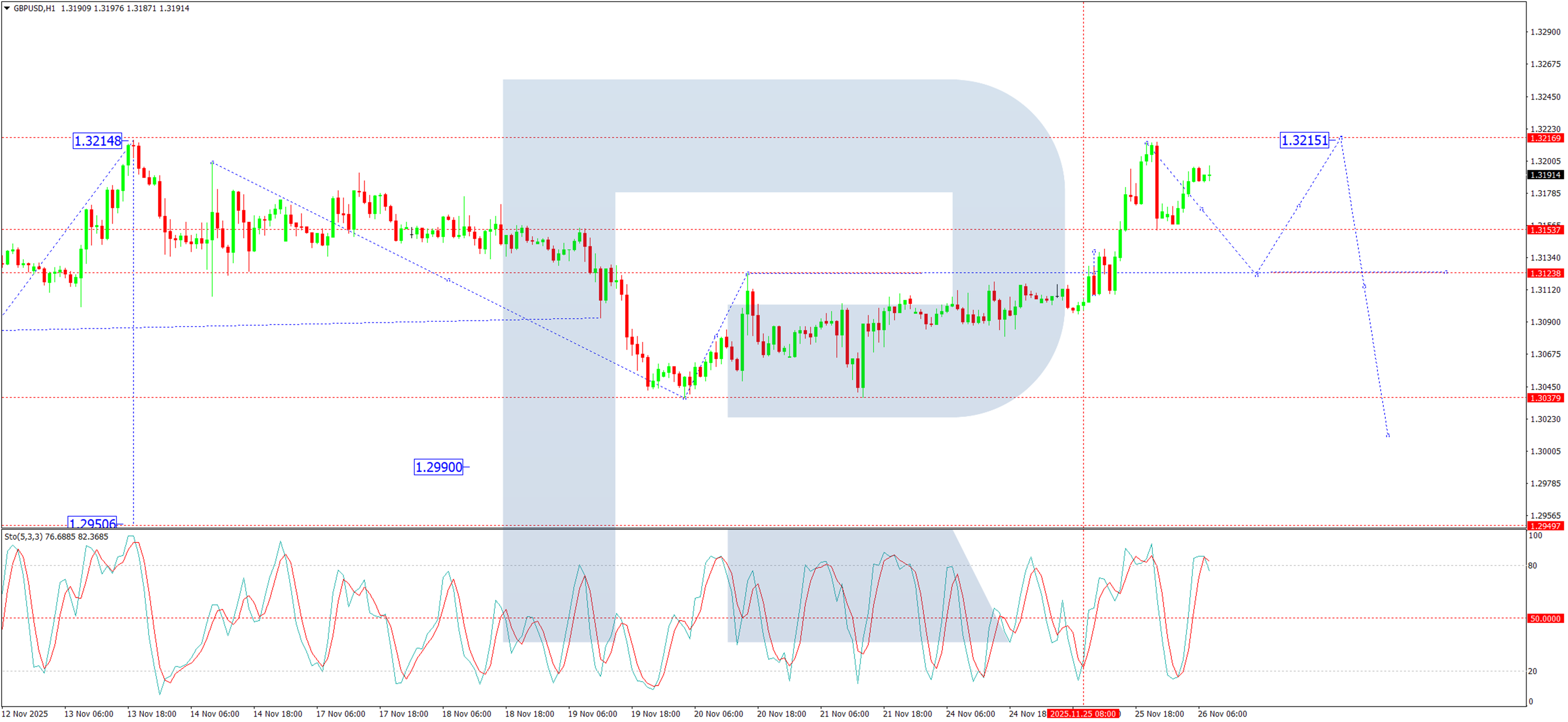
On the H1 chart, the pair broke upwards from a pronounced consolidation range around 1.3123, reaching its initial target at 1.3210. A decline to retest 1.3123 is now expected. This should be followed by a final upward push to 1.3215, at which point the corrective potential is likely to be exhausted.
We then forecast the start of a fifth and typically powerful wave of decline, targeting 1.2911. The Stochastic oscillator confirms this scenario. Its signal line is in overbought territory above 80 and is turning downwards, signalling that the current upward momentum is losing steam.
Conclusion
The pound's strength is fragile, driven by budget speculation rather than a shift in fundamentals. The pre-budget rally is viewed as a corrective bounce within a broader bearish trend. Technically, the pair is approaching a critical resistance zone near 1.3215. We anticipate this level will cap gains and present a selling opportunity, paving the way for a resumption of the downtrend with an initial target at 1.2911. The budget details and the BoE's subsequent December meeting will be key determinants of the pound's medium-term direction.
Author

RoboForex Analysis Department
RoboForex
RoboForex Analysis Department provides timely market insights, expert technical analysis, and actionable forecasts across forex, commodities, indices, and equities.