GBP/USD Forecast: Pound Sterling could push higher once 1.2700 is confirmed as support
- GBP/USD gathered bullish momentum and climbed above 1.2700.
- The pair could continue to push higher if it confirms 1.2700 as support.
- Investors will pay close attention to PMI data, risk perception.

GBP/USD broke above its three-week-old trading range and touched its highest level since early February above 1.2700 on Thursday. The broad-based selling pressure surrounding the US Dollar (USD) fuels the pair's rally as investors' focus shifts to the UK and US PMI data. Market participants will also pay close attention to the risk perception as US stock index futures post impressive gains in the European morning.
Improving market mood caused the USD to lose interest during the Asian trading hours on Thursday. Although Wall Street's main indexes were little changed for the day, upbeat earnings figures from Nvidia after the closing bell attracted risk flows. At the time of press, Nasdaq futures were up nearly 2% on the day and S&P futures were rising 1%. If the risk rally gains momentum in the second half of the day, the USD could continue to weaken against its rivals.
Pound Sterling price this week
The table below shows the percentage change of Pound Sterling (GBP) against listed major currencies this week. Pound Sterling was the strongest against the US Dollar.
| USD | EUR | GBP | CAD | AUD | JPY | NZD | CHF | |
| USD | -0.71% | -0.61% | -0.24% | -0.85% | -0.04% | -1.30% | -0.60% | |
| EUR | 0.69% | 0.09% | 0.46% | -0.15% | 0.65% | -0.60% | 0.10% | |
| GBP | 0.61% | -0.09% | 0.37% | -0.22% | 0.58% | -0.68% | 0.01% | |
| CAD | 0.24% | -0.46% | -0.37% | -0.59% | 0.21% | -1.06% | -0.36% | |
| AUD | 0.82% | 0.12% | 0.22% | 0.58% | 0.78% | -0.47% | 0.23% | |
| JPY | 0.05% | -0.67% | -0.55% | -0.21% | -0.80% | -1.25% | -0.58% | |
| NZD | 1.29% | 0.59% | 0.70% | 1.05% | 0.46% | 1.25% | 0.69% | |
| CHF | 0.60% | -0.11% | -0.02% | 0.36% | -0.24% | 0.57% | -0.71% |
The heat map shows percentage changes of major currencies against each other. The base currency is picked from the left column, while the quote currency is picked from the top row. For example, if you pick the Euro from the left column and move along the horizontal line to the Japanese Yen, the percentage change displayed in the box will represent EUR (base)/JPY (quote).
In the European session, S&P Global/CIPS Manufacturing and Services PMI data will be featured in the UK economic docket. In January, UK PMIs came in above market expectations and helped Pound Sterling stay resilient against its rivals. The Composite PMI is expected to stay unchanged at 52.9 in February's flash estimate to show an ongoing expansion in private sector's economic activity. A better-than-forecast print could provide a boost to GBP/USD with the immediate reaction. On the other hand, a reading below 50, which would point to a contraction, could weigh on Pound Sterling and cause the pair to stage a downward correction.
In the second half of the day, S&P Global will also release preliminary Manufacturing and Services PMI surveys for the US. Both of those PMIs are seen holding steady slightly above 50. If the details of the Services PMI survey point to an acceleration in input inflation, the USD could find a foothold. Unless there is a negative shift in risk mood, however, the USD's gains are likely to limited.
GBP/USD Technical Analysis
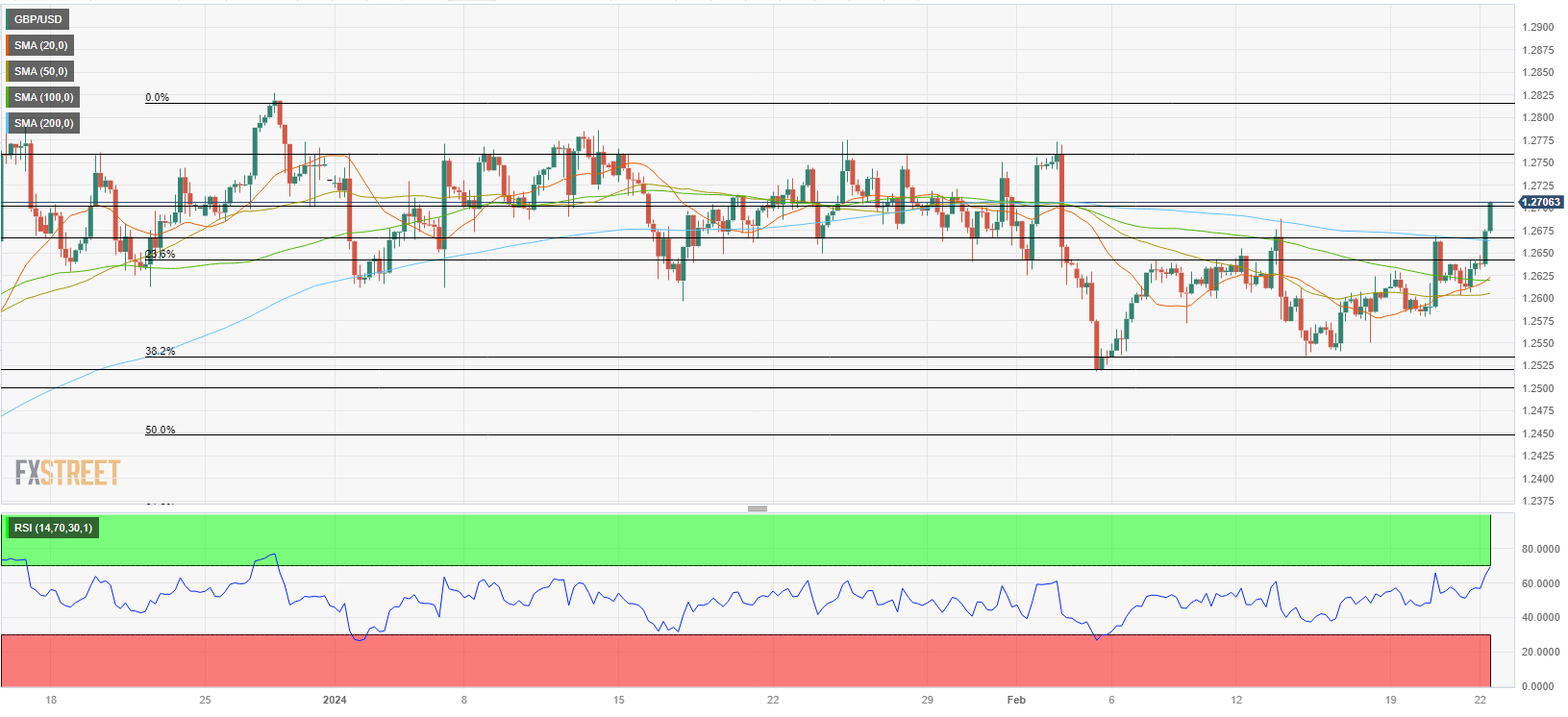
GBP/USD was last seen trading a few pips above 1.2700 (psychological level, static level). In case the pair confirms that level as support, 1.2760 (static level) could be seen as next bullish target before 1.2800 (psychological level, static level).
On the downside, the 50-day Simple Moving Average (SMA) forms dynamic support at around 1.2680 before 1.2650-1.2660 (Fibonacci 23.6% retracement of the latest uptrend, 200-period SMA on the 4-hour chart).
Premium
You have reached your limit of 3 free articles for this month.
Start your subscription and get access to all our original articles.
Author
Eren Sengezer
FXStreet
As an economist at heart, Eren Sengezer specializes in the assessment of the short-term and long-term impacts of macroeconomic data, central bank policies and political developments on financial assets.

















