GBP/USD Forecast: Markets could ignore oversold conditions on a dovish BoE surprise
- GBP/USD dropped to a fresh multi-month low below 1.2300.
- BoE will announce interest rate decision later in the session.
- Technical outlook points to oversold conditions for the pair in the near term.

After rising above 1.2400 during the European trading hours on Wednesday, GBP/USD made a sharp U-turn and closed the day in negative territory. The pair extended its slide in the first half of the day on Thursday and touched its lowest level since early April below 1.2300.
The Federal Reserve left its policy rate unchanged at 5.25%-5.5% as forecast. The revised Summary of Projections confirmed that policymakers intend to hike the policy rate one more time in 2023. More importantly, the rate cut projection for 2024 got revised lower to 50 basis points (bps) from 100 bps. Hawkish dot plot provided a boost to the US Dollar (USD) and forced GBP/USD to stay under bearish pressure.
Pound Sterling price this week
The table below shows the percentage change of Pound Sterling (GBP) against listed major currencies this week. Pound Sterling was the weakest against the Canadian Dollar.
| USD | EUR | GBP | CAD | AUD | JPY | NZD | CHF | |
| USD | 0.10% | 0.68% | -0.26% | 0.43% | 0.26% | -0.22% | 0.91% | |
| EUR | -0.12% | 0.57% | -0.38% | 0.29% | 0.17% | -0.36% | 0.82% | |
| GBP | -0.67% | -0.57% | -0.94% | -0.25% | -0.43% | -0.90% | 0.24% | |
| CAD | 0.27% | 0.36% | 0.93% | 0.68% | 0.52% | 0.01% | 1.18% | |
| AUD | -0.43% | -0.29% | 0.28% | -0.68% | -0.14% | -0.65% | 0.53% | |
| JPY | -0.28% | -0.19% | 0.40% | -0.50% | 0.16% | -0.51% | 0.65% | |
| NZD | 0.22% | 0.37% | 0.94% | -0.03% | 0.65% | 0.51% | 1.20% | |
| CHF | -0.93% | -0.83% | -0.25% | -1.18% | -0.53% | -0.66% | -1.19% |
The heat map shows percentage changes of major currencies against each other. The base currency is picked from the left column, while the quote currency is picked from the top row. For example, if you pick the Euro from the left column and move along the horizontal line to the Japanese Yen, the percentage change displayed in the box will represent EUR (base)/JPY (quote).
Later in the session, the Bank of England (BoE) will announce its interest rate decision. The market expectation points to a 25 bps hike to 5.5%. Following the soft Consumer Price Index (CPI) data for August, however, several financial institutions, including Goldman Sachs, revised their forecasts to say that they were now expecting the BoE to hold the rates steady after September meeting.
In fact, the probability of a BoE rate pause has increased to 57% early Thursday, from nearly 20% earlier in the week, according to Reuters' calculations.
In case the BoE leaves the policy rate unchanged and signals that it might have reached the end of its tightening cycle, Pound Sterling is likely to stay under selling pressure. Given the market positioning, a 25 bps hike could be seen as a hawkish surprise and trigger a rebound in the pair. The vote split could also influence the pair's action. If there is a slim majority for a no change in rates, GBP/USD's losses could remain limited in the near term.
GBP/USD Technical Analysis
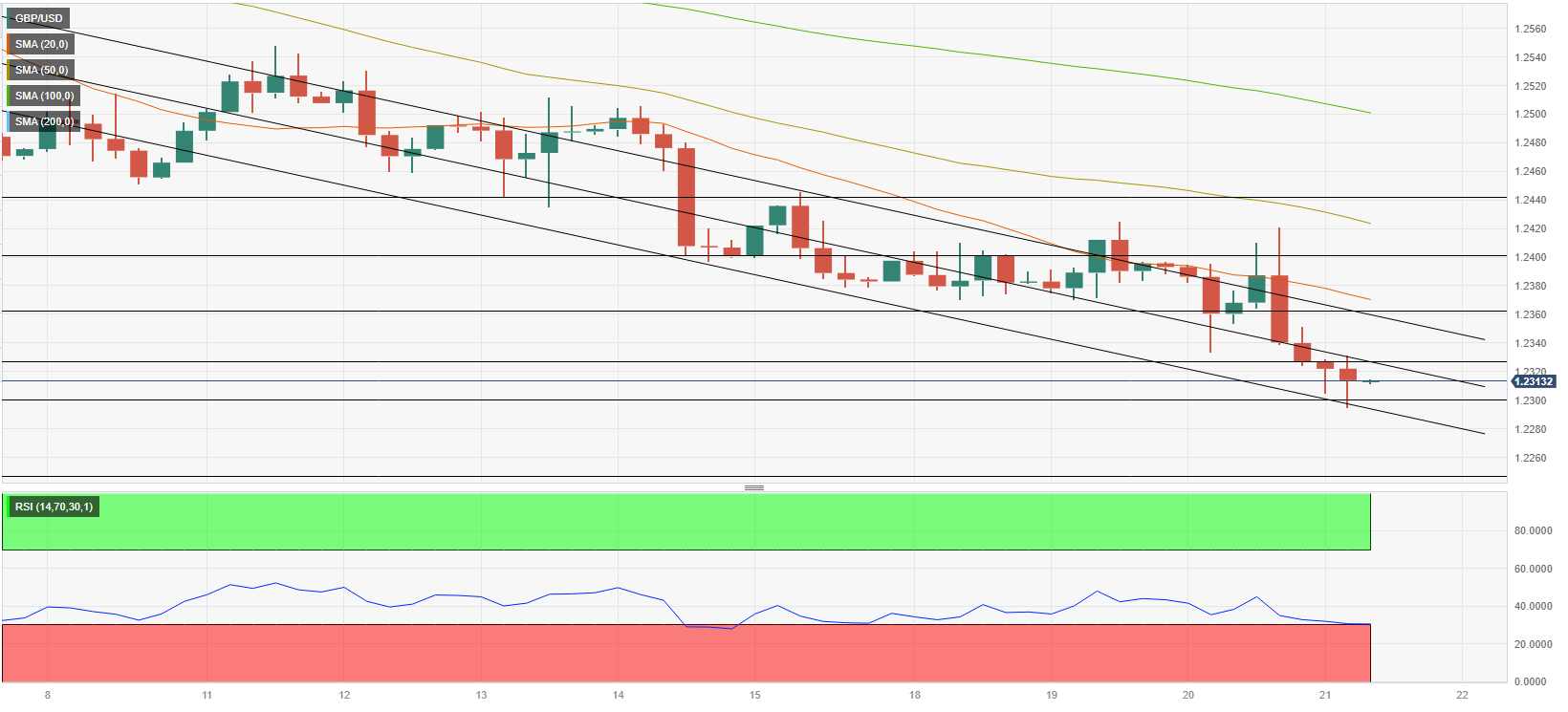
The Relative Strength Index (RSI) indicator on the four-hour chart stays below 30 and GBP/USD trades within a touching distance of the lower limit of the descending regression channel, pointing to oversold conditions.
1.2300 aligns as initial support and a four-hour close below that level could attract sellers. In that scenario, 1.2240 (static level from March) could be set as the next bearish target before 1.2200 (psychological level, static level).
On the upside, first resistance is located at 1.2330 (mid-point of the descending channel) before 1.2360 (upper limit of the descending channel) and 1.2400 (static level, psychological level).
Author

Eren Sengezer
FXStreet
As an economist at heart, Eren Sengezer specializes in the assessment of the short-term and long-term impacts of macroeconomic data, central bank policies and political developments on financial assets.


![How Wall Street rigs the game [Video]](https://editorial.fxsstatic.com/images/i/market-chaos-01.jpg)