|

GBP/USD Elliott Wave: Cable completes five wavesup, watch for a pullback

Some FX majors could stay a bit slow this week, maybe even until next week's Fed decision. EUR/USD, for example, is still testing important resistance around 1.1260 with limited upside for now. But cable stands out, and it looks constructive for more gains after some setback.

Cable came higher as expected, and the reason for this move to the upside was the lower-than-expected unemployment rate in the UK reported yesterday, which dipped to 4.7%. At the same time, inflation is still ticking higher. Today's CPI rose to 3.5% from 3.1%, meaning that the Bank of England could have room for more rate hikes. This could keep GBP/USD in recovery mode.

From an Elliott Wave perspective, on the intraday 1H chart we can already count five waves up from the recent 2026 low, which may be the first leg of a bigger ABC recovery.
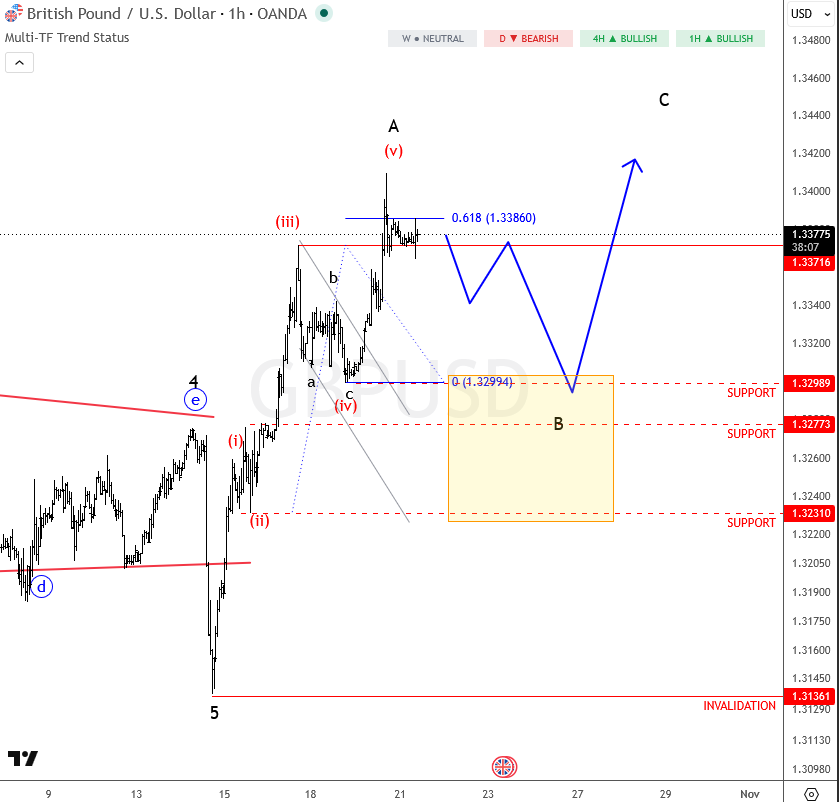
GBPUSD 1H Elliott Wave chart

Since we already have five waves up, it may not be a bad idea to wait for a three-wave pullback rather than chasing new entries up here. Interesting support could be around the previous wave four area near 1.3300–1.3233. A pullback into that zone could offer a better opportunity for the next leg higher, while 1.3136 remains key invalidation for this recovery idea.


Get Full Access To Our Premium Elliott Wave Analysis For 14 Days. Click here.

Author

Gregor Horvat

Gregor Horvat

Wavetraders

Experience Grega is based in Slovenia and has been in the Forex market since 2003.

More from Gregor Horvat
Share:

Editor's Picks

AUD/USD sits at three-week highs above 0.7000 on hawkish RBA-speak

AUD/USD holds a positive bias for the fourth straight day, trading above 0.7000 in the Asian session on Wednesday and at three-week highs. RBA Deputy Governor Andrew Hauser's hawkish remarks and inflation concerns underpin the pair. However, the upside appears capped as the US Dollar attracts some buyers amid looming US-Iran uncertainty.

USD/JPY remains confined in a familiar range below 158.50

USD/JPY sees some dip-buying in the Asian session on Wednesday, though it remains confined within a multi-week range near 158.50 as the uncertainty over the timing of the next BoJ rate hike keeps Japanese Yen bulls on the defensive. Meanwhile, hawkish Fed expectations, bolstered by inflation risks stemming from volatile oil prices, underpin the US Dollar. However, looming intervention fears could limit JPY losses and cap the currency pair.

Gold extends losing spree as US bond yields hold ground

Gold maintains an offered tone heading into the European session, trading near the weekly low it touched earlier this Wednesday, with bears still awaiting a sustained break and acceptance below $4,100 before positioning for further losses. Inflation risks stemming from volatile oil prices underpin prospects for further policy tightening by the US Federal Reserve. Furthermore, a modest US Dollar bounce from a near three-week low is seen weighing on the bullion.

Zcash's bullish reversal eyes $1,698 peak on NU7 upgrade
Zcash (ZEC) shows signs of bullish recovery above $1,200 on Wednesday, following a 9% rebound the previous day linked to the upcoming NU7 upgrade. Blockworks released a Zcash holders report on Tuesday, highlighting steady network growth. The technical outlook for ZEC is bullish, with bulls eyeing an extended rally toward $1,698.
US – Midterm update: Pre-election tail risk scenarios
With two weeks until the US midterm elections on 3 November, early voting has already opened in more than 40 states. Prediction markets are broadly unchanged since we published our Midterm update, 13 October. The prediction market Polymarket continues to see Democrats winning both chambers as the most likely outcome, with a 62.5% probability.
The US Dollar fell. Gold didn't rally. That tells you everything
Gold (XAU/USD) is struggling to capitalize on a weaker US Dollar (USD), after repeatedly failing to establish itself above the $4,200 level. The precious metal remains confined to a relatively narrow trading range despite a combination of developments that would normally support higher prices.