GBP/USD consolidates as outlook remains mixed


GBP/USD rose to 1.3237 on Friday. Following a rapid decline, the pound has entered a consolidation phase, although the main external drivers remain a strong US dollar and a renewed rise in bond yields amid inflation risks.
The focus remains on Bank of England policy. Markets put the probability of a rate hike at the November meeting at over 80% and are effectively pricing in two 25-basis-point hikes by February. High energy prices and concerns that inflationary pressures in the UK could prove more persistent are reinforcing these expectations. MPC member Megan Greene also warned that the Bank of England should not rely solely on high bond yields as a means of curbing inflation.
During his speech in Istanbul, Andrew Bailey focused less on the next rate decision and more on financial stability and fiscal policy. He stressed the need for a credible and predictable fiscal strategy amid soaring borrowing costs. UK government bond yields are near multi-year highs, increasing pressure on the budget and making the pound more sensitive to any signs of deteriorating fiscal discipline.
As a result, the fundamental backdrop for sterling remains mixed. Expectations of further Bank of England tightening support the currency, but a strong US dollar, elevated global yields and rising UK fiscal risks are limiting GBP/USD’s upside. In the short term, the balance will depend on whether expectations of a BoE rate hike can outweigh pressure from the US dollar.
Technical analysis
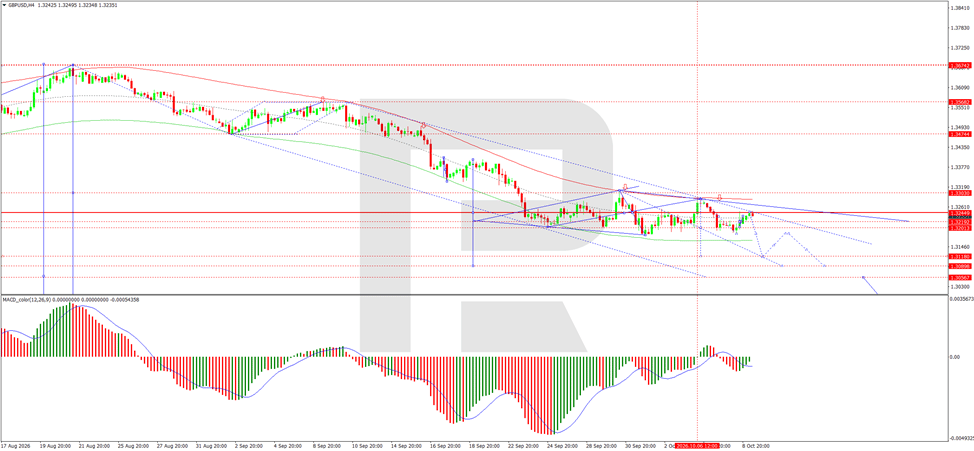
On the H4 chart, GBP/USD remains in the downtrend that developed after the upward correction ended. The pair attempted to recover towards resistance at 1.3250 but failed to establish a foothold above it. The current structure suggests that the corrective move may be nearing completion, with the main downward move poised to resume.
In today’s trading session, the pair is expected to decline towards the nearest support at 1.3185. A confirmed break below this level would set up a third Elliott wave, followed by a move towards 1.3118 and 1.3108. The MACD indicator provides further confirmation of the bearish scenario and remains in negative territory. Despite the local recovery in the histogram, the indicator’s position does not yet signal a full reversal of the medium-term trend.
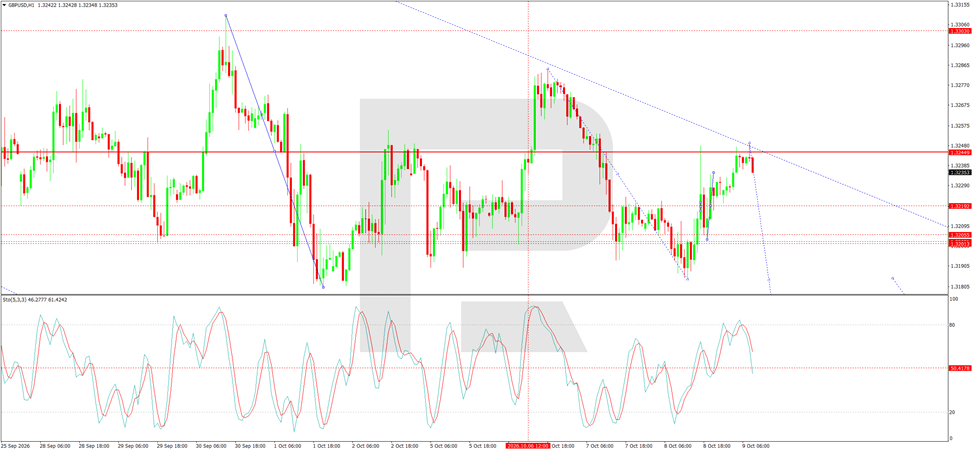
On the H1 chart, GBP/USD appears to be in the final stage of its upward correction around 1.3250. This resistance coincides with the descending trend line, increasing the likelihood of renewed selling. The Stochastic oscillator has turned down from elevated levels, signalling weakening buying momentum.
The main scenario remains a decline towards 1.3180, followed by a further move towards 1.3104. Intermediate levels are 1.3201 and 1.3118. At the same time, a return above 1.3250 would weaken the current bearish scenario and open the way for a retest of resistance at 1.3303.
Conclusion
GBP/USD has steadied after a sharp decline, although the outlook remains mixed as the pound contends with a strong US dollar, elevated bond yields and rising UK fiscal risks. Markets continue to price in further Bank of England tightening, with the probability of a November rate hike above 80% and two 25-basis-point hikes effectively priced in by February, supported by persistent inflation concerns. However, Andrew Bailey’s focus on fiscal sustainability and financial stability, rather than the next rate decision, highlights the broader challenges facing the UK economy. Technically, the pair remains bearish below 1.3250, with a decline towards 1.3185 and potentially 1.3104 if support breaks. A recovery above 1.3250 would ease pressure but would not alter the broader downtrend, with 1.3303 as the next key resistance level.
Author
RoboForex Analysis Department
RoboForex
RoboForex Analysis Department provides timely market insights, expert technical analysis, and actionable forecasts across forex, commodities, indices, and equities.
















