Federal Reserve Beige Book: Information that galvanized the central bank in March
- American economy activity has pulled back “sharply and abruptly”.
- Leisure, hospitality, retail, manufacturing and energy sectors hardest hit.
- Food and medical suppliers saw strong demand but encountered supply problems.

The US economy plunged into a deep freeze in the last two weeks of March as government mandated business closures shuttered stores and factories across the country and layoffs threw millions out of work in the public health effort to stop the Coronavirus pandemic.
“Economic activity contracted sharply and abruptly across all regions in the United States as a result of the COVID-19 pandemic,” said the Beige Book assembled for the April 28-29 FOMC meeting by the Federal Reserve Bank of Boston. “All districts reported highly uncertain outlooks among business contacts, with most expecting conditions to worsen in the next several months.”
March 15 FOMC
This dire assessment from the 12 regional Fed districts is composed from interviews of the bank’s business contacts that took place from the FOMC meeting on March 15 through April 6. It is very likely the same type of information that the governors had been receiving in the two weeks leading up to the 1% rate cut and $700 billion quantitative easing program on the 15th.
Fed Funds
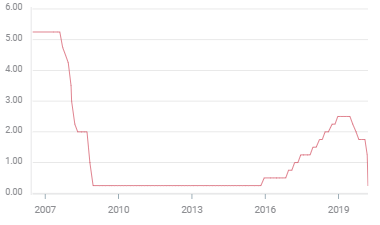
“Employment declined in all Districts, steeply in many cases…[and] cuts were most severe in the retail and leisure and hospitality sectors... Many dictricts said severe job cuts were widespread, including the manufacturing and energy sectors.” "Producers of food and medical products reported strong demand but faced both production delays, due to infection-prevention measures, and supply chain disruptions.'
“Contacts in several Districts noted they were cutting employment via temporary layoffs and furloughs that they hoped to reverse once business activity resumes. The near-term outlook was for more job cuts in coming months,” noted the book.
Although the first initial jobless claims numbers that showed the depth of the labor market damage were not released until March 26, the Fed’s actions 11 days earlier were designed to provide as much support as possible for a US economy headed into a period unlike any experienced before.
Market reaction
Markets were surprised and frightened by the March 15 Fed actions assuming that the central bank had better information. The rate cut failed to quell the equity rout which did not reach bottom until the following Monday the 23rd, three days before the first initial claims figures that confirmed the severity of the job losses on the 26th.
The dollar reached its risk aversion high against the euro at 1.0636 on the 20th, the Friday after the Fed’s Sunday meeting and versus the yen at 111.72 on the 24th the following Tuesday.
There is an old saying on Wall Street, ‘Never buck the Fed’ meaning never go against Fed policy. Or to put it another way, if the central bank is making a surprise cut in rates, there is a very good reason.
Author

Joseph Trevisani
FXStreet
Joseph Trevisani began his thirty-year career in the financial markets at Credit Suisse in New York and Singapore where he worked for 12 years as an interbank currency trader and trading desk manager.