Fed vs ECB: Rate gap adds to pressure on EUR/USD

Eurozone annual inflation rose to 3.8% in September from 3.2% in August – the highest level in recent months. Energy prices increased by 18.9% year-on-year, while services inflation stood at 3.2%.
US CPI accelerated to 3.7% in September from 3.4% in August. The energy index rose by 5.2% over the month, with gasoline prices up 9.1%. Core CPI stood at 2.6%.
Budget negotiations have begun in the French parliament, but with no stable ruling majority and the political crisis dragging on, EUR/USD could fall to 1.05 in a worst-case scenario. UBS forecasts that EUR/USD will recover to 1.16 by year-end.
The 10-year US Treasury yield has climbed above 5.30%, giving the dollar a significant yield advantage. Dollar-denominated assets remain more attractive than European assets, supporting capital inflows to the US.
The Middle East conflict remains the largest source of uncertainty, supporting energy inflation and demand for the US dollar as a safe-haven currency.
EUR/USD is under triple pressure from a hawkish Fed, France’s fiscal crisis and geopolitical risks. The ECB appears more cautious than the Fed, widening the interest rate differential in favour of the dollar. This week’s key events are the Fed meeting on 27–28 October and the ECB meeting on 28–29 October.
Technical analysis
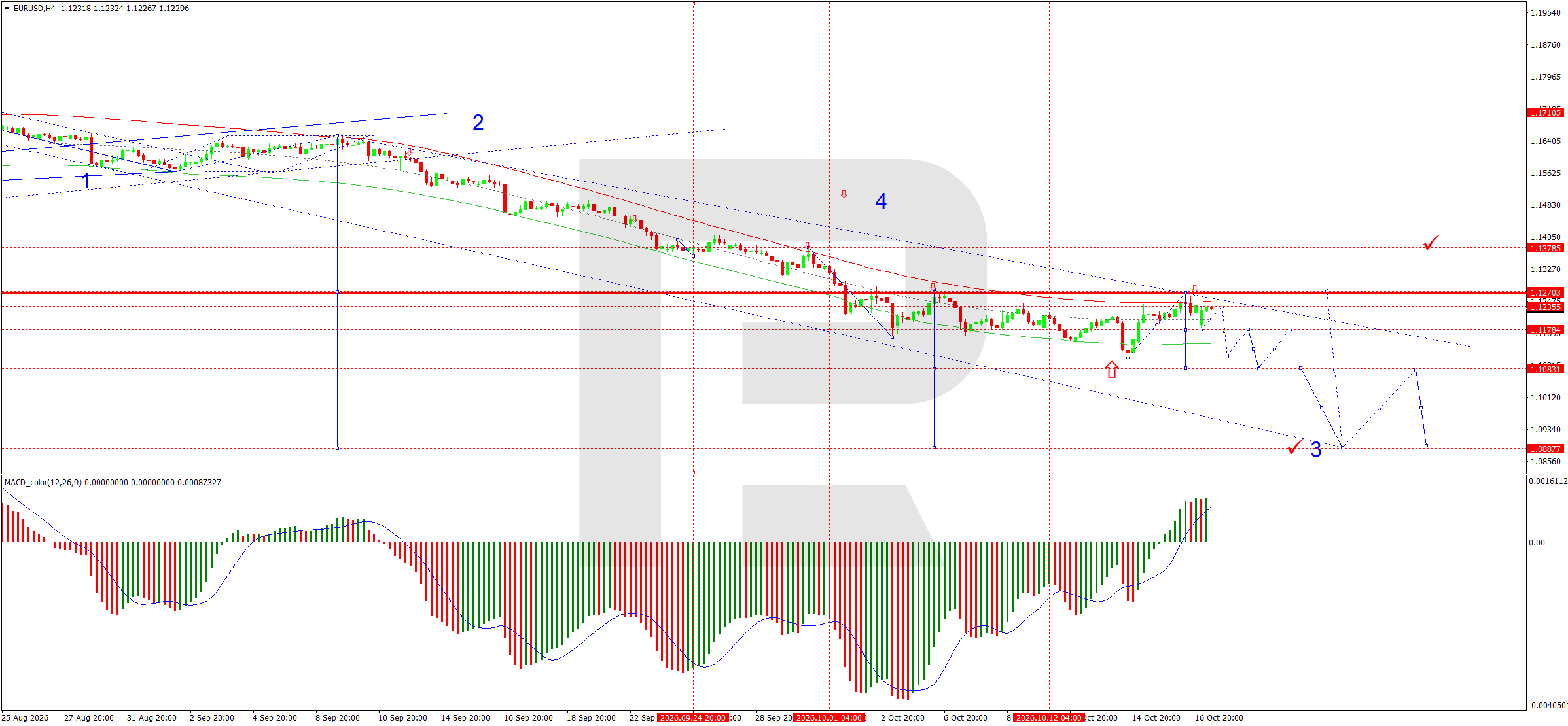
On the H4 chart, EUR/USD remains in a downtrend, within which the market completed another downward wave around 1.1112. The subsequent upward move allowed the pair to recover towards resistance at 1.1270. A consolidation range is currently forming below this level. The rise is viewed as a corrective wave within the main downtrend. The correction is expected to end, followed by another downward move towards 1.1178. A break below this support would open the way towards 1.1083 and then 1.0888. An alternative scenario envisages a break above resistance at 1.1270, with the correction continuing towards 1.1379. The MACD indicator is in positive territory, although the upward momentum could weaken.
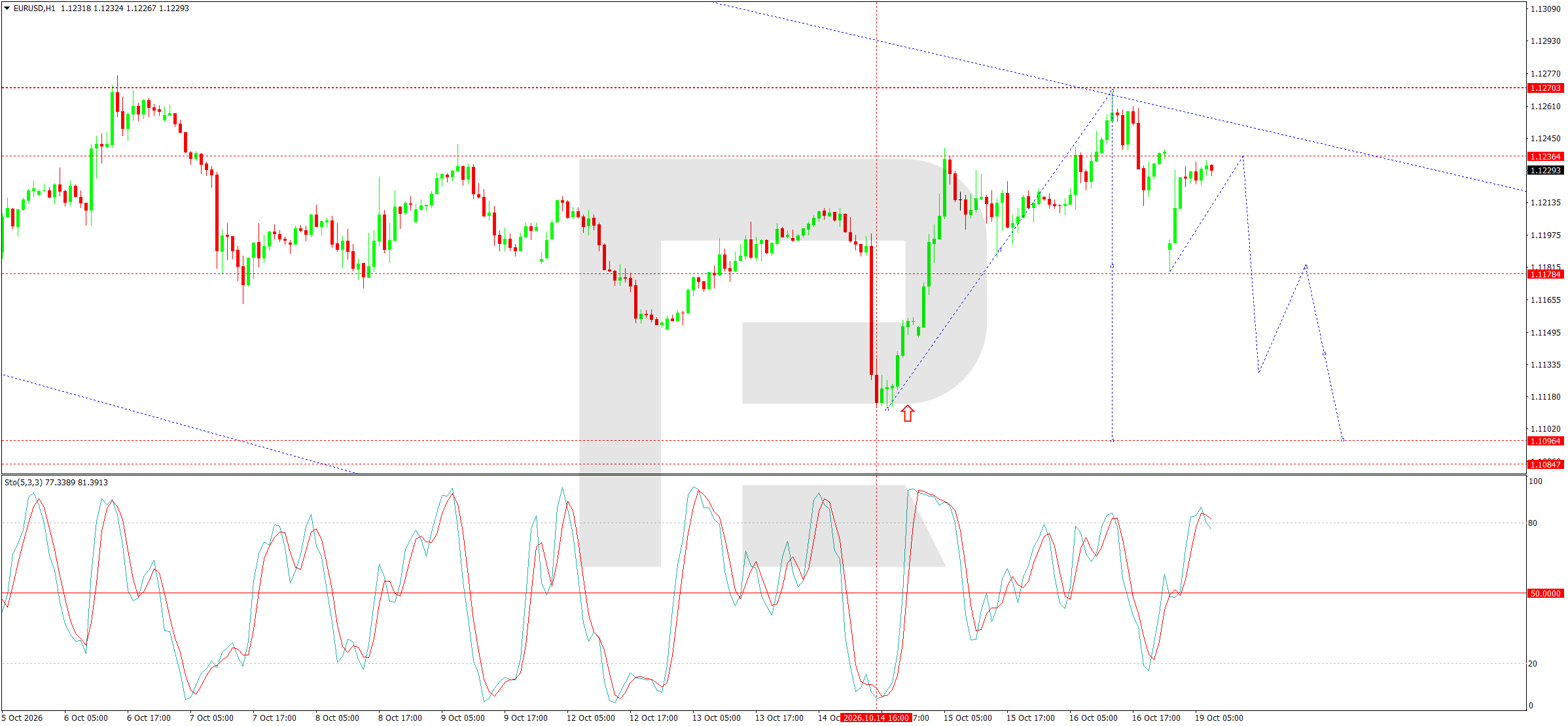
On the H1 chart, a local corrective structure is developing following the completion of the upward move from 1.1112 towards resistance at 1.1270. The market is currently consolidating below 1.1236. During the upcoming trading session, the corrective rise is expected to end, followed by a decline towards 1.1178. A break below this level would open the way towards 1.1130 and then 1.1096. The Stochastic oscillator is in overbought territory, with its signal line turning downwards, indicating that the current correction may be nearing its end. The priority scenario for today remains a decline after a local high forms below resistance at 1.1236. Confirmation would come from a close below the nearest intraday support, followed by increased selling pressure towards the stated targets.
Conclusion
EUR/USD remains under triple pressure from a hawkish Fed, France’s fiscal crisis and geopolitical risks, with the widening interest rate differential favouring the dollar. Eurozone inflation rose to 3.8% in September, while US CPI accelerated to 3.7%, but the ECB’s more cautious stance compared with the Fed continues to weigh on the euro. The 10-year US Treasury yield above 5.30% increases the dollar’s appeal and supports capital inflows to the US. The upcoming Fed and ECB meetings will be the key catalysts, with the pair vulnerable to further downside if the correction ends. Technically, the bearish structure remains intact, with a decline towards 1.1178, 1.1083 and potentially 1.0888 likely if support breaks. A break above 1.1270 would extend the correction towards 1.1379, but the broader trend remains downward.
Author

RoboForex Analysis Department
RoboForex
RoboForex Analysis Department provides timely market insights, expert technical analysis, and actionable forecasts across forex, commodities, indices, and equities.