Fed meeting: Rates on hold, but market senses hawkish bias
The Federal Reserve kept interest rates on hold today, as expected, however, they did revise up their GDP and inflation forecasts, although they continue to see one rate cut this year. The Fed refrained from giving any future guidance due to the huge amount of uncertainty caused by the conflict in the Middle East, and Fed Chair Jerome Powell said that all of the Fed’s updated economic forecasts should be taken with a pinch of salt.
This was the meeting where forward guidance was put to bed, but this also meant that the Fed could not offer hope that monetary policy will cushion the blow from the energy price spike. Financial markets had been rattled earlier in the day after a stronger PPI report suggested that inflation pressures were building in the US before the outbreak of war. Later in the day, the oil price spiked above $110, a jump of nearly 7%, after Iran inflicted extensive damage to Qatar’s largest LNG facility, Ras Laffan. European Natural gas prices also surged 6%.
This war looks far from over, and the energy crisis is shifting from a shipping crisis to a supply crisis. If Iran is targeting energy assets in the region, then the conflict gets more serious and the repercussions for a long term energy price shock also start to play out in financial markets.
The fact that energy prices were surging as Iran attacked Qatar, Saudi Arabia and American airbases in the Middle East highlights the Fed’s impossible position: they need to attempt to set policy in an unprecedented environment and one they cannot control. No wonder they disbanded with forward guidance.
The Fed’s statement included some tweaks, such as an acknowledgement that the unemployment rate was little changed, and that implications of the events in the Middle East on the US economy are uncertain. There was only one dissenter at this meeting, Stephen Miran, unsurprisingly, who voted for a rate cut, however, this time Christopher Waller did not join him Although some members did discuss the need for a rate hike, the vast majority of Fed members did not agree with this and Jerome Powell made it clear that he did not see a return to 1970s for the US economy and he played down the risks of stagflation.
Market sees Fed as more hawkish than before
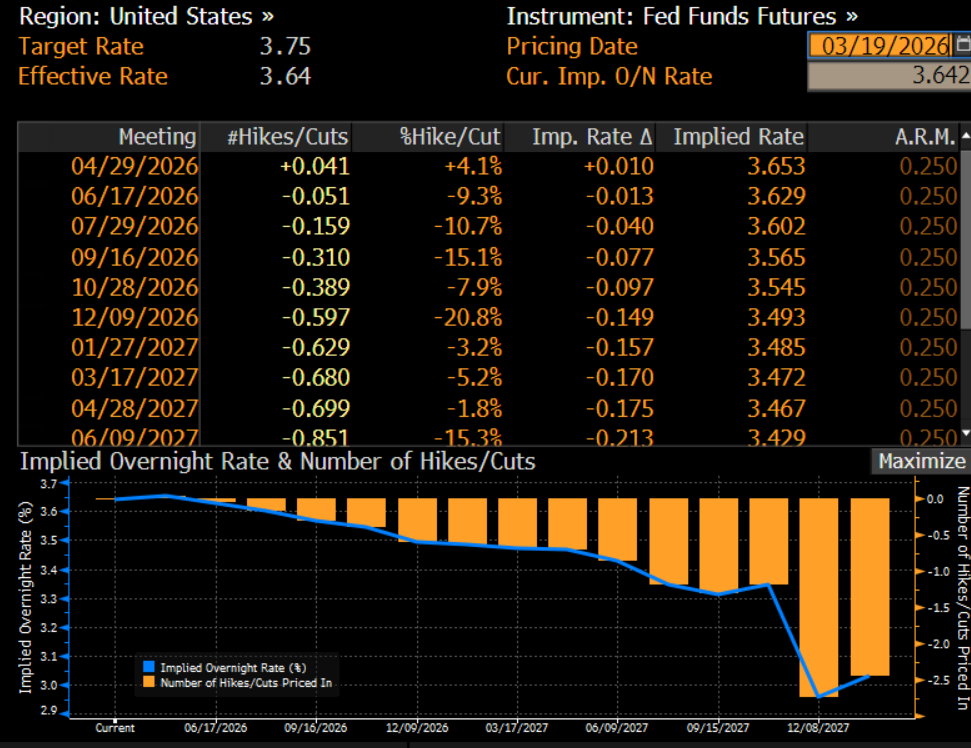
This Fed meeting is seen as being more hawkish than expected, and more hawkish compared to its previous meeting, which exacerbated the sell off in risky assets. The Fed Funds Futures market has reduced the chances of a rate cut for this year. Ahead of the meeting there was just under one cut expected, this has dropped to 0.5% chance of a cut this year. The market now expects US interest rates to end the year at 3.48%. Earlier today the year-end rate was expected to be 3.43% The aftermath of the Fed meeting, combined with another spike in the oil price, has led to a tightening of rate cut expectations in the US.
This exacerbated the stock market sell off, the S&P 500 and the Nasdaq both fell more than 1% today, and the stage is set for a deeper selloff on Thursday across global equities.
Will ECB and BOE follow the Fed?
If the US is the central banker to the world, then this sets the tone for more hawkish than expected outcomes from the BOE and ECB who set policy on Thursday. We believe it would be a policy mistake for the BOE to pivot towards a hawkish stance on the back of this energy price spike due to the underlying weakness in the UK economy. However, today’s Fed meeting highlights the narrow path that central bankers need to tread in the current environment. What tonight’s Fed meeting tells us is that the war in the Middle East is central to all economic and monetary decisions right now, it is also making policy decisions harder, and unless it ends soon, there is the possibility of tighter interest rates around the world.
Author

Kathleen Brooks
XTB UK
Kathleen has nearly 15 years’ experience working with some of the leading retail trading and investment companies in the City of London.














