Everyone who bought Gold near $4,000 is holding their breath right now

Gold (XAU/USD) is hovering near the psychological $4,000 level after suffering a correction of more than 25% from its January record near $5,600. For investors who entered the market around $4,000, the situation is becoming increasingly uncomfortable. What once appeared to be an attractive buying opportunity now looks like a critical test of confidence, with the precious metal struggling to establish a convincing recovery.
The stakes extend well beyond a round number. Gold has lost much of its earlier bullish momentum, while expectations of additional interest rate increases by the United States (US) Federal Reserve (Fed) continue to challenge its appeal.
Yet beneath the recent weakness, an unusual divergence is emerging. Speculative investors are selling Gold aggressively, while central banks and longer-term investors continue to accumulate the metal. The question is whether these structural buyers can absorb the selling pressure before another wave of liquidation pushes prices decisively below $4,000.
Why is Gold falling when investors need a safe haven?
Gold's recent decline is particularly striking because several developments that would normally support the precious metal are failing to attract buyers. Geopolitical tensions in the Middle East remain elevated, global equity markets have experienced renewed volatility, and US Treasury yields have retreated from their recent highs. Nevertheless, Gold has struggled to benefit from these traditionally supportive conditions.
The explanation lies partly in the relationship between energy prices, inflation and monetary policy. Higher Oil prices, driven by tensions in the Persian Gulf, are raising concerns that inflation could remain elevated for longer than previously anticipated. This increases the risk that the Fed will maintain restrictive monetary conditions or deliver additional interest rate increases. For Gold, which generates no interest income, higher borrowing costs make competing assets such as government bonds more attractive.
The situation also reflects broader portfolio adjustments. When investors face losses in equity markets, particularly technology stocks, they may sell profitable or liquid positions in other assets to raise cash and reduce their overall exposure. Gold can, therefore, decline during periods of market stress, even when geopolitical uncertainty would normally encourage safe-haven demand.
Hedge funds are selling, but central banks are buying
The most important development in the Gold market may be the growing divergence between short-term speculative positioning and longer-term investment demand. According to TD Securities, systematic investment funds have already turned decisively bearish: "The long-term [G]old bull thesis faces a test near the $4,000/oz level, with CTAs now short across all signals." Commodity Trading Advisors (CTAs), which frequently use trend-following strategies, have increased their bearish exposure as Gold's momentum deteriorates.
TD Securities also reports early liquidations in Gold-backed Exchange-Traded Funds (ETFs) in October, particularly in China, adding to the immediate selling pressure. However, this weakness contrasts with the broader investment picture. According to the World Gold Council (WGC), global physically-backed Gold ETFs attracted $10 billion in September, bringing third-quarter inflows to a record $31 billion. Total holdings increased by 67 tonnes during September, reaching a record 4,256 tonnes despite falling prices.
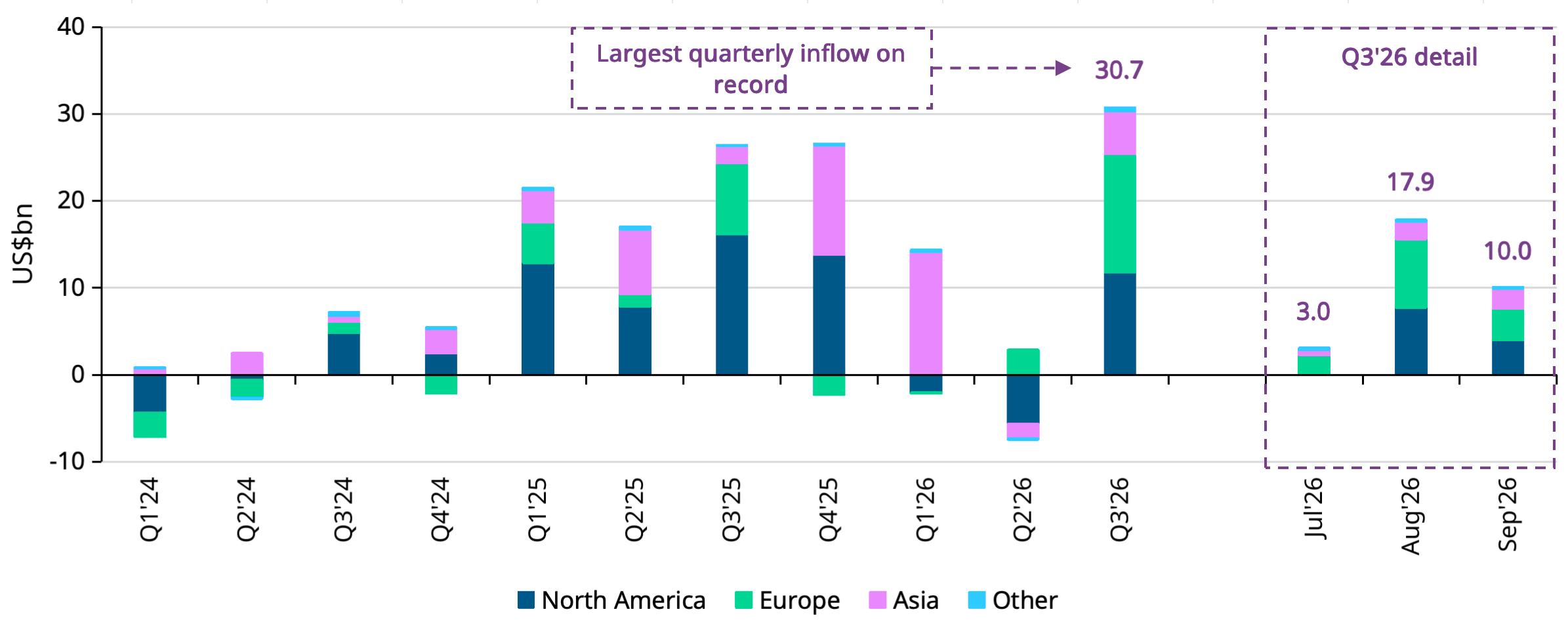
This divergence suggests that longer-term investors are continuing to accumulate Gold even as speculative traders reduce their exposure.
Central banks provide another important source of demand. Goldman Sachs estimates that official institutions purchased approximately 79 tonnes of Gold in August, compared with a monthly average of just 17 tonnes before 2022. China remains among the most important buyers, reflecting a broader effort by emerging-market central banks to diversify their reserves and reduce dependence on traditional reserve currencies.
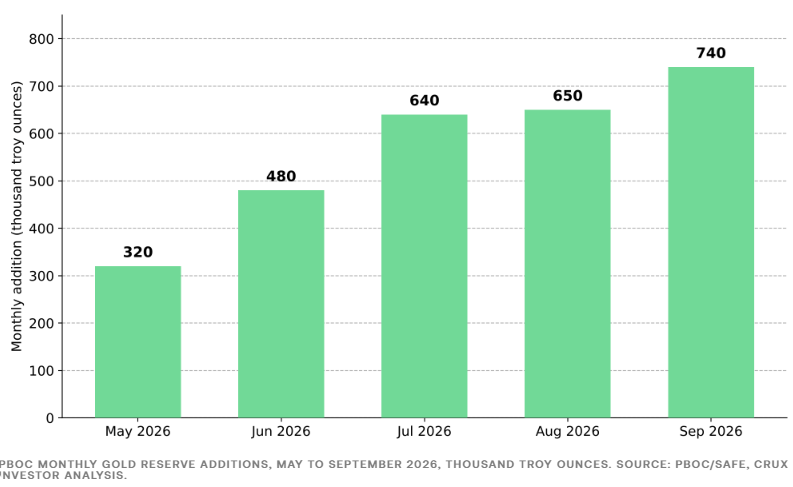
The distinction matters because these institutions generally operate with much longer investment horizons than hedge funds. Their purchases may help absorb selling pressure, but they cannot guarantee that Gold will remain above $4,000 if speculative liquidations accelerate.
The Federal Reserve could decide Gold's next move
Attention now turns to the Fed's monetary policy announcement on Wednesday, followed by key US economic data on Thursday. Markets widely expect the central bank to leave interest rates unchanged at its October meeting. However, investors remain concerned that persistent inflation could force policymakers to tighten monetary conditions again before the end of the year.
The September Personal Consumption Expenditures (PCE) Price Index, the Fed's preferred inflation gauge, will be particularly important. A stronger-than-expected inflation reading could reinforce expectations of another interest rate increase in December, supporting the US Dollar (USD) and putting additional pressure on Gold. Conversely, softer inflation or a less restrictive message from Fed Chair Kevin Warsh could ease pressure on the precious metal.
Commerzbank nevertheless warns that lower interest rate expectations do not necessarily guarantee a recovery: "The downward revision to rate expectations means that the bar for a dovish surprise at the Fed meeting has risen, while the bar for a hawkish surprise has fallen."
This creates an uncomfortable environment for investors positioned for an immediate rebound. Even if the Fed leaves interest rates unchanged, Gold may struggle to recover unless policymakers provide convincing evidence that further monetary tightening is becoming less likely.
The $4,000 level is becoming a battle for confidence
Beyond the macroeconomic uncertainty, the Gold market is approaching an important price area. The daily chart shows that the precious metal is testing a broad support zone between approximately $3,940 and $4,100, an area that has repeatedly attracted buying interest in recent months.
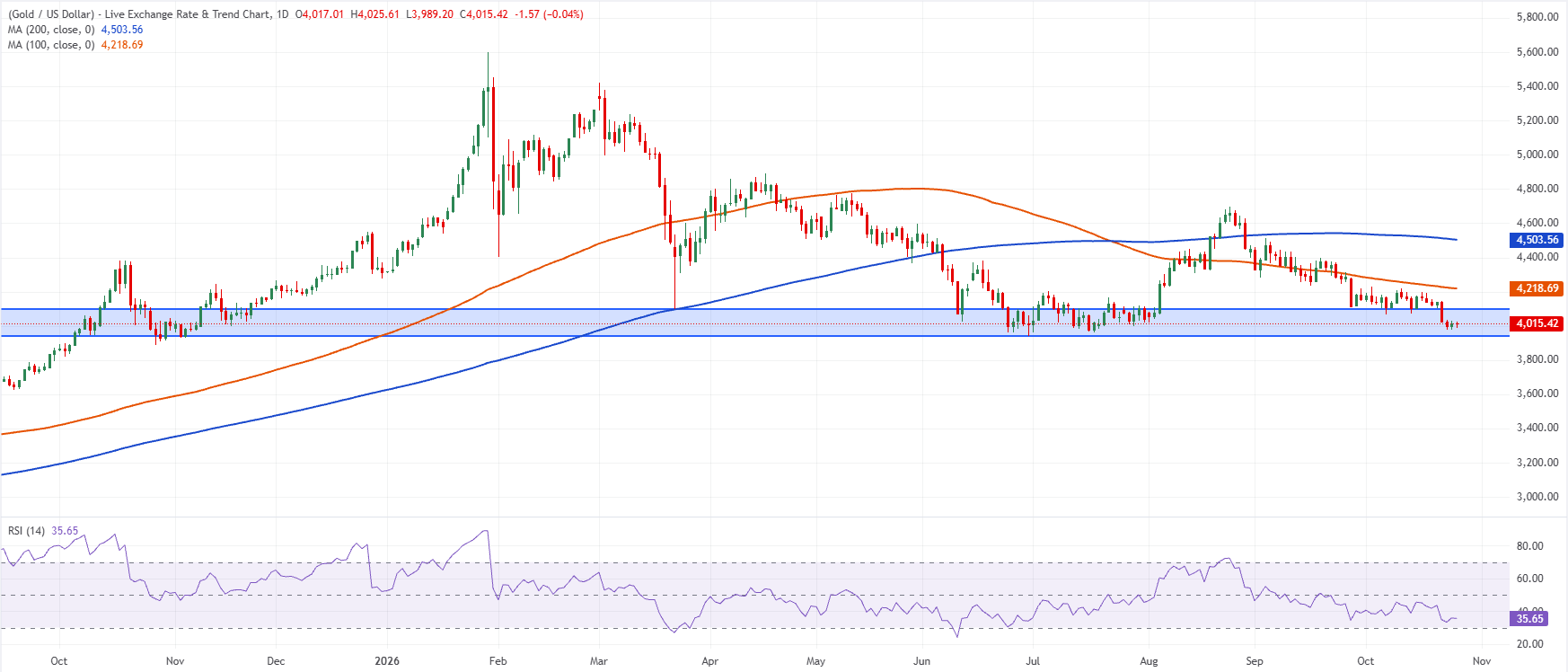
Gold is currently trading near the lower part of this range, while the 100-day and 200-day Simple Moving Averages (SMAs), located around $4,219 and $4,504 respectively, remain above the market price. This configuration highlights the deterioration in medium-term momentum.
A sustained move below $3,940 could expose Gold to another downward adjustment. On the other hand, a recovery above $4,100 could help ease immediate selling pressure.
TD Securities estimates that systematic funds could begin covering their bearish positions once Gold rises above $4,092, potentially creating an additional source of buying demand.
However, the absence of a convincing recovery suggests that investors remain reluctant to increase their exposure ahead of the Fed's decision.
Is the Gold bull market really over?
Despite the recent correction, several major financial institutions remain constructive on Gold's longer-term prospects. Goldman Sachs maintains a price target of $5,400 per ounce by the end of 2027, supported by expectations of sustained central bank purchases. TD Securities also maintains a positive outlook extending into 2027, arguing that official demand and longer-term investment allocations remain supportive despite near-term weakness.
However, these projections depend on monetary conditions and investment flows evolving favorably. A prolonged period of elevated real interest rates could continue to discourage investment in non-yielding assets, while persistent inflation could delay any meaningful recovery.
For investors who bought Gold near $4,000, the coming days could prove decisive. The metal is no longer benefiting automatically from geopolitical uncertainty or declining Treasury yields, and speculative selling remains a significant obstacle. Nevertheless, central bank purchases and resilient ETF demand suggest that the longer-term investment case has not disappeared.
Gold is now caught between two opposing forces: short-term investors reacting to higher interest rates and deteriorating momentum, and strategic buyers treating lower prices as an opportunity to accumulate.
Whether $4,000 becomes the foundation for the next recovery or the starting point of another decline may depend less on the next geopolitical headline than on what the Fed signals about the future of US monetary policy.
Author

Ghiles Guezout
FXStreet
Ghiles Guezout is a Market Analyst with a strong background in stock market investments, trading, and cryptocurrencies. He combines fundamental and technical analysis skills to identify market opportunities.