EUR/USD Weekly Forecast: US rate hike back on the table, US Dollar up
- The Middle East crisis and renewed tariff threats undermined the US Dollar’s safe-haven condition
- Hopes that the US Federal Reserve will hike rates in September rose after Warsh's words at Jackson Hole.
- The EUR/USD pair retreated from recent highs and could resume its mid-term slide.

The EUR/USD pair pulled back in the last full week of August, settling a handful of pips below the 1.1600 mark. The US Dollar (USD) was able to post a comeback after suffering steady losses throughout the month, exacerbated by the United States (US) Department of the Treasury announcement of increased long-bond buybacks on August 19. The recovery that followed the sell-off seems corrective as the pair holds far above the monthly low at 1.1350, yet closer to the peak at 1.1710.
The Middle East war was the main factor behind USD strength between March and July as the conflict pushed energy prices much higher, bringing mounting inflationary pressure back to the fore and, in turn, potentially tighter monetary policies around the globe.
Federal Reserve (Fed) Chair Kevin Warsh debuted as the Fed’s head, pledging to tame inflation. So far, his words have outpaced his actions. Despite inflation almost doubling the Fed’s goal, Warsh and co. kept interest rates on hold. It’s not actually a surprise if we consider that US President Donald Trump spent most of his latest mandate demanding lower interest rates from former Chair Jerome Powell.
Sentiment shift amid uncertainty
The Middle East war continues, but the USD lost its crown as preferred safe-haven as investors dropped bets of higher interest rates in the US. At this point, it is unlikely the Fed will hike rates in September. What’s so terrible about the Fed holding rates? It’s not about the Fed holding rates steady but about almost all major economies having already pulled the trigger more than once. Most major central banks have already delivered rate hikes, and more than one, since the year started. The Fed’s hesitation is not related to macroeconomic data but to a potential clash with President Trump.
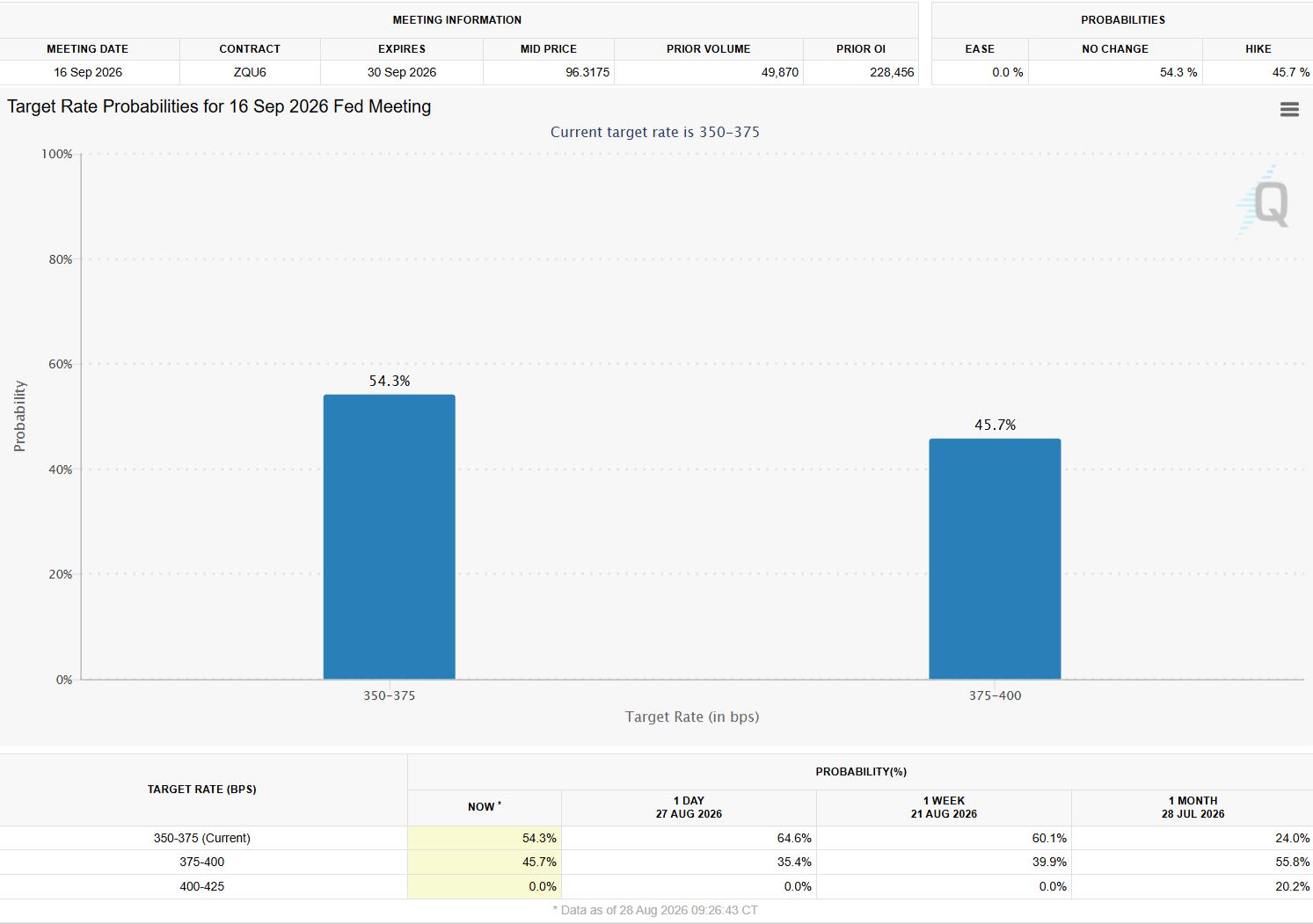
Fed Chair Kevin Warsh spoke at the Jackson Hole Symposium on Friday and said that they must be confident that underlying inflation is moving toward the objective, adding that they have work to do otherwise. The US Dollar found some near-term demand with his hawkish words as the odds for an interest rate hike in September increased from roughly 35% on Thursday to 45.7%, according to the CME FedWatch Tool.
Beyond the continued tensions that keep Oil prices elevated, market participants now have another source of concern. US President Donald Trump abruptly ended trade talks with Canada and imposed fresh levies on the country of around $20 billion. However, Canadian Prime Minister Mark Carney quickly responded by enacting retaliatory tariffs of the same amount.
Hawkish hopes may boost USD demand, but uncertainty is putting a cap on it.
No bad news is good news
US data released throughout the week came in line with expectations, easing pressure on the Greenback. The market saw as good news the fact that the news was not as bad as feared. The US published the first revision of the Q2 Gross Domestic Product (GDP), which confirmed annualized growth at 1.5% in the three months to June, as previously estimated.
The Fed’s favorite inflation gauge, the Personal Consumption Expenditures (PCE) Price Index, remained unchanged at 3.7% YoY in July, although slightly above the expected 3.6%. The core PCE Price Index for the same period held steady at 3.3%, as anticipated. Finally on Friday, the country published the Nonfarm Payrolls annual revision of the twelve months to March 2026. The number of new jobs was revised downward by 79,000, or 0.1%.
The European macroeconomic calendar offered nothing relevant but will become more interesting in the coming days. Germany will publish the preliminary estimates of the August Harmonized Index of Consumer Prices (HICP) on Monday, while the EU will release the HICP on Tuesday. Annualized inflation, as measured by the HICP, is foreseen at 3.2% following the 2.9% posted in July, while the core annual HICP is expected to remain unchanged at 2.5%. Other than that, the EU will publish July Retail Sales while Germany will unveil July Factory Orders on Friday.
The US macroeconomic calendar will also be interesting. The country will publish the August ISM Services and Manufacturing Purchasing Managers Index (PMIs) and multiple employment figures, closing on Friday with the August Nonfarm Payrolls report that is expected to show the economy added 45,000 new job positions in the month after losing 23,000 in July.

EUR/USD Technical Outlook:
The daily chart shows EUR/USD is losing its positive tone, as the pair is struggling to hold the 1.1600 mark and is barely above the 20- and 100-day Simple Moving Averages (SMAs) at 1.1591 and 1.1573, and remains capped by the 200-day SMA at 1.1633. The Momentum indicator eases within positive levels and nears its midline from above, while the Relative Strength Index (RSI) indicator heads south almost vertically and now sits near 54, hinting at buying interest giving up.
In the weekly chart, EUR/USD retains a modest bullish bias as it remains above the 20-week SMA at 1.1571, with the longer-term 100- and 200-week SMAs at 1.1330 and 1.1067 reinforcing an underlying supportive structure. The RSI indicator sits near a neutral 51, while the slightly negative Momentum hints that upside traction continues to vanish.
On the downside, immediate support is seen at the 20-day SMA near 1.1591, with the 100-day SMA at 1.1573 reinforcing a broader demand zone on pullbacks. On the topside, the 200-day SMA at 1.1633 is the next key resistance, followed by recent tops in the 1.1710 level. Only a clear advance beyond the latter would revive the bullish trend and open the door for an extension towards 1.1800.
(The technical analysis of this story was written with the help of an AI tool. Know more.)
Author

Valeria Bednarik
FXStreet
Valeria Bednarik was born and lives in Buenos Aires, Argentina. Her passion for math and numbers pushed her into studying economics in her younger years.