EUR/USD remains under pressure as French budget concerns persist

As of 13 October 2026, the fundamental backdrop for EUR/USD remains moderately negative for the euro, although the US dollar weakened slightly today amid lower oil prices and stabilising US bond yields.
The French budget crisis continues to weigh on the euro. Investors are concerned about France’s rising borrowing costs and political divisions over the budget. These risks increase the risk premium on European assets and hinder a sustained recovery in the euro.
Although eurozone inflation remains above the 2.0% target, ECB officials note that rising prices are largely driven by energy costs, with no sustained acceleration in core inflation yet evident. This reduces the likelihood of imminent policy tightening and limits support for the euro.
Overall, the fundamental backdrop for EUR/USD remains moderately negative for the euro. Today, lower US yields and a weaker US dollar are providing short-term support for the single currency. At the same time, France’s budget problems, the ECB’s cautious stance and the risk of renewed acceleration in US inflation are limiting the pair’s recovery prospects. The key event in the near term will be the release of US CPI data on 14 October.
Technical analysis
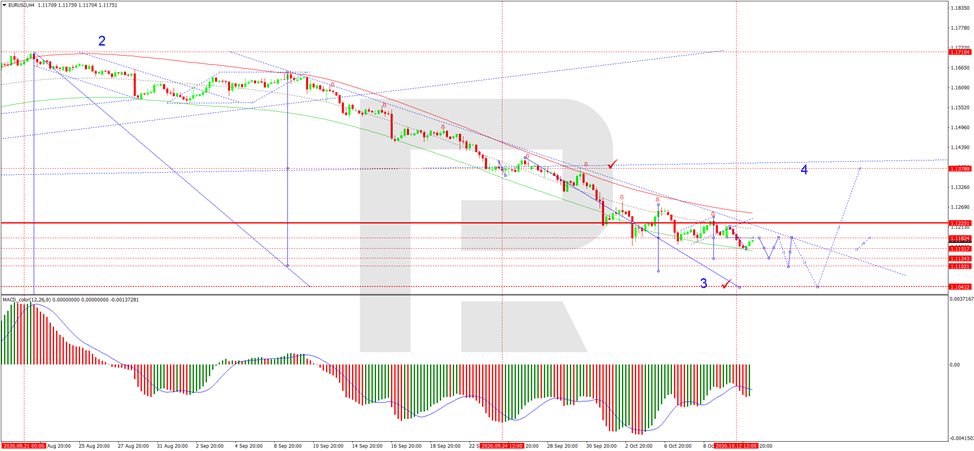
On the H4 chart, EUR/USD remains in a downtrend, characterised by a sequence of lower highs and lower lows. The pair completed another downward wave around support at 1.1152, followed by a corrective move higher towards resistance at 1.1182. A consolidation range is currently forming below this level. The main scenario remains a resumption of the downward move, initially targeting 1.1124. If selling pressure increases, the third downward wave is likely to extend towards support at 1.1102. The MACD indicator confirms this scenario, with the histogram in negative territory and the signal line continuing to point downwards. Additional pressure comes from the pair remaining below the dynamic resistance levels of the descending channel.
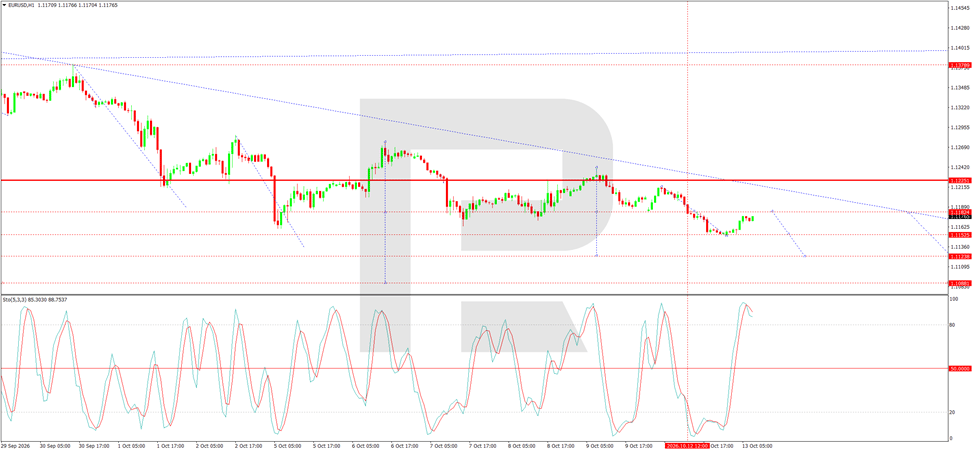
On the H1 chart, a local corrective structure is developing after the pair reached support at 1.1152. Buyers have attempted to push the price back towards resistance at 1.1182, but further gains are being capped by the upper boundary of the short-term range. During today’s trading session, the corrective wave may end around 1.1184, followed by a new downward move towards 1.1124. The Stochastic oscillator is in the overbought zone and is showing signs of turning downwards, increasing the likelihood of weakening buying momentum. A move below 1.1152 would confirm the main bearish scenario. Alternatively, a break above resistance at 1.1184 would open the way for a correction towards 1.1225. However, until this resistance is breached, sellers retain the advantage, with short-term upward moves viewed primarily as corrective within the current downtrend.
Conclusion
EUR/USD remains in a downtrend as the euro faces persistent headwinds from France’s budget crisis, the ECB’s cautious stance and the risk of renewed US inflation. While slight US dollar weakness and lower oil prices are providing temporary relief, the broader fundamental backdrop remains negative for the euro. Technically, the pair is consolidating below resistance at 1.1182, with the main scenario pointing to a resumption of the decline towards 1.1124 and potentially 1.1102. The overbought Stochastic suggests that the corrective rebound may be nearing its end. A break above 1.1184 would open the way for a correction towards 1.1225, but sellers retain the advantage until that level is breached. The upcoming US CPI release will be the key event for the pair’s next directional move.
Author

RoboForex Analysis Department
RoboForex
RoboForex Analysis Department provides timely market insights, expert technical analysis, and actionable forecasts across forex, commodities, indices, and equities.

















