|

EUR/USD outlook: Surges on much weaker than expected US NFP numbers

EUR/USD

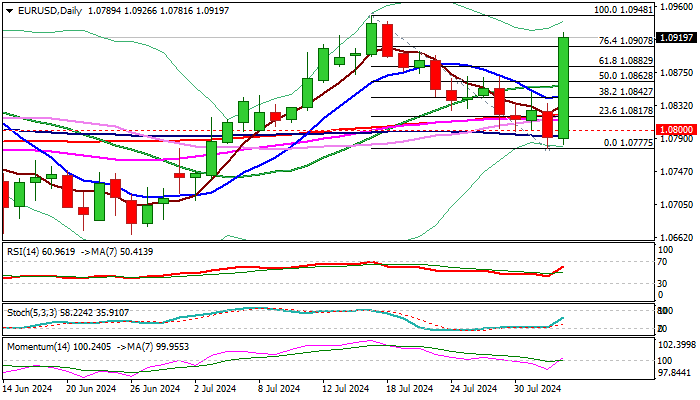
EURUSD bounced sharply on Friday, with fresh strength being boosted by downbeat US labor data.

The pair was up 1.2% for the day (the biggest one-day rally since March 2016) and about to fully retrace the bear-leg of past two weeks (1.0948/1.0777) in just one day.

Shocking labor data (NFP hit the lowest since Aug 2021) pushed the dollar lower across the board, as weak labor numbers add to expectations for stronger rate cuts than initially expected.

Strong rally significantly improved technical picture as daily MA’s turned to bullish configuration and 14-d momentum emerged into positive territory, opening prospects for further advance.

Bulls pressure pivotal resistance at 1.0948 (July 17 high) violation of which to expose targets at 1.0981/1.1000 (Mar 8 peak / psychological).

However, strong rally is likely to result in profit-taking which may stall advance under 1.0948 target and keep fresh bulls on hold for consolidation.

Near term bias turned bullish on improved fundamentals, suggesting that consolidation should be limited and downticks to be contained at 1.0870/60 zone, to keep bulls intact.

Res: 1.0926; 1.0948; 1.0981; 1.1000.

Sup: 1.0900; 1.0870; 1.0855; 1.0842.
Interested in EUR/USD technicals? Check out the key levels

    1. R3 1.111
    2. R2 1.1019
    3. R1 1.0966
  1. PP 1.0874
    1. S1 1.0821
    2. S2 1.0729
    3. S3 1.0676

Author

Slobodan Drvenica

Slobodan Drvenica

Windsor Brokers

Industry veteran with over 22 years’ experience, Slobodan Drvenica joined Windsor Brokers in 1995 when he was an active trader for more than 10 years, managing the trading desk and own account departments.


More from Slobodan Drvenica
Share:

Editor's Picks

AUD/USD hits nine-week lows below 0.7000 on RBA Bullock's remarks

AUD/USD reverses a brief uptick and turns lower to hit nine-week lows below 0.7000 in the European morning on Tuesday, as traders digest cautious remarks from Reserve Bank of Australia (RBA) Governor Michele Bullock during the press conference. Earlier on, the RBA raised the cash rate to 4.60%, as widely expected, leaving the door open to further rate hikes if needed.

USD/JPY consolidates near 157.50 as a bullish USD counters intervention risks

USD/JPY struggles to capitalize on the overnight bounce from a one-week low, consolidating around 157.50 in the Asian session on Tuesday. Trump's concerns about the Japanese Yen's weakness fueled speculation about another US-Japan joint intervention. This, along with the hawkish BoJ, underpins the JPY and caps the currency pair. Meanwhile, rising Fed rate-hike bets and oil-driven inflation fears continue to push US bond yields to multi-year highs, keeping the US Dollar pinned near a two-month high and supporting the pair.

Gold trims gains; back toward $4,150

Gold now surrenders some of its initial advance and retests the $4,150 zone per troy ounce on Tuesday. Meanwhile, the move higher in the yellow metal comes despite the firmer US Dollar and rising US Treasury yields across the board, while escalating geopolitical tensions appear to limit the downside potential.

Crypto Today: Bitcoin, Ethereum, XRP correct upward amid declining ETF inflows

The cryptocurrency market upholds a neutral-to-bullish bias on Tuesday, with Bitcoin edging closer to a breakout above $84,000. Altcoins mirror BTC’s outlook, with Ethereum holding above $2,700 and Ripple pushing past the reclaimed $1.50 level.

RBA recap: Rate hikes are on the table as demand stays too strong

The Reserve Bank of Australia unanimously tightened monetary policy, warning that inflation remained too high and that several upside risks had begun to materialise. Governor Michele Bullock said the Board would raise rates again if necessary.

Silver is more volatile than Gold ahead of PCE and NFP. This chart shows the positioning gap
The market’s attention is focused on American data this week, but there’s something only those with a trained eye may be looking at: Gold and Silver positioning gap. Financial markets are moving on fears, mostly related to persistently high energy prices driven by the Middle East war. Sure, the US Dollar (USD) is strong, but at what cost?