EUR/USD Forecast: trade war and Nonfarm Payrolls in the spotlight this week
- EUR/USD bears not willing to give up, sentiment could improve by the end of the quarter.
- USD strength prevails amid economic health, central banks' imbalances.

The EUR/USD pair was unable to extend its previous week's recovery and is set to close this one with modest losses around 1.1640. It was quite an intense week in terms of headlines related to the trade war, although price action around the pair had been relatively irrelevant in terms of trend. An upward move at the beginning of the week was quickly reverted on news that the US was planning to restrict Chinese investment in American businesses and prevent local companies from selling tech-sensitive technologies to the Asian country. Concerns that the effect will spill into other economies triggered a sell-off in worldwide equities, although the greenback struggled to appreciate as safe-haven, as investors doubt on what to do with the US currency in this environment. For sure, fears limited demand for the high-yielding EUR. Fears receded after Trump decided to revamp an existing law on restrictions rather than apply a harshest one, although National Economic Council Director Larry Kudlow clarified that the US did not soften its stance toward China on foreign investment.
Ahead of the weekly close, equities remain depressed and Treasury yields near their weekly lows, indicating that, despite the ongoing dollar's retracement, fear still rules financial boards. And the situation is far from over, as the latest headlines on Trump's protectionism policies indicate that the US President has asked his advisors to look for ways to withdraw the US from the WTO.
Market players have been steadily ignoring data, although is clear that, while EU economic growth has stabilized after peaking last December, US health overshadows that of its counterpart. Inflation, according to Fed's favorite inflation, has reached the so-long desired target, and even surpassed it, as the core PCE price index reached 2.0%, up from 1.8% and also above market's expectations at 1.9%. And while the Fed has decided to be tolerant with inflation hovering around the 2.0%, they will likely acknowledge this reading that backs the four hikes in the dot-plot, in their upcoming meeting.
The macroeconomic calendar will be quite busy for both economies next week, with final Markit June PMI for the EU and the US, and the official US figures on Monday, and Services and Composite figures coming out next Wednesday. No doubts, however, the star of the week will be the Nonfarm Payroll report, to which the market pays attention despite having lost the ability to shake the market unless divergences are huge between the actual result and market's forecast. For this June, the economy is expected to have added 190K new jobs, while the unemployment rate is seen steady at 3.8%. Wages growth is seen up 0.3% MoM and 2.7% YoY, matching April figures. An outcome in line with market's forecast will be enough to reaffirm Fed's tightening path, and dollar supportive, regardless to where sentiment winds blow at the moment.
EUR/USD technical outlook
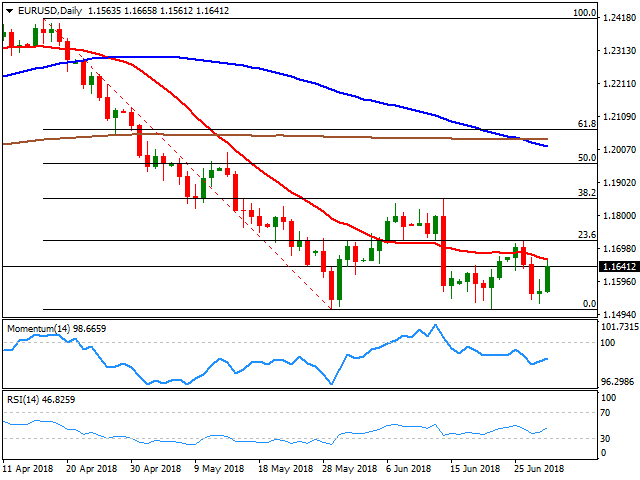
The weekly chart for the EUR/USD pair shows that it peaked at around the 23.6% retracement of its April/May slump at around 1.1720 before pulling back but held above the 1.1500 region, where it has bottomed in May and June. The dollar is easing, despite risk sentiment and solid inflation figures, on profit-taking ahead of the monthly and quarterly close, but technical readings in the mentioned chart keep favoring a bearish continuation, as the pair remains below a strongly bearish 20 SMA, while technical indicators present neutral-to-bearish slopes well below their midlines.
In the daily chart, the pair seems to have entered a consolidative stage after plummeting post-central banks' announcements, but the bearish trend remains firm, as the pair repeatedly met selling interest on attempts to advance beyond a mild-bearish 20 DMA. In the same chart, the 100 DMA is crossing below the 200 DMA but in the 1.20 region, supporting the ongoing trend but little relevant at the time being. Technical indicators have recovered partially within negative levels, but remain well below their weekly highs and dip into the red, suggesting that the ongoing recovery is just corrective.
The mentioned 1.1500 region is the key support, with a break below it exposing the 1.1440/60 region. Further declines below the 1.1400 figure could see the pair plummeting to 1.1320 later in the week. A recovery beyond 1.1720 on the other hand, could see the recovery extending up to the 1.1850 region, where the pair topped in May and the 38.2% retracement of the mentioned slump.
EUR/USD sentiment poll
The FXStreet Forecast Poll shows that the USD is poised to extend its gains against most of its major rivals, with commodity-linked currency being the only unclear exception, as the USD/CAD is neutral while the AUD/USD is seen bullish but to a lower average target. In the specific case of the EUR/USD pair, sentiment flipped to bearish from bullish in the weekly and monthly views, although for the 3-month perspective, bulls remain steady at 46%, but with the average target down from 1.1751, to 1.1699, somehow indicating that bulls' conviction is not that firm.
In the Overview chart, the weekly and monthly moving averages have lost their downward strength, but fell short of confirming a sustainable recovery, while in the longer-term perspective, the bearish trend persist, with the highest accumulation of bears at around 1.1500, somehow suggesting that the market is not yet ready to give up on the greenback.

Author

Valeria Bednarik
FXStreet
Valeria Bednarik was born and lives in Buenos Aires, Argentina. Her passion for math and numbers pushed her into studying economics in her younger years.