Australian Dollar Price Forecast: Testing 0.7000 as traders await confirmation
- AUD/USD retains a constructive structure above its 200-day SMA near 0.6900.
- The pair needs a sustained break above 0.7000 to confirm further upside.
- Rising speculative shorts favour caution but could amplify a breakout via short-covering.

AUD/USD trading outlook
Directional bias: Neutral to bullish above 0.6900, but the pair remains vulnerable to rejection as it struggles to assert itself above 0.7000.
Best approach: Don’t chase the pair immediately below resistance. A confirmed acceptance above 0.7000 or a pullback holding above the 200-day SMA would give a better chance.
Bullish trigger: Break above 0.7000, ideally underpinned by a pickup in risk appetite, softer US yields or further hawkish repricing of RBA expectations.
Bearish trigger: Further failure at 0.7000 with further deterioration in risk sentiment or a fresh bout of USD strength.
Key invalidation level: A daily close below the 200-day SMA around 0.6900 negates the wider constructive setup. Such a step would provide for more downside in the short-term horizon.
Three scenarios for traders
Base case: Consolidation near 0.7000
Traders may hold the AUD/USD in the 0.7000 area and its 200-day SMA near 0.6900 until they see a strong enough catalyst.
Australia’s domestic fundamentals and the RBA’s cautious stance should limit aggressive selling, but persistent US Dollar demand and geopolitical uncertainty may prevent an immediate breakout.
Until either boundary gives way, spot should be treated primarily as a range market rather than a clean directional trade.
Bull case: Confirmed break above 0.7000
A sustained move above 0.7000 would indicate that buyers have absorbed the selling pressure around the psychological threshold.
Such a breakout would be more convincing if accompanied by:
- Strong Australian labour data
- Increased expectations of another RBA rate increase
- Softer US inflation or Fed expectations
- Lower US yields and a weaker Greenback
- An improvement in global risk sentiment
Under this scenario, the next important medium-term objective would be the 0.7200 region, followed by the 2026 ceiling near 0.7280.
The growing number of speculative AUD shorts could reinforce the move if a breakout forces bearish positions to unwind.
Bear case: 0.6900 rejection and breakdown
A move below 0.7000 would open the floodgates for renewed selling in the pair, especially if the Greenback gathers strength or global risk sentiment sours.
The key downside test would then be the 200-day SMA at 0.6900. A daily close below here would break the wider bullish structure and increase the chances of a deeper correction.
If so, a reversal back towards previous support could start to attract sellers.
Australian fundamentals remain supportive
Australia’s economy remains in comparatively good shape, supported by solid domestic demand, positive growth and a resilient labour market.
Preliminary July PMI figures reinforced that picture after the Manufacturing PMI rose to 51.7 from 51.5, and the Services PMI climbed to 53.0 from 50.5, leaving both sectors in expansionary territory.
The labour market has also remained healthy following the auspicious report in June: the Unemployment Rate held steady at 4.4%, while Employment Change crushed initial estimates, increasing by 76.3K following a revised uptick of 44K in the previous month.
The wider picture is not uniformly positive, however, as Australia recorded a A$3.018 billion trade deficit in May, reversing April’s A$1.383 billion surplus. In addition, the first-quarter GDP growth also slowed to 0.3% QoQ from 0.9%, while annual growth held at 2.5%.
These figures suggest that the economy remains resilient, but not strong enough by itself to drive a sustained AUD/USD breakout.
Sticky inflation keeps the RBA cautious
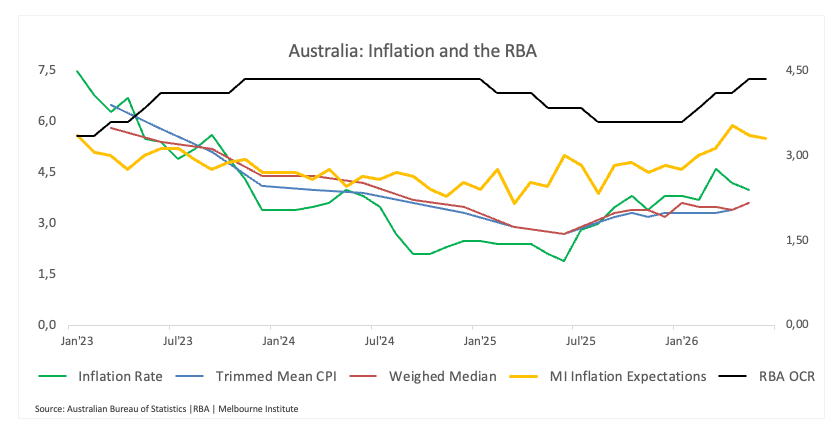
Australian headline inflation eased to 4.0% YoY in May from 4.2%. However, underlying measures remained uncomfortable: the Trimmed Mean and Weighted Median both rose to 3.6% from 3.4%.
Consumer inflation expectations provided some relief, falling to 4.7% in July from 5.5% according to the Melbourne Institute, although inflation remains too high for the RBA to declare victory.
Indeed, at its June meeting, the central bank left the Official Cash Rate (OCR) unchanged at 4.35%. Its message remained cautious, with policymakers warning that further tightening could still be required if inflation proves more persistent than expected.
Governor Michele Bullock adopted a more balanced position. She kept the possibility of another increase alive but indicated there was no immediate urgency to tighten again, given that economic conditions were broadly developing as expected.
Markets currently expect the RBA to leave rates unchanged at its August meeting while pricing around 25 basis points of additional tightening by year-end.
For AUD/USD, this outcome provides a supportive domestic backdrop, but not necessarily an immediate bullish catalyst. Further upside will probably require incoming data to strengthen the case for another increase.
China provides stability rather than acceleration
China remains a relevant but less powerful source of support for the Australian currency.
The economy expanded by 4.3% YoY during the second quarter, while Industrial Production rose by 5.3% in the year to June and Retail Sales increased by only 1.0%.
Business surveys suggest that activity is stabilising: the official (NBS) Manufacturing and Services PMIs remained just above 50, while private-sector gauges (RatingDog) continued to signal expansion.
Meanwhile, China’s trade surplus also widened to $125.62 billion in June from $105.4 billion, supported by stronger imports and exports.
Regarding monetary policy, the People’s Bank of China (PBoC) left its Loan Prime Rates (LPR) unchanged, with the one-year rate at 3.00% and the five-year rate at 3.50%.
Overall, China is neither providing a powerful tailwind nor creating a significant drag. For AUD traders, Chinese data are therefore more likely to generate short-term volatility than establish a lasting directional trend unless a clearer deterioration or acceleration emerges.
Fresh speculative shorts create a two-sided risk
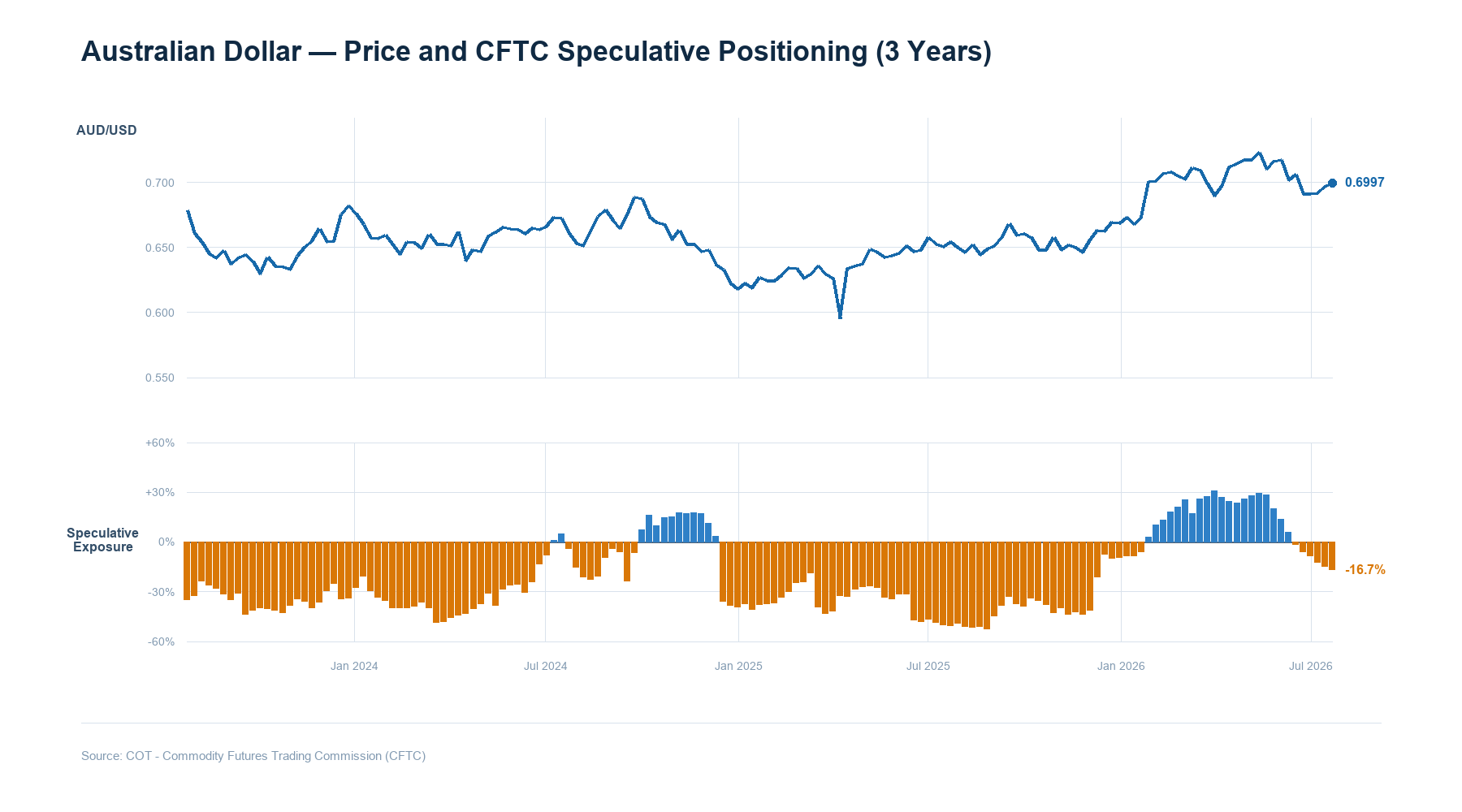
According to the latest Commodity Futures Trading Commission (CFTC) data, short speculative positions in the Australian dollar rose in the week to July 21.
Indeed, net Shorts rose to 37.7K contracts from 30.7K, and net positioning worsened by an additional 7.0K contracts. Furthermore, open interest climbed from 208.5K to 225.2K.
The rise in net shorts and the rise in open interest imply traders are adding to new bearish positions rather than just closing off past longs. In addition, speculative exposure decreased to -16.7% from -14.7%, another sign of increased negative sentiment.
However, the 4-week change in net positioning improved somewhat to -24.7K from -26.6K, showing that the bearish attitude is still deepening, albeit not as fiercely as previously.
Trading-wise, there are two consequences of positioning:
- Fresh short-building below 0.7000 increases the chance of further rejection.
- Above 0.7000, an identical setup may result in a short squeeze if a positive trigger has bearish traders covering.
Event-risk playbook
The June inflation data will be the primary domestic trigger for the week, affecting expectations for the RBA’s next policy move. On this:
Inflation hotter than forecast
A greater headline or core inflation print would add to fears that price pressures are sticky and boost anticipation for another RBA rate hike. A persistent move over 0.7000 might be supported, especially if the US Dollar remains under pressure.
Inflation as expected, mostly
A result in line with expectations would likely keep RBA prices mostly steady. AUD/USD could remain in a sideways trade between the 0.7000 resistance zone and the 200-day SMA around the 0.6900 region.
Weaker-than-expected inflation
A sharp fall in headline and underlying inflation would reduce the perceived need for further RBA tightening. This could expose AUD/USD to further selling and raise the possibility of a move towards 0.6900.
The underlying measures will be hugely important: market reaction to a weaker headline number and continuing Trimmed Mean or Weighted Median inflation may be limited to a dovish response.
Elsewhere, traders outside Australia should keep an eye on the US Dollar, US yields, Fed expectations, global risk sentiment, Chinese developments and geopolitical headlines.
Technical landscape
In the daily chart, AUD/USD trades at 0.6993, holding a capped tone as it sits above the 200-day simple moving average (SMA) at 0.6901 but remains below the 55-day and 100-day SMAs at 0.7038 and 0.7057 respectively. This configuration suggests the broader uptrend is still technically intact yet facing near-term headwinds, with the cluster of shorter-term averages overhead limiting upside attempts. The Relative Strength Index (14) around 52 hints at mildly positive momentum, while the Average Directional Index near 19 signals a relatively weak trend, favoring consolidation rather than a decisive breakout for now.
On the topside, initial resistance emerges at the 55-day SMA at 0.7038, followed closely by the 100-day SMA at 0.7057 and the horizontal barrier at 0.7079, forming a dense supply zone that bulls must clear to regain traction. Above that, further hurdles are seen at 0.7278 and 0.7283, with a more distant cap at 0.7661. On the downside, immediate protection is provided by the 200-day SMA at 0.6901, ahead of horizontal supports at 0.6833 and 0.6660; a break under these levels would expose deeper floors at 0.6593, 0.6414 and 0.6373, shifting the broader picture more decisively bearish.
(The technical analysis of this story was written with the help of an AI tool. Know more.)
Bottom line
AUD/USD retains a constructive medium-term structure above its 200-day SMA, but the immediate outlook remains less convincing while price struggles to establish itself above 0.7000.
The best setup is conditional rather than aggressively directional. Confirmed acceptance above 0.7000 would favour further gains and introduce the possibility of a positioning-driven short squeeze. Conversely, another rejection at that threshold would leave the pair vulnerable to a return to 0.6900.
Until one of these levels gives way, AUD/USD remains caught between supportive Australian fundamentals and an external backdrop dominated by the US Dollar, geopolitical risk and only moderate support from China.
Australian Dollar FAQs
One of the most significant factors for the Australian Dollar (AUD) is the level of interest rates set by the Reserve Bank of Australia (RBA). Because Australia is a resource-rich country another key driver is the price of its biggest export, Iron Ore. The health of the Chinese economy, its largest trading partner, is a factor, as well as inflation in Australia, its growth rate and Trade Balance. Market sentiment – whether investors are taking on more risky assets (risk-on) or seeking safe-havens (risk-off) – is also a factor, with risk-on positive for AUD.
The Reserve Bank of Australia (RBA) influences the Australian Dollar (AUD) by setting the level of interest rates that Australian banks can lend to each other. This influences the level of interest rates in the economy as a whole. The main goal of the RBA is to maintain a stable inflation rate of 2-3% by adjusting interest rates up or down. Relatively high interest rates compared to other major central banks support the AUD, and the opposite for relatively low. The RBA can also use quantitative easing and tightening to influence credit conditions, with the former AUD-negative and the latter AUD-positive.
China is Australia’s largest trading partner so the health of the Chinese economy is a major influence on the value of the Australian Dollar (AUD). When the Chinese economy is doing well it purchases more raw materials, goods and services from Australia, lifting demand for the AUD, and pushing up its value. The opposite is the case when the Chinese economy is not growing as fast as expected. Positive or negative surprises in Chinese growth data, therefore, often have a direct impact on the Australian Dollar and its pairs.
Iron Ore is Australia’s largest export, accounting for $118 billion a year according to data from 2021, with China as its primary destination. The price of Iron Ore, therefore, can be a driver of the Australian Dollar. Generally, if the price of Iron Ore rises, AUD also goes up, as aggregate demand for the currency increases. The opposite is the case if the price of Iron Ore falls. Higher Iron Ore prices also tend to result in a greater likelihood of a positive Trade Balance for Australia, which is also positive of the AUD.
The Trade Balance, which is the difference between what a country earns from its exports versus what it pays for its imports, is another factor that can influence the value of the Australian Dollar. If Australia produces highly sought after exports, then its currency will gain in value purely from the surplus demand created from foreign buyers seeking to purchase its exports versus what it spends to purchase imports. Therefore, a positive net Trade Balance strengthens the AUD, with the opposite effect if the Trade Balance is negative.
Author

Pablo Piovano
FXStreet
Born and bred in Argentina, Pablo has been carrying on with his passion for FX markets and trading since his first college years.

















