EUR/USD Forecast: Tough decisions coming for the ECB

EUR/USD Current Price: 1.0869
- The Euro Zone Harmonized Index of Consumer Prices rose more than anticipated in August.
- The United States PCE Price Index was up by 4.2% YoY in July as expected.
- EUR/USD trimmed half of its weekly gains, but buyers did not really give up.
The EUR/USD pair trades around 1.0870 following the release of critical inflation gauges for the Euro Zone and the United States (US) and comments from top policymakers.
Eurostat reported that the EU Harmonized Index of Consumer Prices (HICP) rose 5.3% YoY in August, higher than the 5.1% anticipated by financial markets. The core annual reading printed at 5.3%, as expected. Finally, the HICP increased by 0.6% on a monthly basis, much higher than the expected decline of 0.1%.
On the other hand, the US released the July Personal Consumption Expenditures (PCE) Price Index, the Federal Reserve's (Fed) favorite inflation measure. As expected, the core PCE Price Index was up by 0.2% MoM and 4.2% YoY, although higher than the 4.1% posted in June.
Meanwhile, Atlanta Federal Reserve Bank President Raphael Bostic stated that the US monetary policy is "appropriately restrictive" but added that if inflation unexpectedly climbs, he would support more tightening. Bostic then added that a rate cut is out of the picture for now.
Across the pond, European Central Bank (ECB) executive board member Isabel Schnabel noted policymakers can not predict where the peak rate will be or for how long they will have to maintain rates at restrictive levels. On the other hand, Austrian central bank chief Robert Holzmann said the ECB may need to raise interest rates further, noting one or two more rate hikes are still possible.
The Euro is between a rock and a hard place, as the latest figures suggest additional monetary tightening is needed, while the deterioration of economic growth has forced policymakers to consider a pause.
Beyond PCE figures, the US released Initial Jobless Claims for the week ended August 25, which were up by 228K, better than the 235K expected.
EUR/USD short-term technical outlook
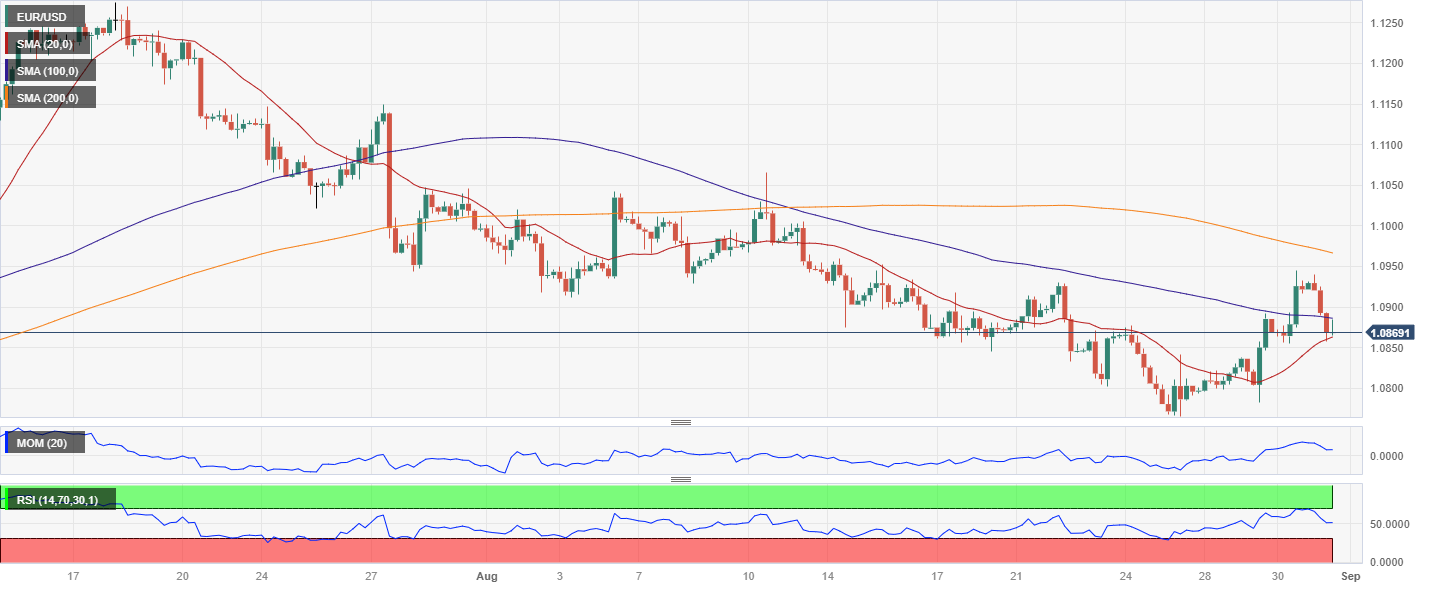
The EUR/USD pair bottomed at 1.0857 and bounced towards the current price zone ahead of the release of US data, which so far had a limited impact on price action. From a technical perspective, the daily chart shows that the pair trimmed Wednesday's gains and retreated sharply from a flat 100 Simple Moving Average (SMA). EUR/USD also trades below a bearish 20 SMA, while technical indicators rotated south below their midlines, limiting the bullish potential.
In the near term, and according to the 4-hour chart, however, it seems like bulls still have a chance. Technical indicators corrected overbought conditions and are currently consolidating within positive levels. Furthermore, the pair met buyers around a bullish 20 SMA, although it remains below bearish 100 and 200 SMA. The pair needs to quickly regain the 1.0890 level for bears to lose interest. On the other hand, a continued slide through 1.0840 should maintain the pair on the downward path.
Support levels: 1.0840 1.0795 1.0750
Resistance levels: 1.0890 1.0930 1.0980
Author

Valeria Bednarik
FXStreet
Valeria Bednarik was born and lives in Buenos Aires, Argentina. Her passion for math and numbers pushed her into studying economics in her younger years.

















