EUR/USD Forecast: Soft inflation data limit Euro's upside for now
- EUR/USD has failed to reclaim 1.0400 early Tuesday.
- The technical outlook suggests that the pair coming under bearish pressure.
- Soft inflation data from Germany seems to be hurting the Euro.


EUR/USD has lost its traction after having climbed toward 1.0400 earlier in the day and dropped into negative territory below 1.0350. The technical picture points to a buildup of bearish momentum but the pair's downside could remain limited in case risk flows start to dominate the financial markets in the American session.
Earlier in the day, the data from Germany showed that the annual Consumer Price Index (CPI) declined to 10% in November from 10.4% in October. Similarly, CPI in Spain declined by 0.5% on a monthly basis in November, bringing the annual rate down to 6.8% from 7.3%. Soft inflation readings from major European economies, which could allow the European Central Bank (ECB) to adopt a gradual approach toward policy tightening, seem to be making it difficult for the Euro to gather strength.
Meanwhile, US stock index futures erased earlier gains and turned flat on the day, helping the US Dollar find demand as a safe haven and stay resilient against its rivals.
The Conference Board will release the Consumer Confidence Index data for November and investors will keep a close eye on the performance of Wall Street's main indexes. In case US stocks turn south following the opening bell, EUR/USD could continue to stretch lower.
It's worth noting that China's National Health Commission announced earlier in the day that they will strengthen vaccination for the elderly. This decision is assessed as a sign that China could continue to move away from its zero-Covid policy. Hence, the market mood could improve later in the day and help EUR/USD edge higher.
EUR/USD Technical Analysis
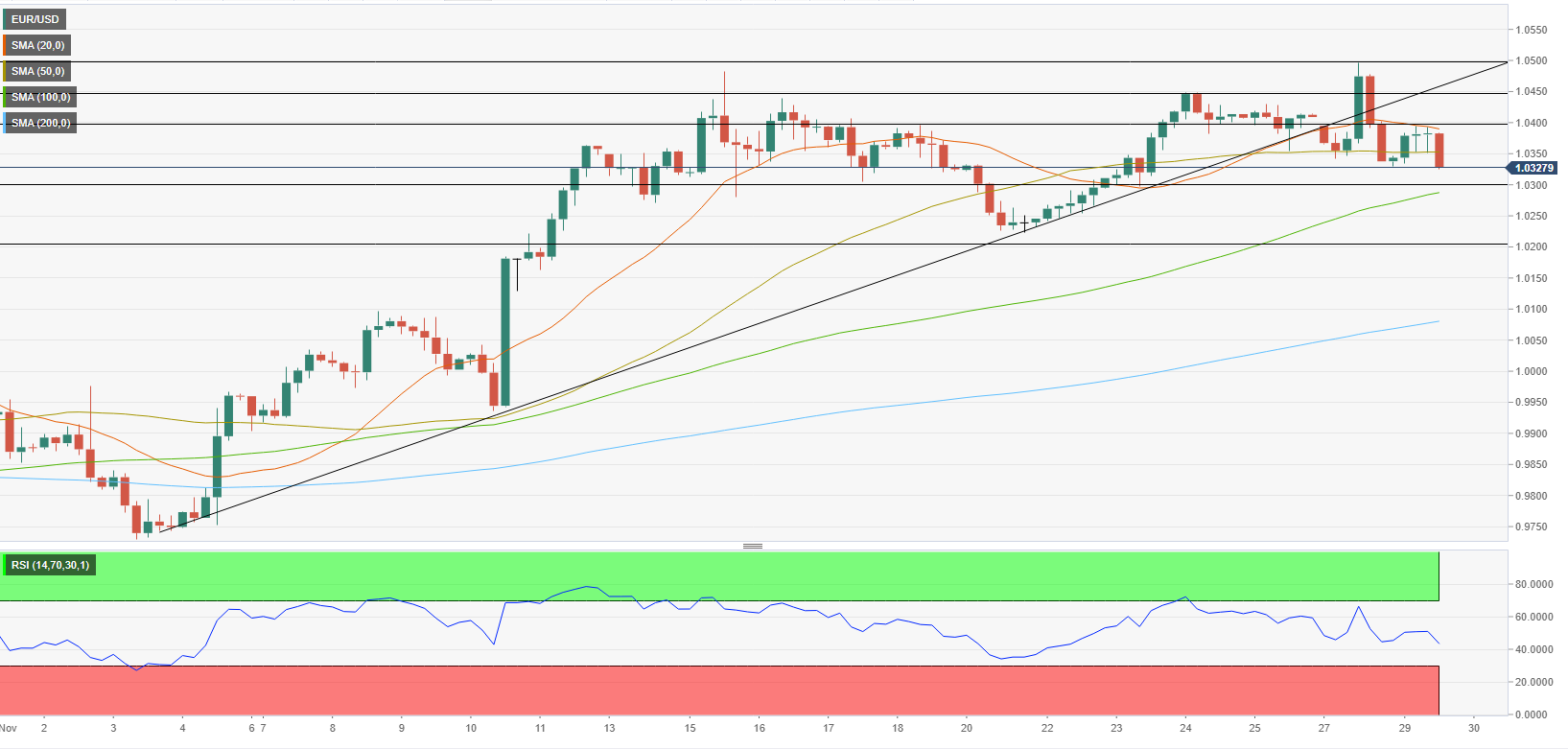
EUR/USD failed to rise above the 20-period Simple Moving Average (SMA) on the four-hour chart and continues to trade below the ascending trend line, suggesting that buyers are struggling to take control of the pair's action. Additionally, the Relative Strength Index (RSI) indicator dropped below 50, confirming the bearish tilt.
1.0300/1.0290 (static level, psychological level, 50-period SMA) aligns as key support area for the pair. In case EUR/USD falls below that area and starts using it as resistance, additional losses toward 1.0200 ould be witnessed.
On the upside, 1.0400 (20-period SMA, psychological level) forms first resistance before 1.0450 (static level) and 1.0500 (static level, psychological level).
Premium
You have reached your limit of 3 free articles for this month.
Start your subscription and get access to all our original articles.
Author
Eren Sengezer
FXStreet
As an economist at heart, Eren Sengezer specializes in the assessment of the short-term and long-term impacts of macroeconomic data, central bank policies and political developments on financial assets.