EUR/USD Forecast: Next support for Euro aligns at 1.0670
- EUR/USD consolidates above 1.0700 at the beginning of the week.
- The pair could stretch lower if 1.0670 support fails.
- Comments from central bank officials could impact EUR/USD's action on Monday.


EUR/USD struggled to find demand on Friday and touched its lowest level since early May below 1.0670. After staging a technical correction heading into the weekend, the pair seems to have stabilized slightly above 1.0700 in the European morning on Monday.
Euro PRICE Last 7 days
The table below shows the percentage change of Euro (EUR) against listed major currencies last 7 days. Euro was the weakest against the Swiss Franc.
| USD | EUR | GBP | JPY | CAD | AUD | NZD | CHF | |
|---|---|---|---|---|---|---|---|---|
| USD | 0.87% | 0.35% | 0.50% | -0.15% | -0.37% | -0.20% | -0.66% | |
| EUR | -0.87% | -0.17% | -0.10% | -0.75% | -0.95% | -0.81% | -1.26% | |
| GBP | -0.35% | 0.17% | 0.18% | -0.58% | -0.79% | -0.64% | -1.10% | |
| JPY | -0.50% | 0.10% | -0.18% | -0.64% | -0.94% | -0.81% | -1.11% | |
| CAD | 0.15% | 0.75% | 0.58% | 0.64% | -0.19% | -0.06% | -0.52% | |
| AUD | 0.37% | 0.95% | 0.79% | 0.94% | 0.19% | 0.15% | -0.31% | |
| NZD | 0.20% | 0.81% | 0.64% | 0.81% | 0.06% | -0.15% | -0.46% | |
| CHF | 0.66% | 1.26% | 1.10% | 1.11% | 0.52% | 0.31% | 0.46% |
The heat map shows percentage changes of major currencies against each other. The base currency is picked from the left column, while the quote currency is picked from the top row. For example, if you pick the Euro from the left column and move along the horizontal line to the US Dollar, the percentage change displayed in the box will represent EUR (base)/USD (quote).
The only data featured in the US economic calendar on Monday will be the Federal Reserve Bank of New York's Empire State Manufacturing Survey for June. Investors are likely to ignore this data and stay focused on comments from central bank officials.
Over the weekend, Minneapolis Fed President Neel Kashkari said that it would be reasonable to predict that the Fed will not lower the policy rate until December.
The CME FedWatch Tool currently shows that markets are pricing in a stronger-than-65% probability that the Fed will opt for a rate cut in September. In case policymakers push back against this expectation and voice support for a single rate reduction toward the end of the year, the USD could preserve its strength and weigh on EUR/USD. On the other hand, the market positioning suggests that the USD could come under pressure if Fed officials leave the door open to a policy pivot in September.
EUR/USD Technical Analysis
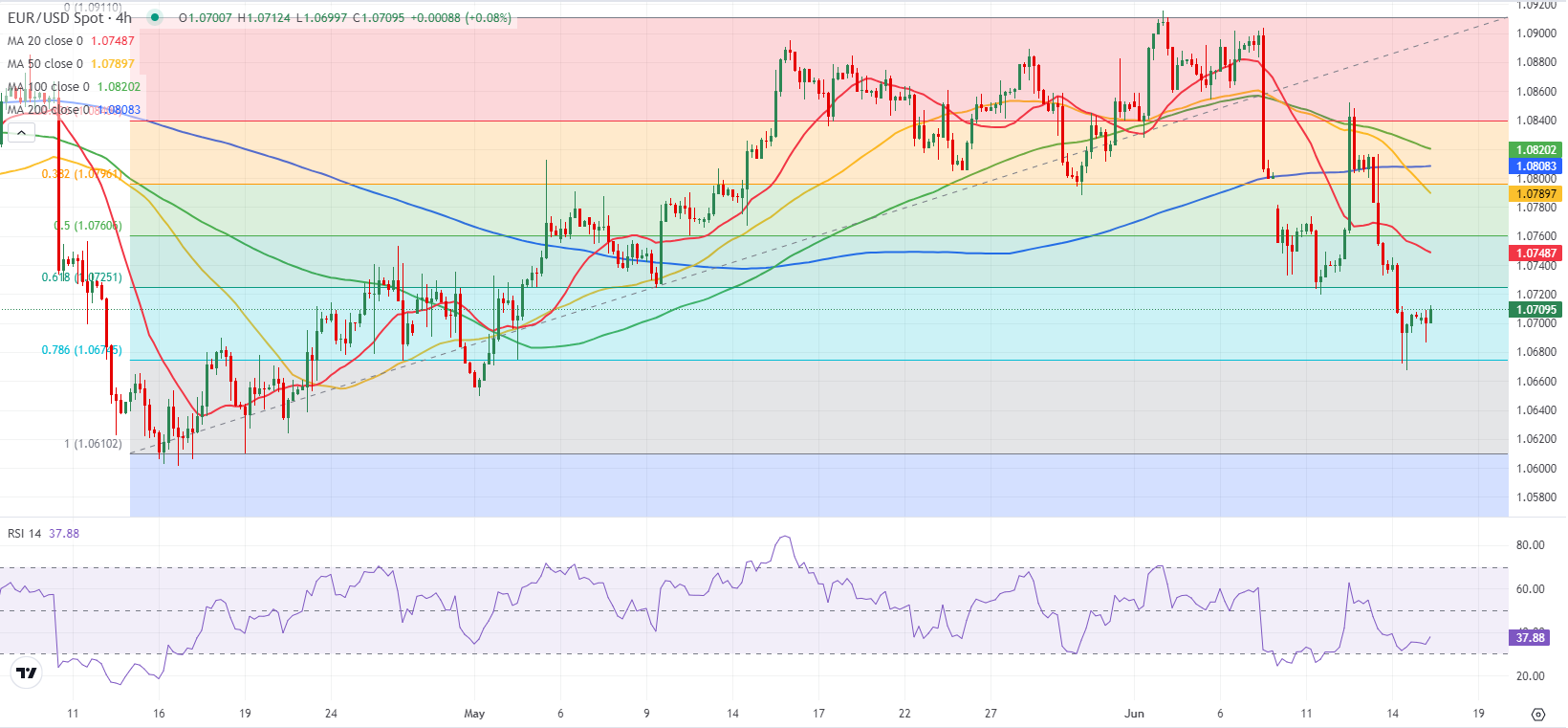
The Relative Strength Index (RSI) indicator on the 4-hour chart edges slightly higher but remains below 40, suggesting that the bearish bias is intact and EUR/USD's latest recovery was a technical correction.
The Fibonacci 78.6% retracement of the latest uptrend aligns as key support at 1.0670. If EUR/USD falls below that level, additional losses toward 1.0600 (beginning point of the uptrend) could be seen. On the upside, first resistance is located at 1.0730 (Fibonacci 61.8% retracement) before 1.0760 (Fibonacci 50% retracement) and 1.0800 (Fibonacci 38.2% retracement).
Fed FAQs
Monetary policy in the US is shaped by the Federal Reserve (Fed). The Fed has two mandates: to achieve price stability and foster full employment. Its primary tool to achieve these goals is by adjusting interest rates. When prices are rising too quickly and inflation is above the Fed’s 2% target, it raises interest rates, increasing borrowing costs throughout the economy. This results in a stronger US Dollar (USD) as it makes the US a more attractive place for international investors to park their money. When inflation falls below 2% or the Unemployment Rate is too high, the Fed may lower interest rates to encourage borrowing, which weighs on the Greenback.
The Federal Reserve (Fed) holds eight policy meetings a year, where the Federal Open Market Committee (FOMC) assesses economic conditions and makes monetary policy decisions. The FOMC is attended by twelve Fed officials – the seven members of the Board of Governors, the president of the Federal Reserve Bank of New York, and four of the remaining eleven regional Reserve Bank presidents, who serve one-year terms on a rotating basis.
In extreme situations, the Federal Reserve may resort to a policy named Quantitative Easing (QE). QE is the process by which the Fed substantially increases the flow of credit in a stuck financial system. It is a non-standard policy measure used during crises or when inflation is extremely low. It was the Fed’s weapon of choice during the Great Financial Crisis in 2008. It involves the Fed printing more Dollars and using them to buy high grade bonds from financial institutions. QE usually weakens the US Dollar.
Quantitative tightening (QT) is the reverse process of QE, whereby the Federal Reserve stops buying bonds from financial institutions and does not reinvest the principal from the bonds it holds maturing, to purchase new bonds. It is usually positive for the value of the US Dollar.
Premium
You have reached your limit of 3 free articles for this month.
Start your subscription and get access to all our original articles.
Author
Eren Sengezer
FXStreet
As an economist at heart, Eren Sengezer specializes in the assessment of the short-term and long-term impacts of macroeconomic data, central bank policies and political developments on financial assets.