EUR/USD Forecast: Nearing the base of the weekly range but far from bearish

EUR/USD Current Price: 1.0959
- Caution rules amid tepid data, uncertainty about the economic future.
- A batch of Federal Reserve speakers could trigger some noise in the American afternoon.
- EUR/USD could extend its decline in the near term, but buyers could take their chances at lower levels.
The EUR/USD pair keeps trading uneventfully at around 1.0950, as the lack of first-tier data and mounting speculation central banks could extend monetary tightening, undermine the market mood. At the same time, demand for the US Dollar remains subdued amid growing recession-related fears, following a batch of dismal United States macroeconomic figures and the banking crisis that fueled concerns mid-March.
Where are the ECB and the Fed standing?
Throughout the last few weeks, policymakers on both shores of the Atlantic fell short of surprising market participants. European Central Bank (ECB) officials maintained the hawkish bias, hinting at a 25 or 50 basis points (bps) rate hike in May. As for the US Federal Reserve (Fed), the usual hawks have claimed for more action, although according to the CME FedWatch tool, odds for a final 25 bps rate hike in May are roughly 83%. American policymakers shifted to dovish in their latest meeting amid a couple of local banks collapsing, partially due to the more restrictive monetary policy imposed by the Fed to control inflation.
All of the above leaves speculative interest without a clear directional catalyst. Furthermore, global inflation remains stubbornly high, but without clear signs from policymakers that they are willing to resume aggressive tightening, the focus shifts to growth and how central banks’ actions through 2022 affect it. Would that result in a new cycle of monetary easing? If so, when will it start? The ECB is far from making a U-turn, but the Fed anticipated it might occur next year.
Numbness will likely continue in the upcoming days as policymakers enter the blackout period ahead of the May meetings, which will take place in two weeks.
Ahead of Wall Street’s opening, global stock markets trade in the red, reflecting the cautious mood, while government bond yields lost traction, limiting the bullish potential of the US Dollar. Data-wise, Germany published the March Producer Price Index (PPI), which rose by 7.5% YoY, well below the previous 15.8% and less than the 9.8% anticipated. The Eurozone Trade Balance posted a seasonally adjusted deficit of €-0.1 billion, beating expectations but not enough to boost the Euro.
Finally, the ECB published the Accounts of its latest meeting, which showed that some members would have preferred that the key interest rates not be raised until financial market worries had abated. However, a large majority agreed to hike rates by 50 bps. The document also showed that policymakers believe that the monetary policy “still had some way to go to bring inflation down.”
Across the pond, the United States released Initial Jobless Claims for the week ended April 14, which rose by more than anticipated, hitting 245K vs the 240K forecast. Also, the April Philadelphia Fed Manufacturing Survey printed at -31.3, much worse than expected and below the previous -23.2.
Later today, the country will publish March Existing Home Sales, while Treasury Secretary Janet Yellen is due to speak about US-China Economic Ties in Washington. During the American afternoon, several Federal Reserve officials will hit the wires.
EUR/USD short-term technical outlook
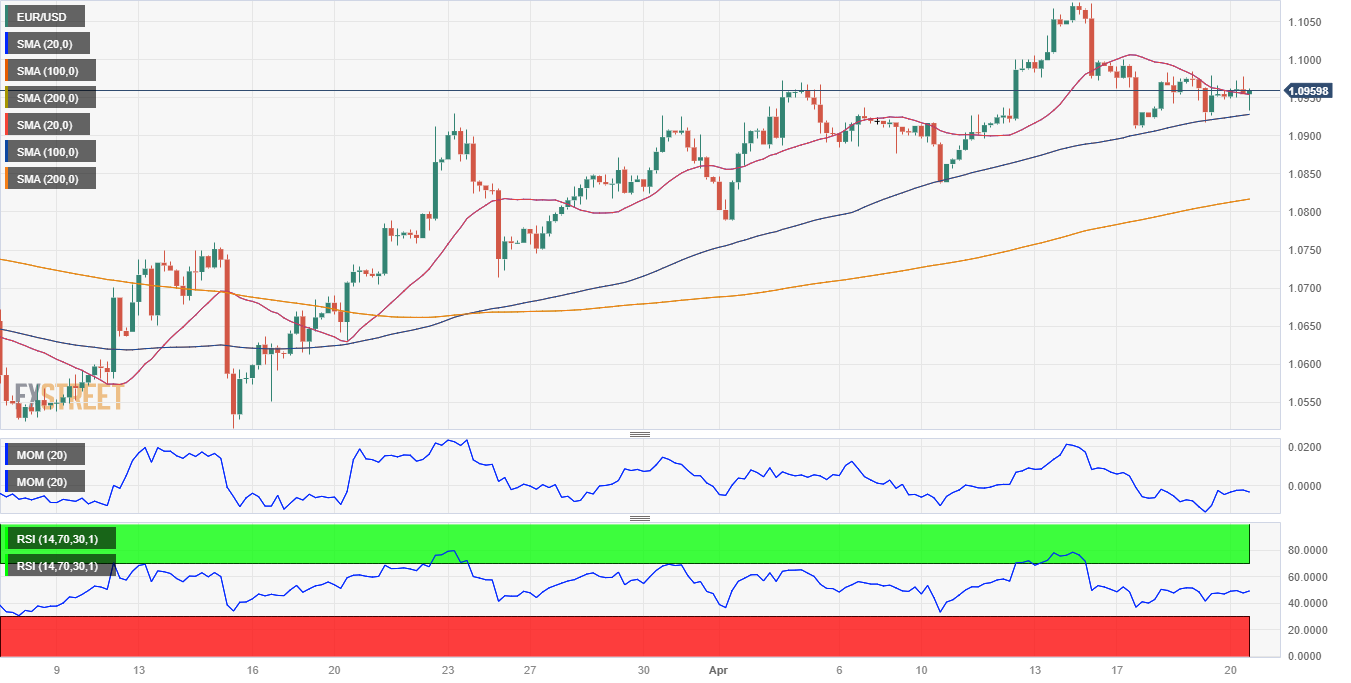
The EUR/USD pair has spent the week between 1.0908 and 1.0991, the range established on Monday. Despite the lack of follow-through, the risk of a substantial decline is out of the table. The pair is in a consolidative phase, awaiting a reason to storm through the 1.1000 psychological figure.
Technical readings in the daily chart maintain the risk skewed to the upside. EUR/USD finds intraday support around a mildly bullish 20 Simple Moving Average (SMA), which advances above also bullish 100 and 200 SMAs. At the same time, technical indicators remain within positive levels but with uneven directional strength. The Momentum indicator ticks north just above its midline, while the Relative Strength Index (RSI) indicator keeps retreating, now heading south at around 55.
The near-term picture suggests a test of the base of the range. EUR/USD seesaws around a mildly bearish 20 SMA, currently below it and not far above a mildly bullish 100 SMA. The 200 SMA, in the meantime, heads firmly higher, over 100 pips below the current level. Finally, technical indicators turned sharply lower, with the Momentum around its midline and the RSI already at 43. The decline could extend once below 1.0895, but buyers will likely take their chances at lower levels ahead of 1.0800.
Support levels: 1.0895 1.0850 1.0810
Resistance levels: 1.0970 1.1010 1.1060
Author

Valeria Bednarik
FXStreet
Valeria Bednarik was born and lives in Buenos Aires, Argentina. Her passion for math and numbers pushed her into studying economics in her younger years.

















