EUR/USD Forecast: Euro turns vulnerable despite hot inflation data
- EUR/USD has turned south after having registered modest gains on Monday.
- Hot inflation data failed to help the euro gather strength.
- A drop below 1.0700 could attract sellers and open the door for additional losses.

EUR/USD has reversed its direction after having posted its highest daily close in more than a month at 1.0780 on Monday. 1.0700 aligns as key support in the near term and sellers could show interest if the pair breaks below that level.
The renewed dollar strength amid rising US Treasury bond yields caused EUR/USD to edge lower during the Asian trading hours on Tuesday.
In the early European session, Eurostat reported that Harmonised Indices of Consumer Prices (HICP) data climbed to a new record high of 8.1% on a yearly basis in May from 7.4% in April. This print surpassed the market expectation of 7.7%. Additionally, the Core HICP rose to 3.8%, compared to analysts' estimate of 3.5%.
This report comes in after the European Union announced that they will be banning 90% of Russian oil imports by the end of the year on Monday. The shared currency struggles to attract demand as the current situation puts the European Central Bank (ECB) in a difficult spot with respect to figuring out the pace of policy tightening amid heightened uncertainty surrounding the economic outlook.
European Central Bank (ECB) Governing Council member Ignazio Visco said earlier in the day that they will have to hike rates gradually. "Monetary policy cannot counter the increase in commodity prices," Visco added.
In the second half of the day, the Conference Board's Consumer Confidence data for May will be watched closely by market participants. In case this publication points to inflation having a negative impact on consumer confidence and activity, safe-haven flows could dominate the markets and provide a boost to the dollar.
EUR/USD Technical Analysis
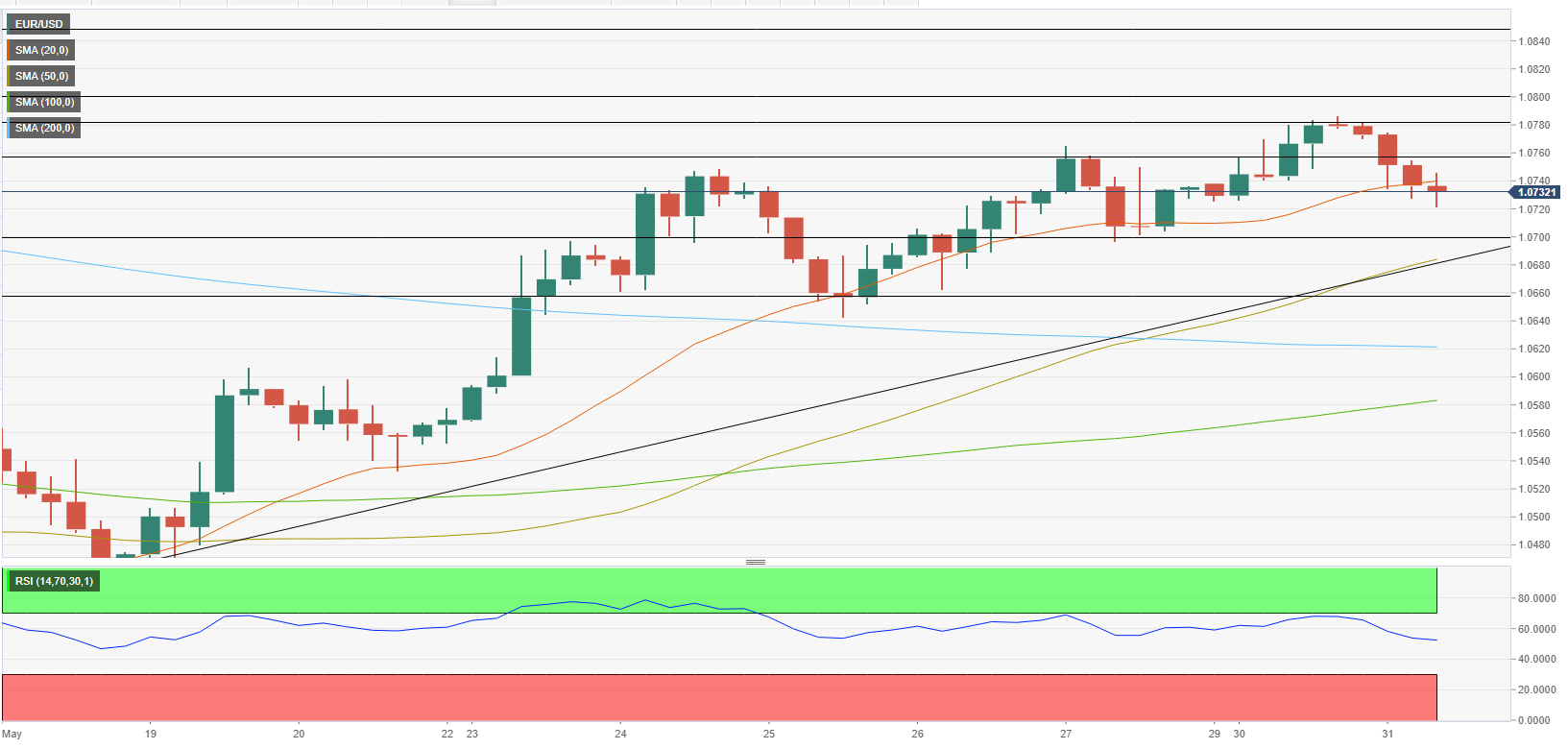
EUR/USD fell below the 20-period SMA on the four-hour chart and seems to be having a tough time reclaiming it. Meanwhile, the Relative Strength Index (RSI) indicator retreated toward 50, suggesting that buyers remain hesitant.
Nevertheless, EUR/USD continues to trade above the ascending trend line coming from mid-May, which is currently located at 1.0700. As long as this support stays intact, sellers could stay on the sidelines. If that level turns into resistance, however, additional losses toward 1.0680 (50-period SMA), 1.0660 (static level) and 1.0620 (200-period SMA) could be witnessed.
On the other hand, 1.0740 (20-period SMA) aligns as interim resistance before 1.0760 (static level), 1.0780 (static level) and 1.0800 (psychological level).
Author

Eren Sengezer
FXStreet
As an economist at heart, Eren Sengezer specializes in the assessment of the short-term and long-term impacts of macroeconomic data, central bank policies and political developments on financial assets.