EUR/USD Forecast: Euro remains vulnerable despite reclaiming parity
- EUR/USD has gone into a consolidation phase above parity.
- The probability of a 100 bps Fed rate hike in July declined to 50%.
- Retail Sales and long-term inflation expectations could significantly impact the dollar's valuation.

EUR/USD has managed to stage a rebound after having plunged to its weakest level in nearly 20 years at 0.9952 on Thursday and steadied above parity in the European session. The pair remains at the mercy of the dollar's valuation and it is likely to face renewed bearish pressure in case investors start betting on a 100 basis points rate hike in July after the US data.
On Thursday, Federal Reserve Governor Christopher Waller said that markets may have gotten ahead of themselves by pricing a 100 basis points (bps) rate hike in July after the inflation data. Although Waller further noted that he could lean toward a bigger-than-75 bps rate increase if retail sales and housing data come in stronger than expected, investors scaled back July rate hike bets.
According to the CME Group FedWatch Tool, markets are now pricing in around a 50% probability of a 100 bps rate hike at the next meeting, compared to nearly 90% during the European trading hours on Thursday.
Later in the session, the US Census Bureau will release June Retail Sales data, which is expected to increase by 0.8% on a monthly basis following the 0.3% decline recorded in May. Since Waller specifically mentioned this data on Thursday, a stronger-than-forecast print could trigger another dollar rally and weigh on the pair and vice versa.
The US economic docket will also feature the University of Michigan's (UOM) Consumer Sentiment Survey. The headline Confidence Index is expected to fall to a record low of 49.9 in July's flash estimate. Market participants will pay close attention to the 5-10 year ahead inflation expectations component. "Long-run expectations receded from its mid-month reading of 3.3% and settled at 3.1%, back within the 2.9-3.1% range seen in the past 10 months," the UOM said in June. Hence, a print above 3.1% could ramp up 100 bps rate hike odds in July and help the greenback end the week on a firm footing. On the other hand, a reading within the 10-month range could make it difficult for the dollar to find demand and help EUR/USD rebound ahead of the weekend.
EUR/USD Technical Analysis
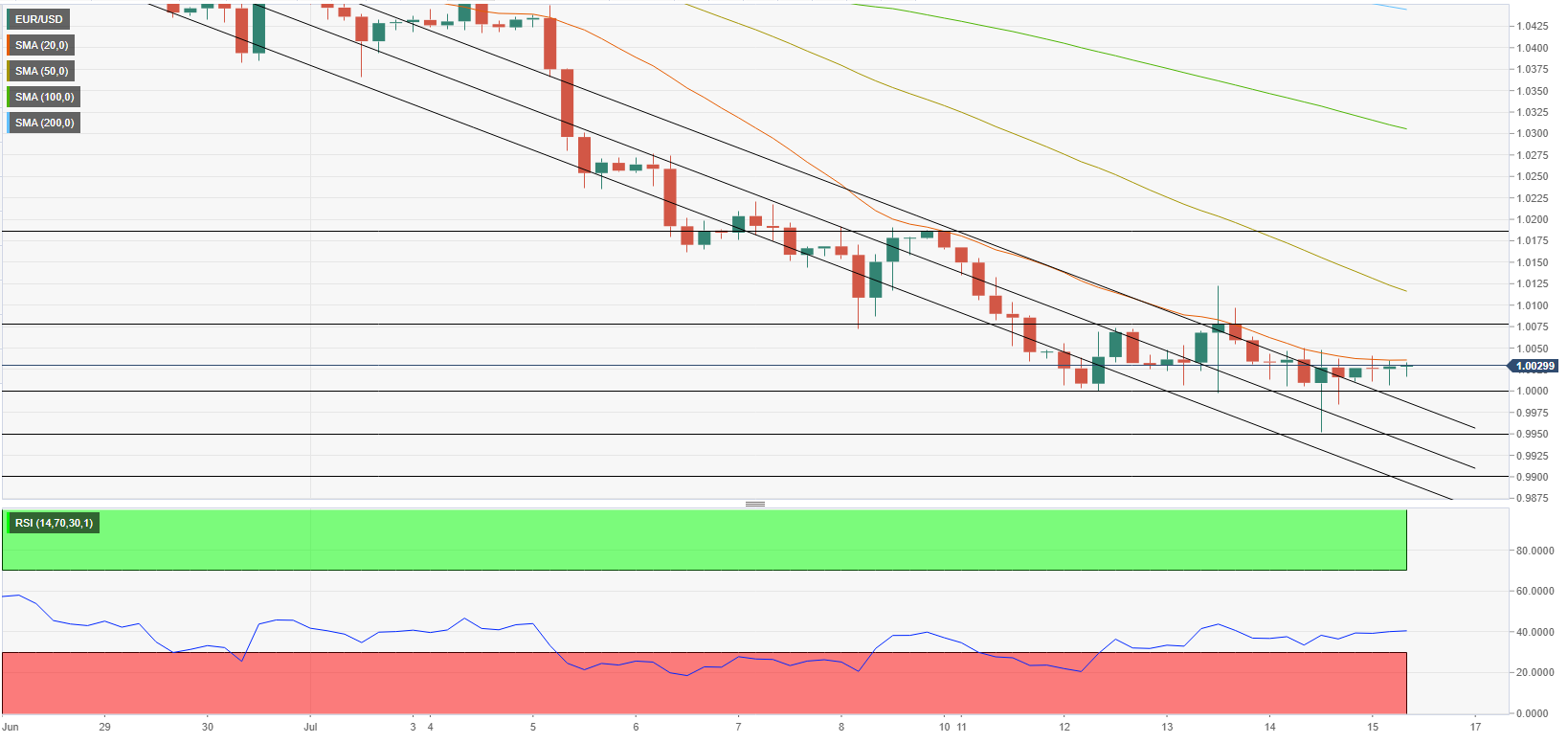
EUR/USD is moving sideways on the outside of the descending regression channel coming from late June. The Relative Strength Index (RSI) indicator on the four-hour chart, however, stays well below 50, suggesting that buyers remain on the sidelines.
On the upside, 1.0050 (20-period SMA) aligns as immediate resistance ahead of 1.0080 (static level), 1.0100 (psychological level) and 1.0120 (50-period SMA).
In case the pair returns within the descending channel below parity, it could target 0.9950 (static level, July 14 low) and 0.9900 (psychological level).
Author

Eren Sengezer
FXStreet
As an economist at heart, Eren Sengezer specializes in the assessment of the short-term and long-term impacts of macroeconomic data, central bank policies and political developments on financial assets.