EUR/USD Forecast: Euro remains stuck between key technical levels
- EUR/USD continues to fluctuate near 1.0950 for the second straight day.
- The pair remains stuck between the 100- and 200-period SMAs on the 4-hour chart.
- The economic calendar will not offer any high-impact data releases.

EUR/USD is having a difficult time finding direction for the second consecutive day on Tuesday and extending its consolidation near 1.0950.
Euro price this week
The table below shows the percentage change of Euro (EUR) against listed major currencies this week. Euro was the weakest against the Japanese Yen.
| USD | EUR | GBP | CAD | AUD | JPY | NZD | CHF | |
| USD | -0.15% | -0.25% | -0.01% | 0.18% | -0.49% | 0.08% | -0.38% | |
| EUR | 0.15% | -0.09% | 0.14% | 0.33% | -0.31% | 0.24% | -0.22% | |
| GBP | 0.25% | 0.09% | 0.24% | 0.43% | -0.23% | 0.33% | -0.13% | |
| CAD | 0.02% | -0.13% | -0.23% | 0.21% | -0.45% | 0.10% | -0.36% | |
| AUD | -0.16% | -0.33% | -0.43% | -0.18% | -0.64% | -0.11% | -0.55% | |
| JPY | 0.46% | 0.33% | 0.23% | 0.49% | 0.69% | 0.58% | 0.10% | |
| NZD | -0.07% | -0.24% | -0.33% | -0.10% | 0.10% | -0.55% | -0.46% | |
| CHF | 0.37% | 0.22% | 0.12% | 0.37% | 0.56% | -0.11% | 0.46% |
The heat map shows percentage changes of major currencies against each other. The base currency is picked from the left column, while the quote currency is picked from the top row. For example, if you pick the Euro from the left column and move along the horizontal line to the Japanese Yen, the percentage change displayed in the box will represent EUR (base)/JPY (quote).
The cautious start to the week helped the US Dollar (USD) stay resilient against its rivals in the first half of the day on Monday. In the American session, however, the bullish action in Wall Street made it difficult for the USD to gather strength. Additionally, the Federal Reserve Bank of New York's monthly survey showed that the consumers' one-year-ahead inflation expectation dropped to 3% in December from 3.4% in November. This marked the lowest reading since January 2021 and didn't allow the USD to find demand.
Meanwhile, Atlanta Federal Reserve (Fed) President Raphael Bostic said that his bias for monetary policy was for it to remain tight and argued that the Fed would need to lower the policy rate by a total of 50 basis points in 2024. The benchmark 10-year US Treasury bond yield stabilized above 4% later in the American session and helped the USD limit its losses.
Eurostat will release November Unemployment Rate data later in the day, which is unlikely to trigger a noticeable reaction due to its lagging nature. November Goods Trade Balance and NFIB Business Optimism Index will be featured in the US economic docket but investors are unlikely to take large positions based on these figures, especially while waiting for the Consumer Price Index (CPI) data that will be published on Thursday.
EUR/USD Technical Analysis
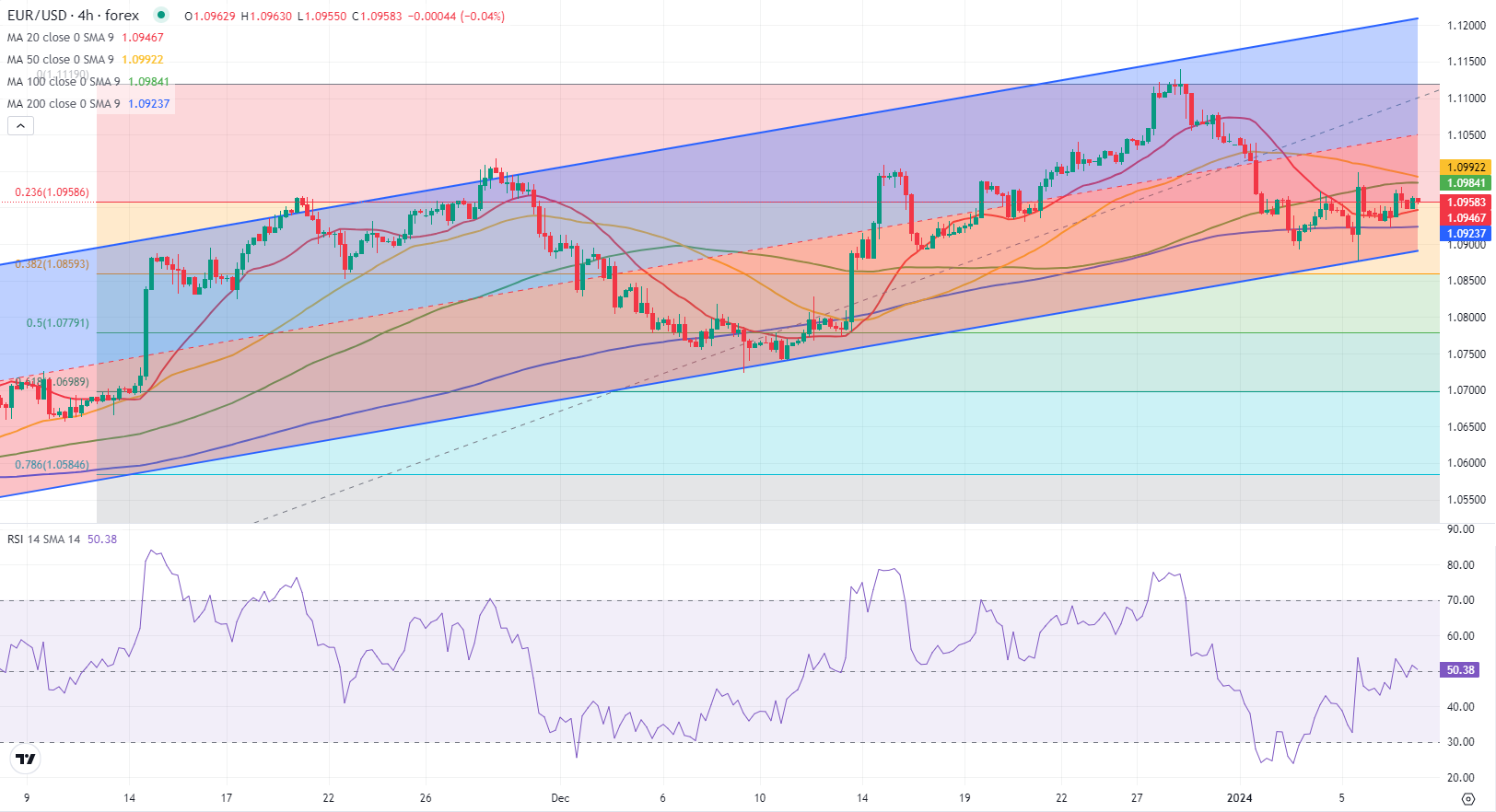
EUR/USD has been fluctuating between the 100-period and the 200-period Simple Moving Averages (SMA) on the 4-hour chart since January 3. 1.0990-1.1000 (100-period SMA, psychological level) aligns as key resistance on the upside ahead of 1.1050 (mid-point of the ascending regression trend channel) and 1.1100 (psychological level).
In case EUR/USD drops below 1.0920 (200-period SMA), 1.0900 (lower limit of the ascending channel) aligns as next immediate support before 1.0850 (Fibonacci 38.2% retracement of the latest uptrend).
Author

Eren Sengezer
FXStreet
As an economist at heart, Eren Sengezer specializes in the assessment of the short-term and long-term impacts of macroeconomic data, central bank policies and political developments on financial assets.

















