EUR/USD Forecast: Consolidative phase continues as sellers retain control

EUR/USD Current Price: 1.0710
- The absence of relevant news and upcoming first-tier events keep traders cautious.
- Market players lift bets on a Federal Reserve's rate hike in July.
- EUR/USD technical perspective favors another leg south, particularly once below 1.0634.
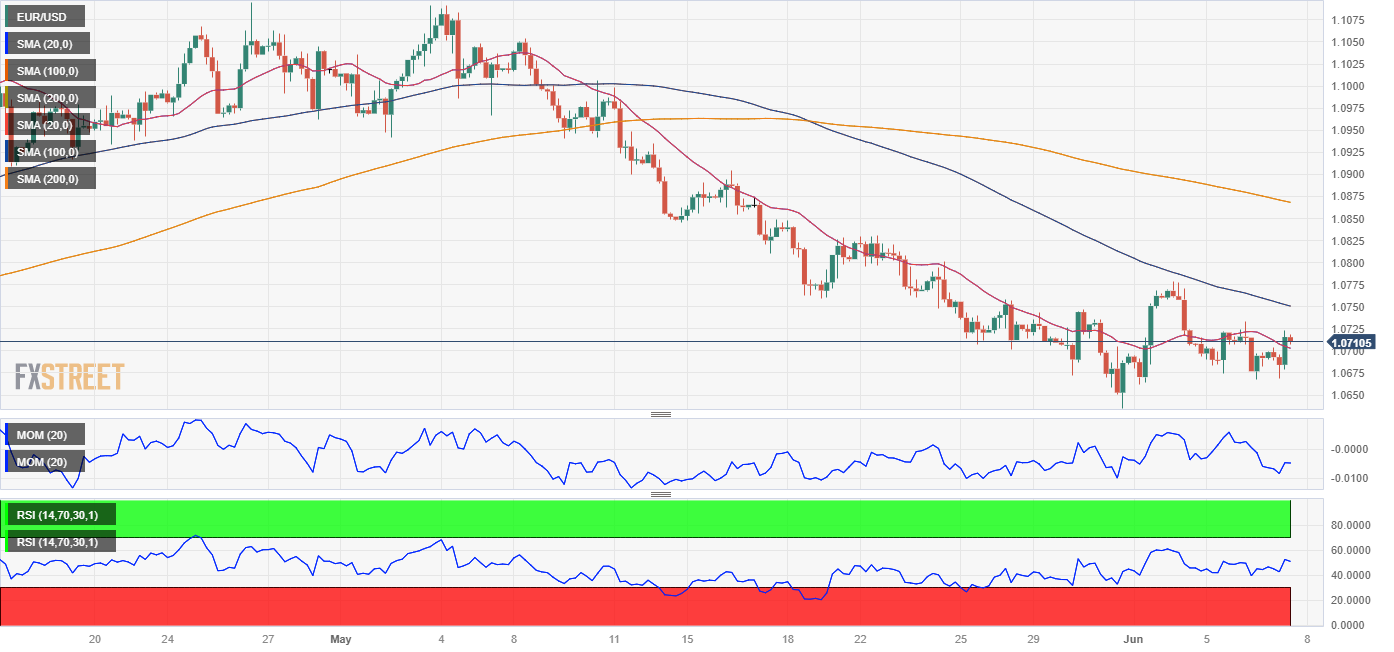
The EUR/USD pair recovered the 1.0700 threshold on Wednesday but trades within limited intraday ranges. Overall, financial markets remain cautious and in wait-and-see mode amid the absence of relevant news and ahead of first-tier events next week. Demand for the US Dollar eased as the market mood is somehow in better shape, with global stock markets posting modest gains, reflecting an improved sentiment.
Germany published April Industrial Production, which rose by 0.3% MoM, missing expectations although improving from the previous 2.1% decline. The annual reading printed at 1.6%, beating the 1.2% expected. Other than that, the European macroeconomic calendar had nothing relevant to offer. The United States (US) published the April Goods and Services Trade Balance, which posted a deficit of $74.6 billion, better than the $75.2 billion expected deficit, although much higher than the previous gap of $60.6 billion.
Meanwhile, financial markets continue to price in a Federal Reserve (Fed) pause in June, but odds for a 25 basis points (bps) rate hike in July continue to increase. At the time of writing, the CME FedWach Tool shows odds for such a move at 52.5% against 35% of a no-move.
Across the pond, the European Central Bank (ECB) is expected to continue to hike rates for at least two more meetings. On Wednesday, ECB governing council member Gabriel Makhlouf said that key rates will likely stay there once they reach the "top of the ladder of increasing interest rates." He added that there's no rate cut in the docket for this year. Earlier in the day, ECB policymaker Klaas Knot warned "prolonged monetary tightening might still lead to stress in financial markets," but added that inflation expectations "seem optimistic."
EUR/USD short-term technical outlook
The EUR/USD pair trades between 1.0660 and 1.0730 since the week started, meeting sellers ahead of a critical Fibonacci resistance level at 1.0745, the 61.8% retracement of the 2022 yearly slump. As long as it remains below it, the risk will be skewed to the downside.
Technical readings in the daily chart reflect the ongoing consolidation and the increased risk of another leg south. The 20 Simple Moving Average (SMA) extends its slide below a flat 100 SMA, both developing above the aforementioned Fibonacci resistance. At the same time, technical indicators advance alongside price, although below their midlines, suggesting limited buying interest.
In the near term, and according to the 4-hour chart, EUR/USD is neutral. The pair is seesawing around a mildly bearish 20 SMA, while the longer moving averages are heading firmly south well above the current level. Meanwhile, technical indicators advance, crossing their midlines with uneven strength and falling short of suggesting additional gains. A clear break through 1.0745 will encourage bulls, while sellers will likely take over if EUR/USD pierces 1.0634, the multi-month low posted last week.
Support levels: 1.0635 1.0590 1.0550
Resistance levels: 1.0710 1.0745 1.0790
Author

Valeria Bednarik
FXStreet
Valeria Bednarik was born and lives in Buenos Aires, Argentina. Her passion for math and numbers pushed her into studying economics in her younger years.

















