USD/JPY – Bearish continuation as yield differentials narrow

USD/JPY one-hour chart
USD/JPY could be preparing for another move lower as shifting monetary policy expectations and narrowing US–Japan yield differentials begin to favour the Japanese yen.
Wednesday’s US inflation report showed headline CPI climbing to 3.7% annually, while core inflation reached 2.6%, both exceeding expectations. The figures initially revived concerns over further Federal Reserve tightening, sending Treasury yields higher.
However, the reaction proved short-lived. US Treasury yields subsequently retreated, while market expectations for an October rate hike eased from approximately 40% immediately after the release to 33% later in the session. This suggests that investors remain reluctant to fully embrace a more aggressive Fed tightening outlook despite persistent inflation.
Meanwhile, Bank of Japan policymaker Junko Koeda reinforced the case for further monetary tightening on Thursday, warning against excessive caution in raising interest rates amid continued inflation risks. Her comments suggest Japan’s tightening cycle may have further to run, potentially supporting the yen.
US–Japan yield spread: Supporting the bearish outlook
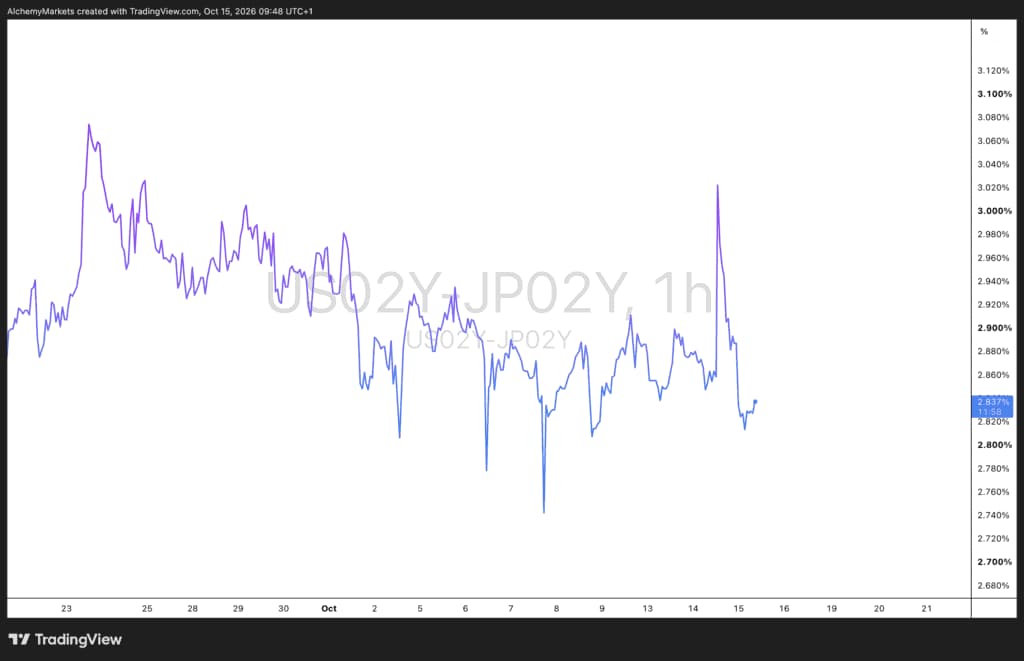
The US–Japan two-year yield differential provides further context for USD/JPY’s recent weakness.
As illustrated in the chart, the spread has generally narrowed since late September, declining from approximately 3.07 percentage points to 2.84 percentage points.
Although Wednesday’s stronger CPI briefly pushed the differential back above 3.00 percentage points, the move quickly reversed, suggesting that the initial repricing of US interest-rate expectations struggled to hold.
This matters because a narrower yield differential reduces the relative interest-rate advantage of holding US dollars over Japanese yen, potentially weakening support for USD/JPY.
With the Fed’s hawkish outlook facing increasing scrutiny while the BOJ maintains its tightening bias, further narrowing in the spread could reinforce downside pressure on the currency pair.
Technical analysis: Another bearish leg ahead?
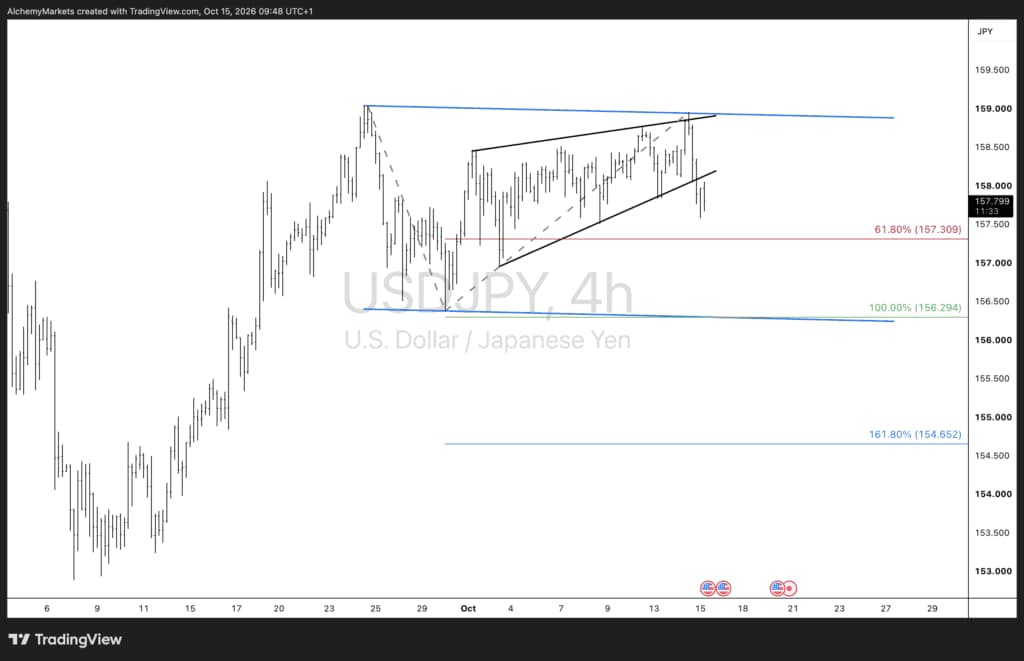
Turning to the hourly chart, USD/JPY experienced a sharp decline in late September before entering a corrective recovery throughout early October.
However, the recovery encountered resistance around 158.90–159.00, where the upper boundary of the broader descending structure coincided with the rising corrective channel.
The subsequent rejection and break beneath the channel’s lower boundary suggest the corrective phase may have concluded, opening the door to another bearish leg.
The immediate downside target sits at 157.309, corresponding to the 61.8% Fibonacci extension. A sustained break beneath this level could expose 156.294, followed by the extended target at 154.652.
Outlook: The technical structure favours further downside, with the narrowing US–Japan yield differential providing additional fundamental support. However, a renewed widening of the spread, particularly if Fed tightening expectations strengthen again, could challenge the bearish scenario.
For now, the combination of resistance near 159.00, a broken corrective channel and weakening yield support leaves USD/JPY vulnerable to another leg lower.
Author

Zorrays Junaid
Alchemy Markets
Zorrays Junaid has extensive combined experience in the financial markets as a portfolio manager and trading coach. More recently, he is an Analyst with Alchemy Markets, and has contributed to DailyFX and Elliott Wave Forecast in the past.

















