EUR/USD Forecast: Can 1.0500 support hold on another NFP beat?
- EUR/USD has been struggling to stage a rebound following Thursday's decline.
- Eyes on EU inflation data and US December jobs report.
- The pair could extend its slide in case buyers fail to defend 1.0500.

EUR/USD has been struggling to gain traction and moving sideways in a tight channel above 1.0500 eary Friday after having declined sharply on Thursday. The pair's near-term technical outlook points to a bearish tilt in the near term and additional losses could be witnessed in case 1.0500 support fails.
The data from the US revealed on Thursday that ADP Employment Change arrived at 235,000 for December, surpassing analysts' estimate of 150,000 by a wide margin. Additionally, the US Department of Labor reported that there 204,000 Initial Jobless Claims in the last week of the year, compared to 223,000 in the previous week.
Following these data, the CME Group FedWatch Tool's probability of a 25 basis points Fed rate hike in February declined to 57% from 70% on Wednesday, suggesting that upbeat employment figures caused investors to reassess the Fed's policy outlook.
Later in the session, Eurostat will publish December inflation figures. On a yearly basis, the Core Harmonized Index of Consumer Prices (HICP) is forecast to hold steady at 5%. A wekaer-than-expected core reading could hurt the Euro with the immediate reaction and vice versa but market participants could refrain from committing to large positions ahead of US December jobs report.
Nonfarm Payrolls (NFP) in the US are forecast to rise by 200,000 following November's 263,000 increase. A NFP reading near the consensus or better should help the US Dollar preserve its strength ahead of the weekend. On the other hand, a significant negative surprise with NFP coming in below 150,000 should weigh on the US Dollar and help EUR/USD gather bullish momentum.
Nonfarm Payrolls Preview: Layoffs spreading or another blockbuster month? Three scenarios for the US Dollar.
EUR/USD Technical Analysis
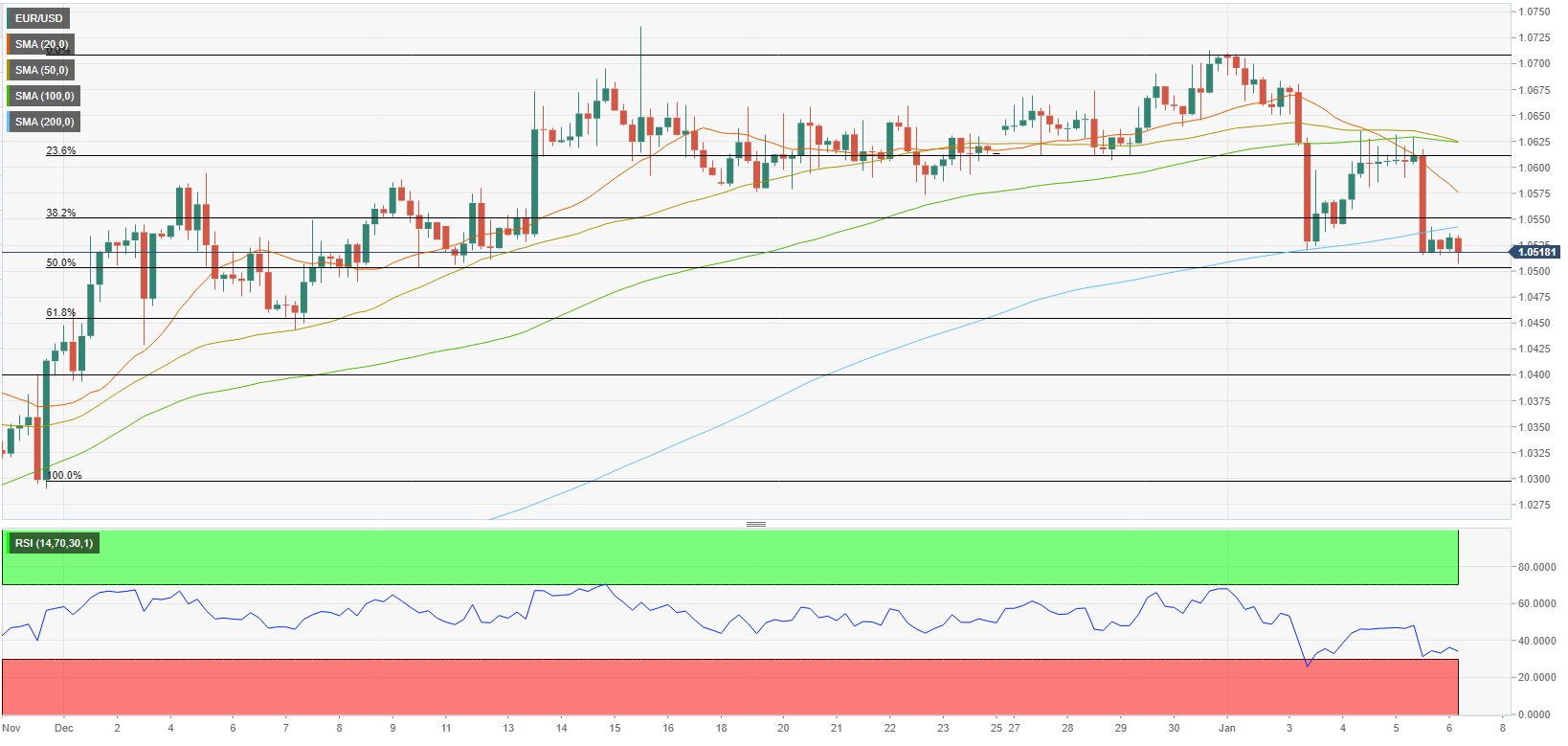
EUR/USD was last seen trading slightly above 1.0500, where the Fibonacci 50% retracement of the latest uptrend is located. In case the pair drops below that level and starts using it as resistance, it could extend its slide toward 1.0450 (Fibonacci 61.8% retracement) and 1.0400 (psychological level, static level).
On the upside, the 200-period SMA on the four-hour chart aligns as immediate resistance at around 1.0550. This level is also reinforced by the Fibnacci 38.2% retracement. With a four-hour close above that hurdle, EUR/USD could gather recovery momentum and target 1.0610/20 area (Fibonacci 23.6% retracement, 100-period SMA, 50-period SMA).
Author

Eren Sengezer
FXStreet
As an economist at heart, Eren Sengezer specializes in the assessment of the short-term and long-term impacts of macroeconomic data, central bank policies and political developments on financial assets.