EUR/USD Forecast: Buyers hesitate to commit to a move beyond 1.1000
- EUR/USD fluctuates above 1.0950 after Thursday's volatile trading.
- The technical outlook fails to turn bullish as 1.1000 resistance stays intact.
- Producer inflation data from the US will be watched closely by investors.

After spiking to 1.1000 on Thursday, EUR/USD made a sharp U-turn and dropped below 1.0950. With the US Dollar (USD) struggling to find demand in the late American session, the pair regained its traction and closed the day flat. The pair holds steady above 1.0950 early Friday as markets await producer inflation data from the US.
Mixed inflation figures from the US ramped up market volatility on Thursday. The Consumer Price Index (CPI) rose 3.4% on a yearly basis in December, the US Bureau of Labor Statistics (BLS) reported. This reading followed the 3.1% increase recorded in November and came in above the market expectation of 3.2%. The Core CPI, which excludes volatile food and energy prices, rose 0.3% on a monthly basis to match analysts' estimate.
These prints failed to influence the market positioning on Federal Reserve (Fed) policy outlook in a noticeable way. The CME FedWatch Tool shows that the probability of a 25 basis points rate reduction in March stays about 70%.
Commenting on the rate outlook, Cleveland Fed President Loretta Mester told Bloomberg that Fed is "not there yet on rate cuts" and added that she would want to see more evidence that the economy is progressing as expected. Inflation has to be coming down on a "sustainable basis" before rate cut conversation can happen, Mester argued.
On a yearly basis, the Producer Price Index (PPI) is forecast to rise by 1.3% in December, up from 0.9% in November. A smaller-than-forecast increase could make it difficult for the USD to hold its ground ahead of the weekend. A print at or above 1.5% could revive concerns over stronger producer inflation making it difficult for the Fed to control consumer inflation and weigh on EUR/USD.
EUR/USD Technical Analysis
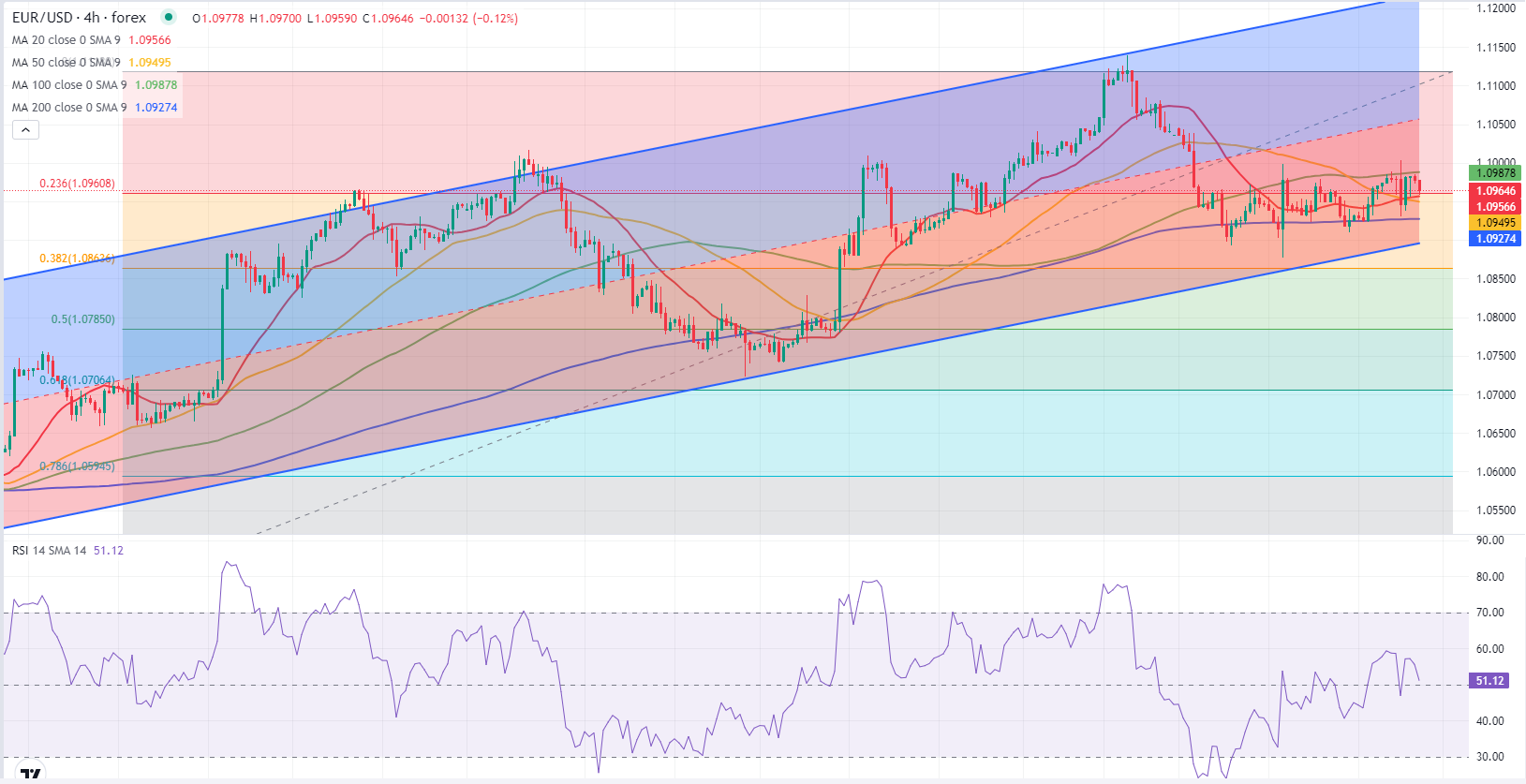
EUR/USD continues to fluctuate between the 100- and the 200-period Simple Moving Averages (SMA) on the 4-hour chart, while the Relative Strength Index (RSI) stays near 50 following Thursday's short-lasting advance, reflecting the pair's indecisiveness.
1.0990-1.1000 (100-period SMA, psychological level) stays intact as key resistance. If EUR/USD manages to flip that area into support, it could target 1.1050 (mid-point of the ascending regression trend channel) and 1.1100 (psychological level, static level) next.
On the downside, 1.0930 (200-period SMA) aligns as important support before 1.0900 (psychological level, lower limit of the ascending regression trend channel) and 1.0850 (Fibonacci 38.2% retracement of the latest uptrend).
Author

Eren Sengezer
FXStreet
As an economist at heart, Eren Sengezer specializes in the assessment of the short-term and long-term impacts of macroeconomic data, central bank policies and political developments on financial assets.

















