ETFs dumped Gold in March except in Asia [Video]
![ETFs dumped Gold in March except in Asia [Video]](https://editorial.fxsstatic.com/images/i/Commodities_Gold-1.jpg)
Unsurprisingly, given the significant price corrections in January and after the onset of the Iran conflict, significant amounts of metal flowed out of gold ETFs in March. However, it was a tale of regions, with North American funds accounting for the bulk of those outflows and Asian ETFs actually adding metal during the month.
On net, 84.8 tonnes of metal flowed out of gold-backed funds valued at $12 billion. It was the largest monthly outflow in dollar terms on record.
In tonnage terms, ETF holdings charted their largest monthly decline since September 2022.
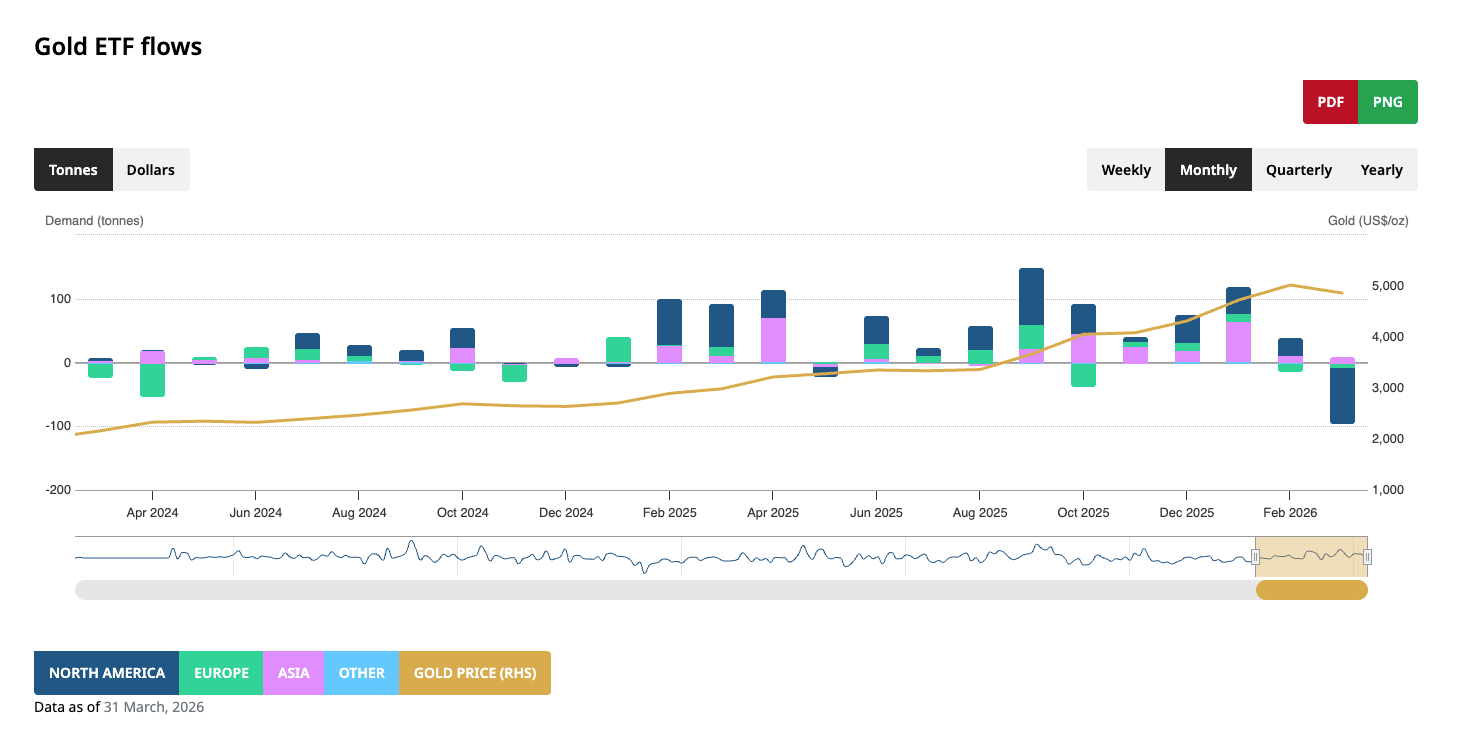
Despite the sharp March outflows, ETFs globally added a net 62 tonnes of gold in the first quarter.
Global gold ETFs ended the quarter with $606 billion in assets under management (AUM). That was 9 percent above FY25 levels.
Asia posted its largest quarterly inflow on record, with positive flows in March helping to offset weakness in North America.
North American ETF gold holdings fell by -87 tonnes valued at $13 billion in March. That ended a 9-month streak of inflows and gave North America the distinction of being the only region to report outflows for the quarter.
Notably, North American ETFs have only charted two periods with at least nine consecutive months of inflows – during the 2008 financial crisis and the COVID‑19 pandemic.
The World Gold Council pinpointed three factors that drove North American outflows:
- Broader risk‑off conditions, triggered by Operation Epic Fury, weighed on most asset classes – except oil – and likely prompted US investors to raise liquidity by selling prior winners such as gold
- Commodity Trading Advisors (CTAs) entered mid-March with elevated long positioning and appear to have amplified the downside price momentum, forcing weaker hands to capitulate
- Opportunity costs rose as the US dollar and interest rates moved higher, while rate expectations shifted materially from potential cuts in 2026 to rates now expected to remain unchanged through September 2027, adding uncertainty and weighing on gold demand.
European funds also reported gold outflows, but not to the extent of North America. ETFs based in Europe decreased their gold holdings by -7.3 tonnes valued at $154 million.
According to the World Gold Council, Germany, Italy, and France led monthly selling, with flows closely tracking gold price movements. There were significant outflows during the second half of March as prices fell. However, modest inflows re‑emerged toward the end of March as prices rebounded.
Meanwhile, Asian ETFs kept adding gold.
Asian funds reported a 9.9-tonne increase in gold holdings in March valued at $2 billion.
Flows were positive until the last week of the month.
Chinese funds led the buying. According to the World Gold Council, heightened safe‑haven demand amid geopolitical risks, falling local equity markets, and a weaker currency, all incentivized Chinese investors to keep piling into gold even as Americans and Europeans were selling.
Dip-buying supported ETF inflows across the region. Indian funds reported a $177 million increase in gold holdings.
Funds in other regions, including Australia and Africa, reported a modest -0.4-tonne decrease in gold holdings. According to the World Gold Council, “Despite heightened gold price volatility, Australian and South African holdings remained relatively resilient, with only minimal outflows during the month.”
ETFs are a convenient way for investors to play the gold market, but owning ETF shares is not the same as holding physical gold.
ETFs are relatively liquid. You can buy or sell an ETF with a couple of mouse clicks. You don’t have to worry about transporting or storing metal. In a nutshell, it allows investors to play the gold market without buying full ounces of metal at the spot price.
Since you are just buying a number in a computer, you can easily trade your ETF shares for another stock or cash whenever you want, even multiple times on the same day. Many speculative investors take advantage of this liquidity.
But while a gold ETF is a convenient way to play the price of gold on the market, you don’t possess any gold. You have paper. And you don’t know for sure that the fund has all the gold either, especially when the fund sees inflows. In such a scenario, there have been difficulties or delays in obtaining physical metal.
To receive free commentary and analysis on the gold and silver markets, click here to be added to the Money Metals news service.
Author

Mike Maharrey
Money Metals Exchange
Mike Maharrey is a journalist and market analyst for MoneyMetals.com with over a decade of experience in precious metals. He holds a BS in accounting from the University of Kentucky and a BA in journalism from the University of South Florida.