|

Elliott Wave view: EUR/USD looking for larger degree zigzag correction [Video]

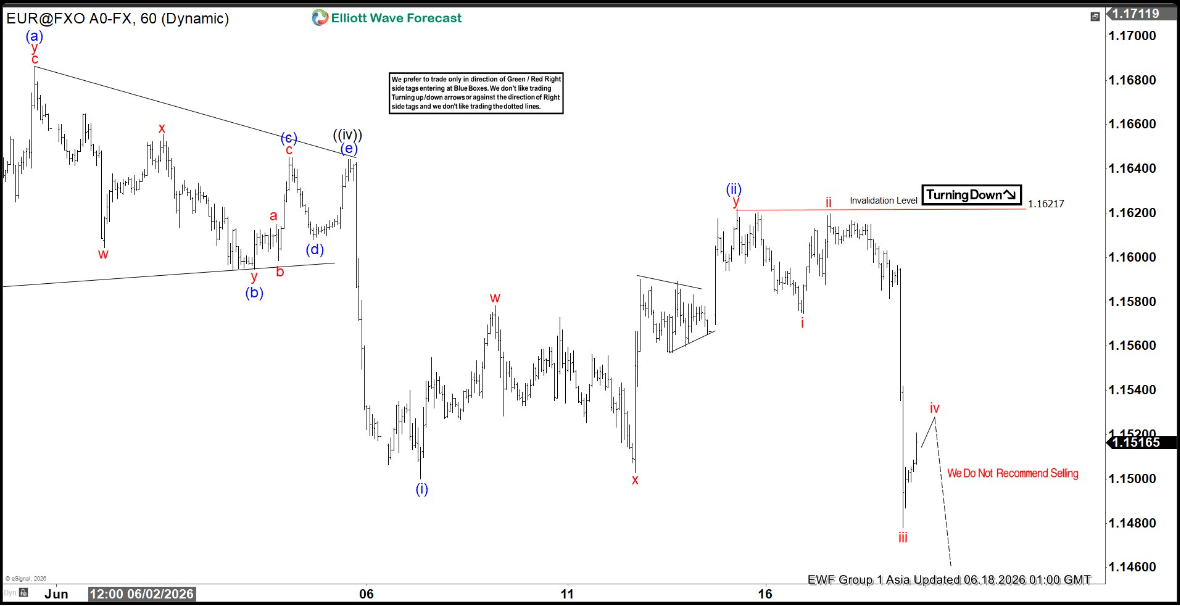
The short-term Elliott Wave analysis of EURUSD shows that the decline from the April 17, 2026 peak is unfolding as a five-wave impulse. From the April 17 high, wave ((i)) ended at 1.1655. A corrective rally in wave ((ii)) then followed which terminated at 1.1796. The pair then moved lower in wave ((iii)), reaching 1.1576. Afterward, wave ((iv)) completed at 1.164 in the form of a triangle, confirming the continuation of bearish momentum.

The market has since resumed lower in wave ((v)), which subdivides into a smaller degree impulse. From wave ((iv)), wave (i) concluded at 1.15, while wave (ii) retraced to 1.1622. The expectation is that EURUSD will continue declining through further subdivisions before completing wave (v) of ((v)). This completion would mark the end of wave 1 in the larger degree, thereby concluding the cycle that began from the April 17 high. Once wave 1 is finalized, the pair should enter a corrective rally of larger degree before resuming its downward path. Pair can potentially extend lower to the extreme area from January 27 peak towards 1.075 – 1.117. In the near term, as long as the pivot at 1.1845 remains intact, rallies are expected to fail within corrective structures of three or seven swings.

EUR/USD 60-minute Elliott Wave chart
EUR/USD Elliott Wave [Video]

Youtube preview

Author

Elliott Wave Forecast Team

Elliott Wave Forecast Team

ElliottWave-Forecast.com

More from Elliott Wave Forecast Team
Share:

Editor's Picks

160.80: Japanese Yen remains close to nearly two-year lows

USD/JPY inches lower after four days of gains, trading around 160.60 during the Asian hours. The USD/JPY pair surged to 160.80 the previous day, marking its highest level since July 2024 and significantly heightening speculation that Japanese authorities could soon intervene to support the struggling Yen.

AUD/USD eyes 0.7050 on weaker USD; 100-day SMA holds the key for bulls

The AUD/USD pair regains positive traction during the Asian session, reversing part of the previous day's slide to sub-0.7000 levels, or the weekly low. Spot prices currently trade around the 0.7040 region, up nearly 0.40% for the day, amid a broadly weaker US Dollar.

$4,300: Gold bounces amid US-Iran peace deal signing, Fed’s hawkish hold

Gold is reversing the previous slump early Wednesday, regaining $4,300 after finding fresh buyers near $4,250. The US Dollar retreats as US-Iran peace deal optimism overshadows hawkish Fed outlook. Technically, Gold needs a sustained break above the 21-day SMA near $4,390 to revive the recovery.

Ripple awaits a breakout while Stellar rally gathers pace

Ripple steadies at $1.19 below the upper boundary of its falling channel after facing rejection. Meanwhile, Stellar extends its gains, rallying over 25% so far this week. Derivatives metrics suggest a cautious outlook for XRP, while XLM's improving futures positioning suggests a bullish outlook.

A new era for the Fed
The Fed has shifted to a more hawkish stance at the first meeting chaired by Kevin Warsh. Although rates were left unchanged, there will be meaningful adjustments to how the Federal Reserve operates in the coming months and years. There are two main takeaways from today’s meeting, firstly what the Fed did, and secondly, what they are planning to do.
Why a hawkish RBA is no longer enough to lift the Australian Dollar

The Reserve Bank of Australia delivered more than what markets expected: a hawkish hold that should have supported the Aussie. But markets widely ignored it, focusing instead on slowing economic growth and proving that central bank messaging alone isn’t always enough to drive currencies.