Dollar pullback tests whether Warsh’s hawkish repricing can stick

The US Dollar has started September on the back foot, giving back roughly half of the gains triggered by Federal Reserve Chair Kevin Warsh’s hawkish speech on Friday. On the surface, that could look like markets are beginning to fade the prospect of tighter Fed policy. Underneath, however, the rates market is telling a different story.
The front end of the US curve remains firmly repriced. Two-year SOFR rates are holding above 4.20%, more than 10 basis points higher than before Warsh spoke, while markets are pricing around 16bp of tightening for September and roughly 37bp by year-end. In other words, the dollar has weakened even though expectations for Fed tightening have largely held.
That divergence is the key story for FX traders this week.
The Dollar is falling despite support from rates
Every G10 currency gained against the dollar on Monday, even as the US front end continued to reflect a more hawkish Fed outlook.
Normally, that combination should be supportive for the greenback. Higher expected US rates raise the relative return available on dollar assets and can attract capital towards the currency.
Instead, attention appears to have shifted further out along the Treasury curve.
Long-end US yields have moved higher, partly alongside the renewed rise in oil prices following the latest exchange of strikes between the US and Iran. But rather than treating higher long-term yields purely as a sign of stronger US returns, FX markets appear to be viewing the move through a more uncomfortable fiscal lens.
That matters because the market is increasingly sensitive to the possibility of Treasury intervention designed to control borrowing costs.
Treasury concerns are complicating the bullish Dollar story
The reaction suggests the so-called debasement trade has not completely disappeared.
Treasury Secretary Scott Bessent’s previous move towards increased Treasury buybacks appears to have left a lasting impression on markets. If investors believe rising long-end yields will eventually trigger greater intervention from the Treasury, then higher yields do not necessarily translate cleanly into dollar strength.
Instead, they can raise questions around fiscal sustainability, debt management and the longer-term value of the currency.
That creates an unusual split.
The front end is saying the Fed may stay tighter, which should support the dollar.
The back end is raising fiscal and Treasury-management concerns, which is weighing against that support.
For dollar bulls, that divergence is worth watching closely. A hawkish repricing from the Fed has so far been unable to completely unwind the fiscal-risk premium embedded in the currency.
This week’s data should decide whether the correction continues
Despite Monday’s weakness, chasing the dollar lower may still be premature.
After Warsh’s speech, markets would probably need a run of materially weaker US economic releases to meaningfully unwind expectations for the 16 September FOMC meeting.
The key test begins with ISM Manufacturing and JOLTS, followed by ADP employment, ISM Services and finally Friday’s payroll report.
The baseline remains relatively resilient.
ISM Manufacturing is expected to remain above 55, while services activity is expected to stabilise. ADP employment around 40,000 would be soft but not necessarily weak enough to completely change the Fed debate, while payroll growth of around 65,000 would reinforce the idea that the labour market is cooling rather than collapsing.
That distinction matters.
A modest slowdown is unlikely to be enough to overturn Warsh’s hawkish signal. For the dollar correction to develop into something more structural, markets probably need several indicators to deteriorate together and force a meaningful reassessment of September tightening expectations.
DXY: 100 remains the key technical level
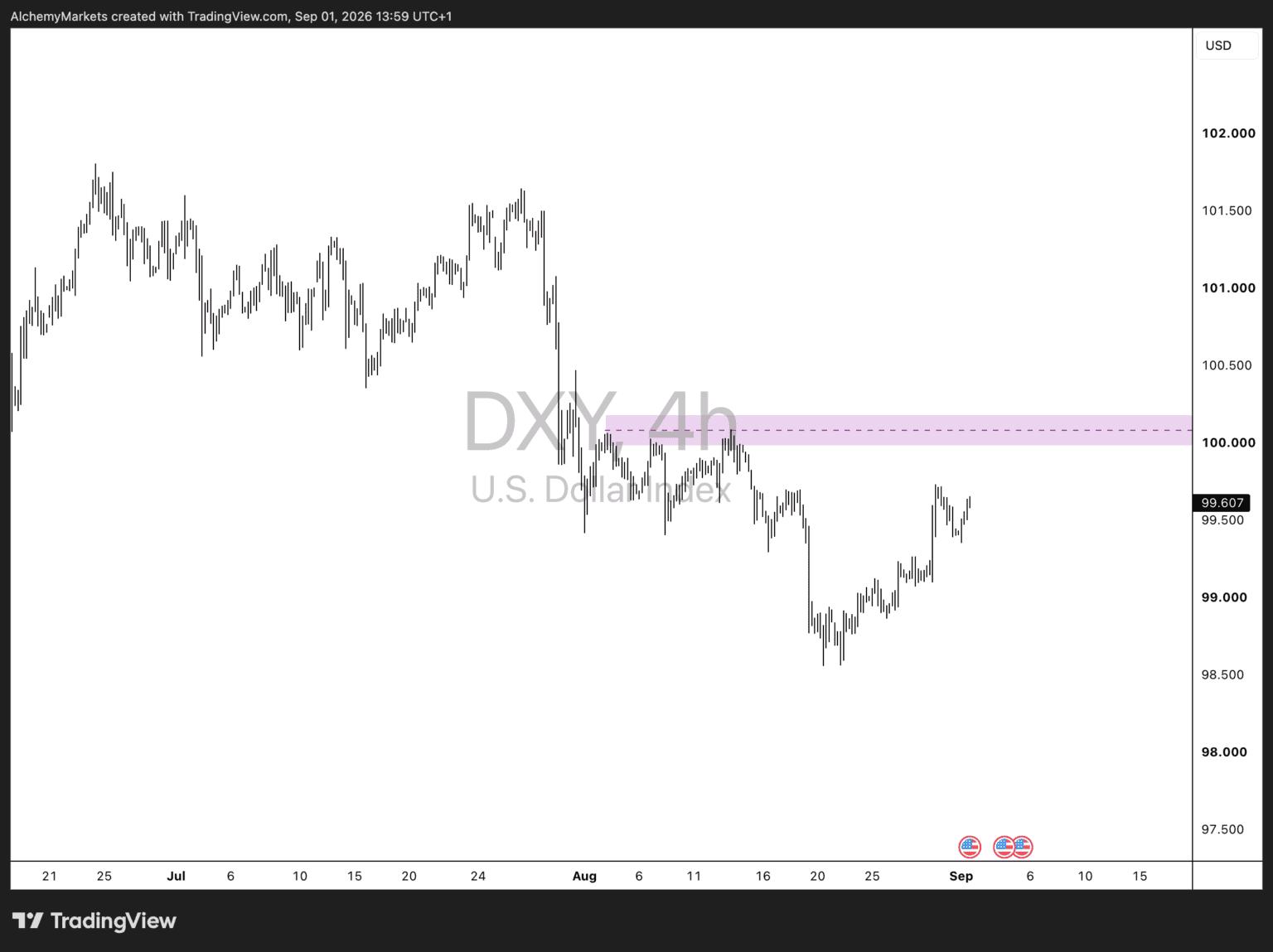
Technically, the Dollar Index is trading back around 99.60, having rebounded from the August lows near 98.60 but so far failed to reclaim the psychologically important 100.00 area.
The chart makes the battle fairly clear. The 100.00–100.15 region has become an important resistance zone following August’s breakdown. A clean move back through that area would suggest the post-Warsh repricing is beginning to feed back into FX and would strengthen the case for another leg higher in the dollar.
For now, however, DXY remains underneath it.
That leaves the dollar in an interesting position: monetary-policy expectations are supportive, but the currency itself has yet to fully confirm them.
Opening bell view
The important signal this week is therefore not simply whether US data is “good” or “bad”. It is whether the data is weak enough to reverse the hawkish repricing already embedded in short-term rates.
If ISM, labour data and services activity broadly hold up, the front-end rates story should remain supportive and DXY could make another attempt at reclaiming 100.00. September seasonality also historically tends to favour the dollar.
If, however, the US produces a cluster of meaningful downside surprises and markets begin stripping out September tightening expectations, the current dollar pullback would have a much stronger fundamental foundation.
For now, the cleaner read is that the dollar correction has run ahead of the change in Fed expectations.
The burden of proof therefore sits with the US data. Until the front end begins following the dollar lower, the move below 100 looks more like a test of support for the hawkish narrative than a definitive reversal of it.
Author

Zorrays Junaid
Alchemy Markets
Zorrays Junaid has extensive combined experience in the financial markets as a portfolio manager and trading coach. More recently, he is an Analyst with Alchemy Markets, and has contributed to DailyFX and Elliott Wave Forecast in the past.