Dollar holds near 19-month high as Fed hike debate and AI jitters underpin gains

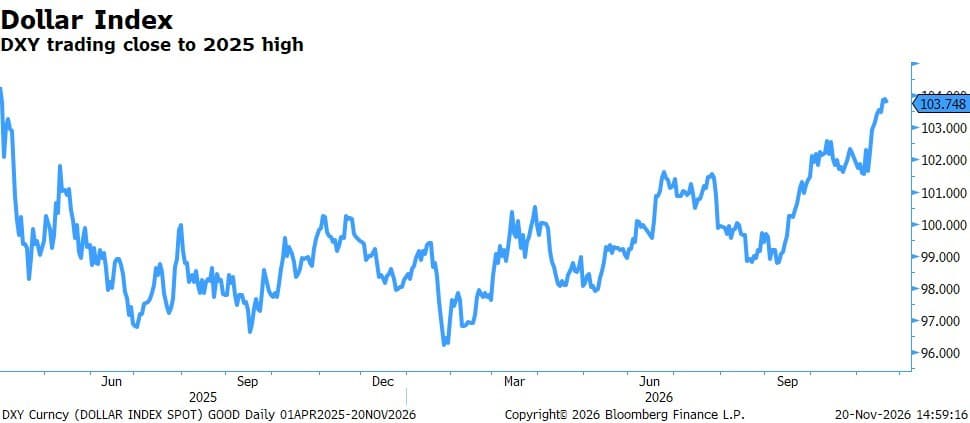
USD is on track for a fourth consecutive weekly advance, trading near 103.9 on the Dollar Index, the Greenback’s strongest level since early April 2025 and the days of tariff doom and gloom. Hawkish Federal Reserve signals and a risk-off shift linked to AI valuation concerns are the main drivers.
October FOMC minutes showed almost all participants judging that further rate increases would likely be appropriate. Governor Christopher Waller has suggested the Fed should either deliver a 50bp hike in December or signal a faster pace of tightening thereafter. Markets have entirely priced a 25bp move on 9 December, with a 5% chance of 50bp. FOMC member Waller has made it clear repeatedly that he may back a 50bps hike, although he has so far been the sole holder of that position.
At the same time, equity volatility around stretched AI valuations and Anthropic’s large IPO has boosted safe-haven demand for the dollar and Treasuries. The 10-year yield has eased from recent highs but remains elevated, supporting the greenback against higher-beta currencies.
EUR/USD is trading near its lowest since April 2025, while GBP/USD has slipped toward 1.3080–1.3100, pressured by the stronger dollar and softer-than-expected UK inflation data that has trimmed Bank of England hike expectations. USD/JPY remains elevated, though the yen has found some support from firmer Japanese inflation.
Near-term dollar strength looks intact as long as Fed hike pricing holds and risk sentiment stays cautious. Next week’s US PCE inflation data will be the key test. A soft print could prompt a pullback toward 103.00–103.50 on the Dollar Index; a firm reading would reinforce the case for further gains toward 104.50–104.60. For GBP/USD, the 1.3010 area (last November’s low) is the next major support if downside momentum persists.
Author
David Stritch
Caxton
Working as an FX Analyst at London-based payments provider Caxton since 2022, David has deftly guided clients through the immediate post-Liz Truss volatility, the 2020 and 2024 US elections and innumerable other crises and events.

















