Dollar eyes key support as PCE tests the bond rally
The US dollar enters Wednesday’s session under pressure, and today’s PCE inflation report could determine whether the latest move has further to run.
The backdrop has changed noticeably over the past week. Longer-dated US Treasury yields have retreated following Treasury Secretary Scott Bessent’s decision to expand buybacks of long-dated government bonds, while falling oil prices have provided another source of relief for the bond market. On Tuesday, the US 10-year yield fell to around 4.63%, while the 30-year moved towards 5.16%.
At the same time, Brent crude has fallen for a third consecutive session, moving towards $86 a barrel as markets respond to renewed hopes surrounding negotiations over the Strait of Hormuz. Lower energy prices matter beyond the oil market: if sustained, they reduce one of the more immediate sources of inflation pressure and make it easier for bond yields to remain contained.
That leaves today’s PCE report as the next major test.
PCE could decide whether lower yields have room to continue
The Federal Reserve’s preferred measure of inflation remains uncomfortable. Economists expect July core PCE inflation to remain around 3.3% year-on-year, still well above the Fed’s 2% objective.
But for markets, the more useful question is not simply whether inflation remains high. It is whether the rate of inflation is accelerating again.
That puts the monthly core PCE number firmly in focus.
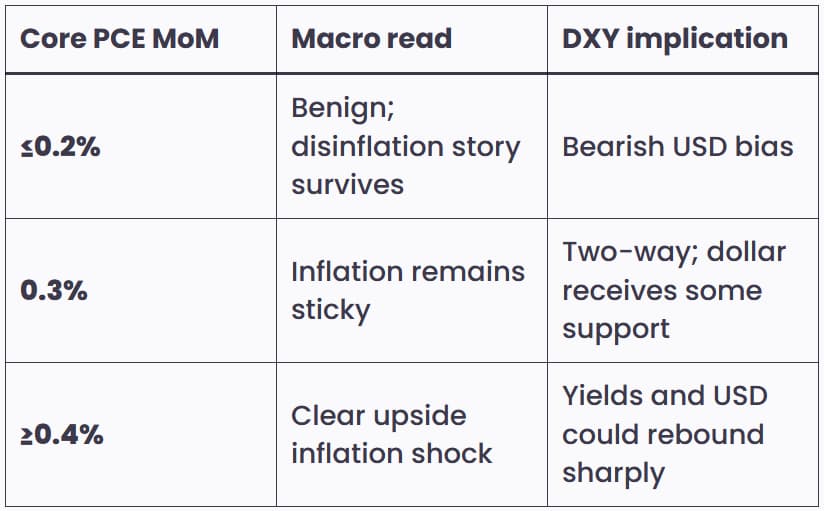
A reading around 0.2% month-on-month or softer would fit neatly with the narrative that has developed across markets over the past week:
Oil falling → inflation risk easing → Treasury yields contained → less support for the dollar.
It would not mean the Fed has defeated inflation. Instead, it would make it harder for markets to justify aggressively rebuilding expectations for higher rates at a time when energy prices and longer-term yields are already moving in the opposite direction.
The risk to that view is a clear upside surprise.
A 0.3% core reading would reinforce concerns that underlying inflation remains sticky, while 0.4% or higher would be much more disruptive. In that scenario, Treasury yields could reverse higher as markets reconsider the risk of further Fed tightening, potentially giving the dollar a much-needed catalyst for recovery.
Boston Fed President Susan Collins reinforced that sensitivity this week, warning that rates may need to rise unless the inflation data provides convincing evidence of further progress.
DXY: The channel has broken
The technical picture makes today’s release particularly interesting.
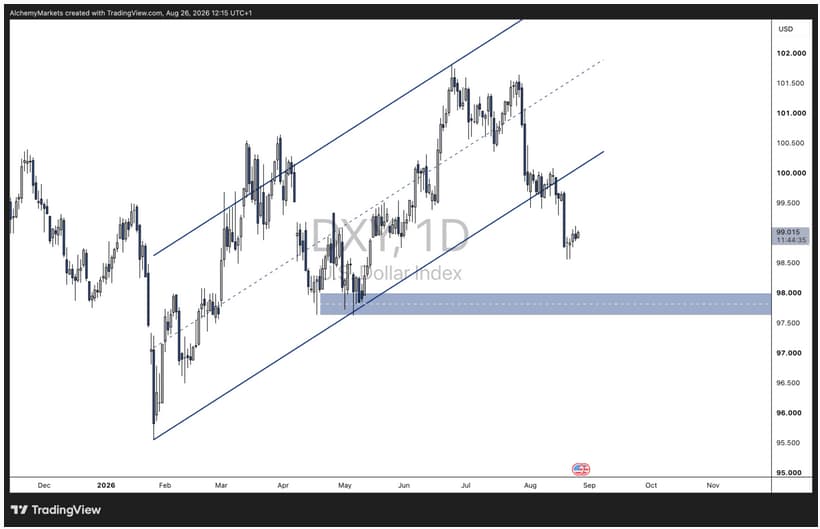
DXY spent much of the year trading within a broad rising channel, but the recent sell-off has now pushed the index decisively beneath the lower boundary of that structure.
That matters.
The dollar is no longer simply pulling back inside an established uptrend. It is now attempting to stabilise below former trend support, with the index sitting around the 99.00 area on the chart.
Unless price can quickly reclaim the broken channel, the next important area sits lower around 97.65–98.00.
That shaded zone has previously attracted demand and represents the clearest downside area to watch if today’s inflation data allows the bond rally to continue.
Primary view
Below the broken channel, the bias remains towards 97.65–98.00.
A benign core PCE reading around 0.2% or below would strengthen that view, particularly if US yields respond by moving lower again.
The cleaner invalidation would be a combination of hotter PCE + rising Treasury yields + DXY reclaiming the broken channel, rather than simply a temporary intraday dollar bounce.
The next test does not end with PCE
Today’s release is only the first hurdle.
Markets then face the $44 billion seven-year Treasury auction on Thursday, before attention turns to Federal Reserve Chair Kevin Warsh at Jackson Hole on Friday.
That creates an unusually concentrated sequence of catalysts for the rates market.
PCE tests the inflation story.
The Treasury auction tests demand for US duration.
Warsh then has the opportunity to shape expectations around how the Fed intends to respond.
For now, however, the dollar sits on the weaker side of that equation. Oil is falling, longer-dated yields have come off their highs and DXY has broken its rising technical structure.
If today’s inflation report fails to challenge that combination, the 97.65–98.00 support zone may be the next destination for the Dollar Index.
Author

Zorrays Junaid
Alchemy Markets
Zorrays Junaid has extensive combined experience in the financial markets as a portfolio manager and trading coach. More recently, he is an Analyst with Alchemy Markets, and has contributed to DailyFX and Elliott Wave Forecast in the past.