|

Currency strength and pair matrix

Methodology and approach

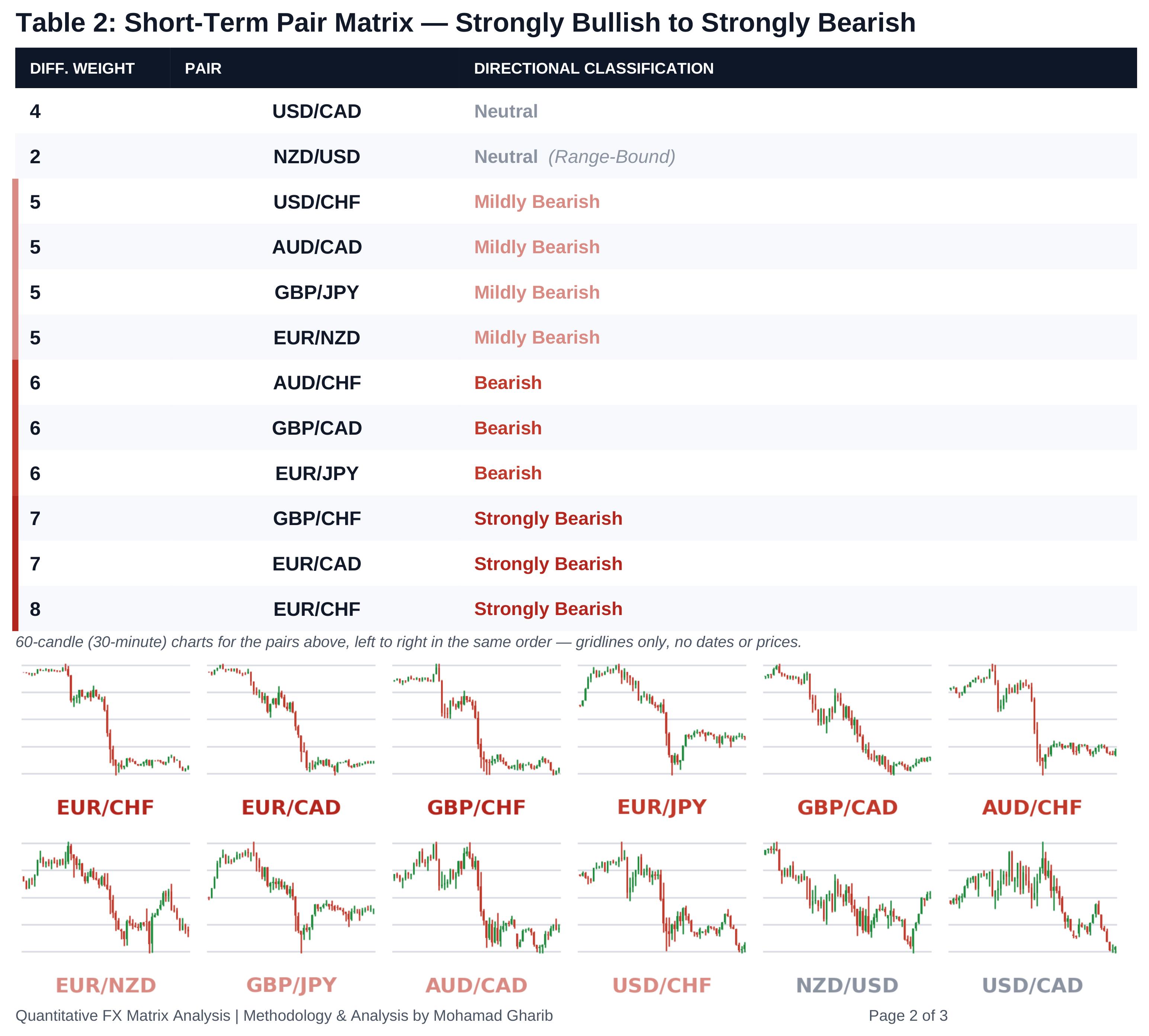
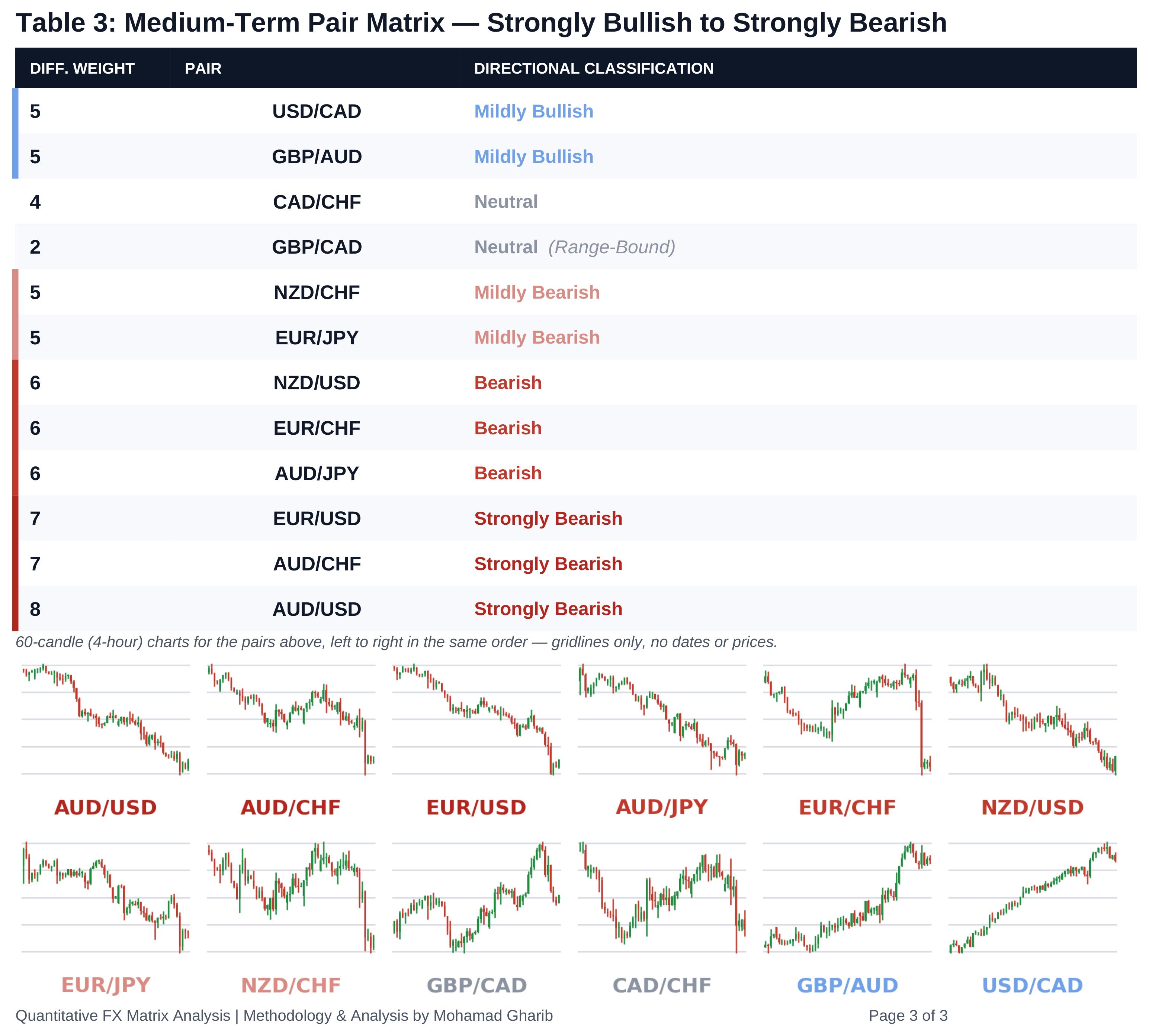
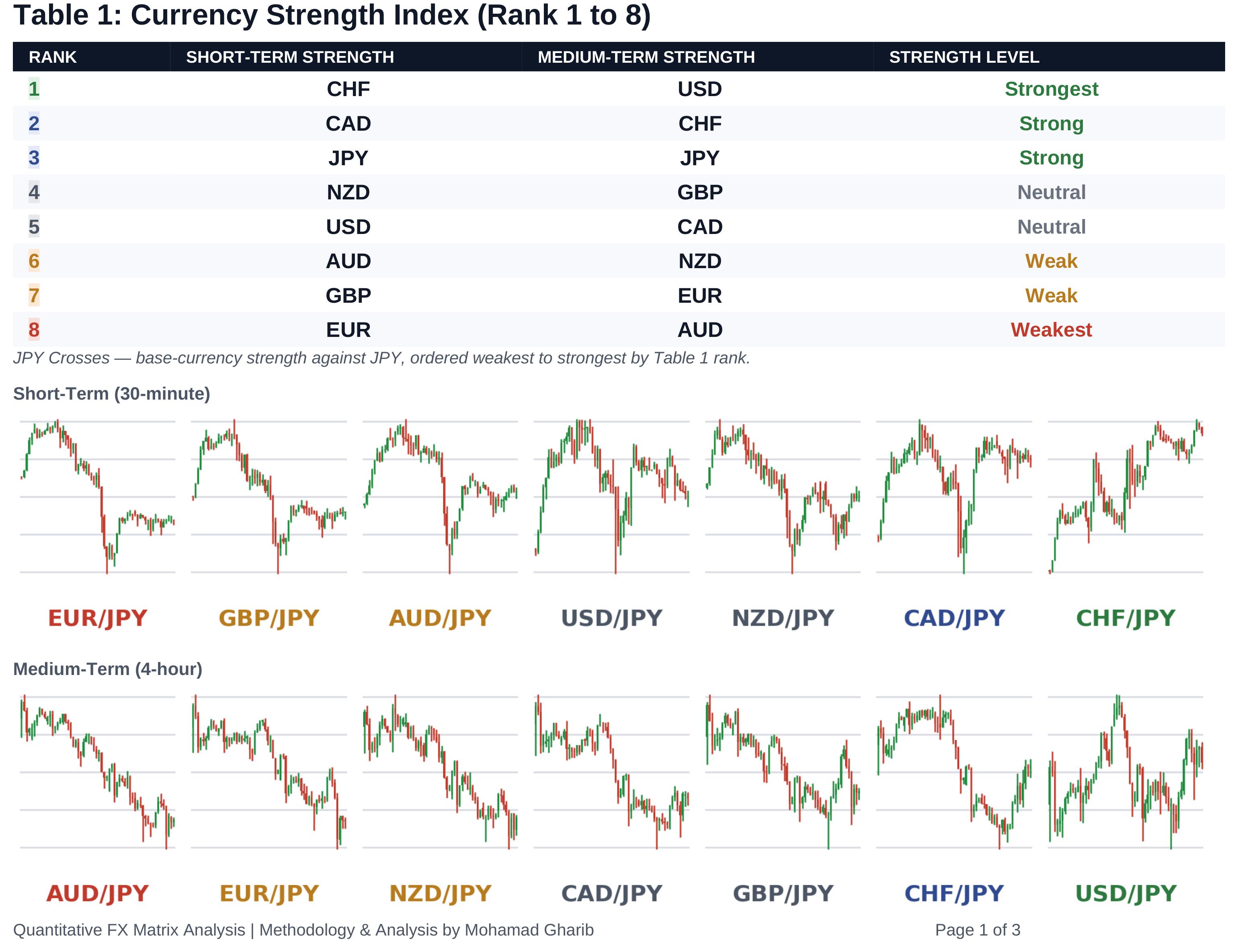
This report evaluates major currencies by constructing a relative strength index for each currency, ranking them systematically from Strongest (Rank 1) to Weakest (Rank 8) across Short-Term and Medium-Term horizons. By pairing stronger and weaker currencies, the model identifies the currency pairs with the largest relative-strength differentials and classifies each from Strongly

Bullish to Strongly Bearish. The pair with the narrowest differential in each horizon is treated separately as the model's RangeBound pair.

Short-term executive takeaway

CHF ranks as the strongest currency short-term, while EUR ranks as the weakest, placing EUR/CHF at the Strongly Bearish end of the Short-Term Pair Matrix.

Separately, NZD/USD has the narrowest differential (Diff. Weight 2), marking it as Range-Bound.

Medium-term executive takeaway

USD ranks as the strongest currency medium-term, while AUD ranks as the weakest, placing AUD/USD at the Strongly Bearish end of the Medium-Term Pair Matrix.

Separately, GBP/CAD has the narrowest differential (Diff. Weight 2), marking it as Range-Bound.
Chart
Chart
Chart


Author

Mohamad Gharib

Mohamad Gharib

Independent Analyst

Mohamad Gharib is a Financial Markets Analyst and Quantitative Researcher with more than 18 years of experience in financial markets, including 15 years as an FX Quant Trader.


More from Mohamad Gharib
Share:

Editor's Picks

AUD/USD bounces back toward 0.6950 on fresh USD supply

AUD/USD bounces back toward 0.6950 in the Asian session on Friday. The US Dollar retreats from 17-month highs as traders take profits off the table ahead of the all-important US Nonfarm Payrolls report. Meanwhile, the Australian Dollar draws support from reviving expectations of a November interest rate hike amid elevated global yields and inflation risks.


USD/JPY struggles near 158.00 as USD retreats ahead of NFP

USD/JPY is struggling for fresh impetus near 158.00, moving away from the top end of its weekly range in the Asian session on Friday, after hotter-than-expected Tokyo CPI and amid a broad US Dollar retreat. Traders reposition themselves ahead of US Nonfarm Payrolls.

Gold approaches $4,200 as USD bulls pause for a breather ahead of US NFP report

Gold reverses a modest Asian session dip, climbing back closer to the $4,200 mark in the last hour. Any meaningful upside, however, seems elusive amid a bullish US Dollar as traders keenly await the release of US employment details. The US Nonfarm Payrolls report is expected to show that the economy added only 90K jobs in September, down from the previous month's reading of 162K.

Pi Network retreats to key support level as selling pressure resurfaces

Pi Network price remains volatile in the near term, hovering around $0.0900 at press time on Friday after losing over 3% the previous day. The pullback warns of a steeper correction, with a risk of breaking below a rising wedge pattern on the four-hour chart. Pi Network struggles to maintain a steady recovery as the price remains capped below the $0.1000 psychological barrier.

US jobs report is due: We expect a hot one
In Japan, September Tokyo core CPI rose to 2.7% (cons: 2.4%). The figure was above the BOJ's 2% target for the first time since January. In commodities, Brent crude futures traded above USD 102/bbl on Friday morning after the WSJ reported that the Pentagon will be sending a third aircraft-carrier strike group and additional soldiers to the Middle East.
Markets are pricing a Fed pause. The jobs data says the hike is still coming
The market has rapidly changed its mind about the Federal Reserve (Fed). Only a week ago, investors saw an October interest-rate hike as the most likely outcome. However, softer inflation and cautious comments from policymakers have since turned a pause into the dominant scenario. Yet beneath that dramatic repricing, the US economy is sending a considerably less dovish message.