|

Currency strength and pair matrix

Methodology and approach

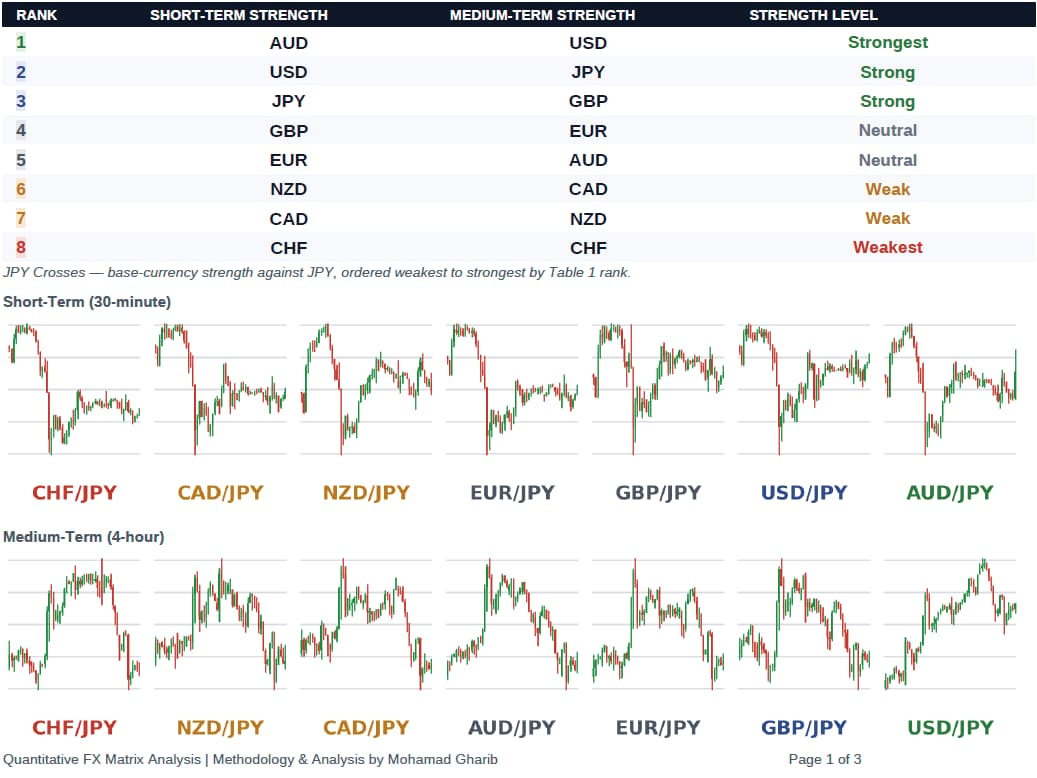
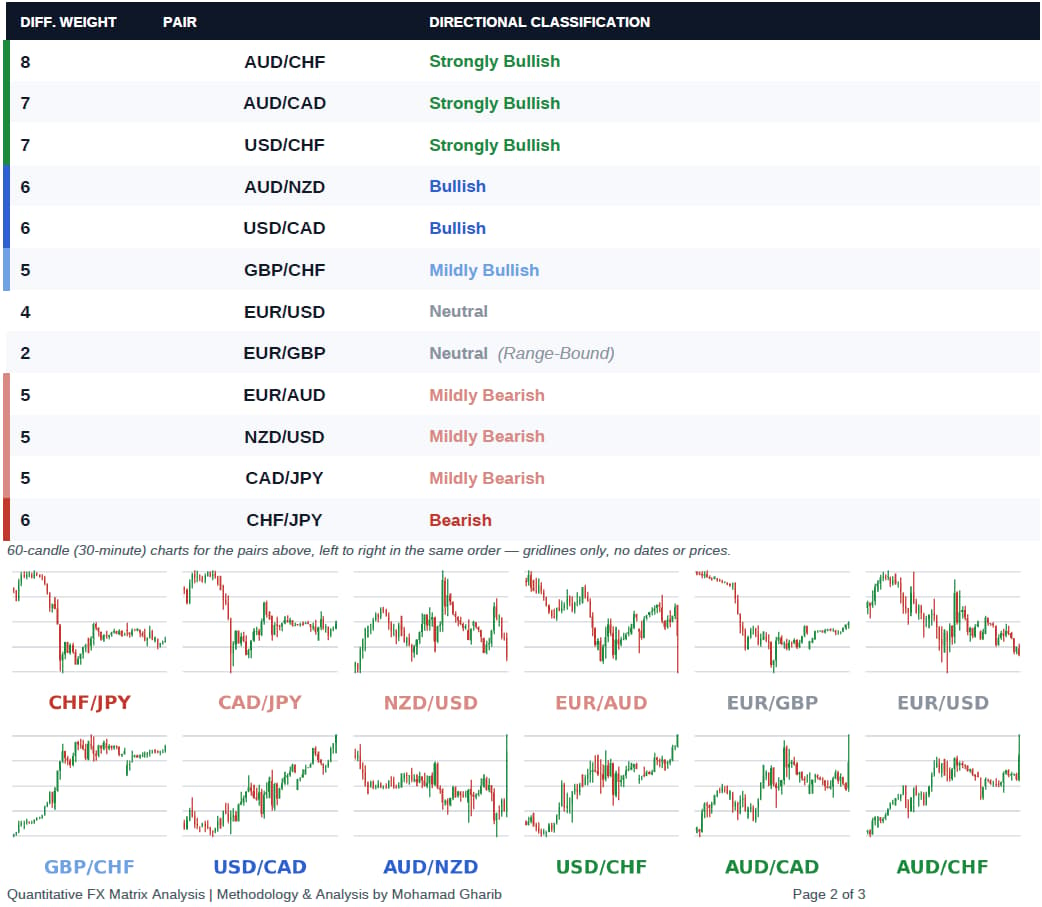
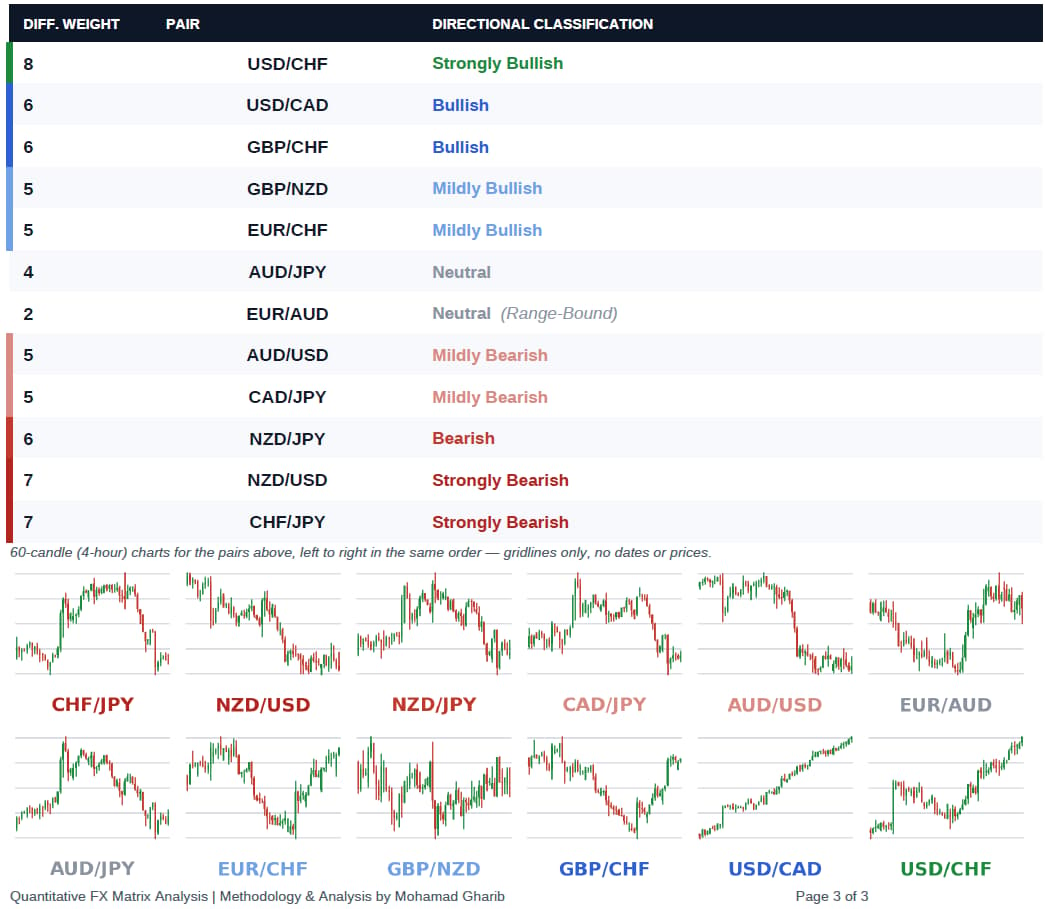
This report evaluates major currencies by constructing a relative strength index for each currency, ranking them systematically from Strongest (Rank 1) to Weakest (Rank 8) across Short-Term and Medium-Term horizons. By pairing stronger and weaker currencies, the model identifies the currency pairs with the largest relative-strength differentials and classifies each from Strongly Bullish to Strongly Bearish. The pair with the narrowest differential in each horizon is treated separately as the model's Range- Bound pair.

Short-term executive takeaway

AUD ranks as the strongest currency short-term, while CHF ranks as the weakest, placing AUD/CHF at the Strongly Bullish end of the Short-Term Pair Matrix.

Separately, EUR/GBP has the narrowest differential (Diff. Weight 2), marking it as Range-Bound.

Medium-term executive takeaway

USD ranks as the strongest currency medium-term, while CHF ranks as the weakest, placing USD/CHF at the Strongly Bullish end of the Medium-Term Pair Matrix.

Separately, EUR/AUD has the narrowest differential (Diff. Weight 2), marking it as Range-Bound.

Table 1: Currency Strength Index (Rank 1 to 8)
Chart

Table 2: Short-term pair matrix — Strongly bullish to strongly bearish
Chart

Table 3: Medium-term pair matrix — Strongly bullish to strongly bearish
Chart

Author

More from Mohamad Gharib
Share:

Editor's Picks

AUD/USD hits nine-week lows below 0.7000 on RBA Bullock's remarks

AUD/USD reverses a brief uptick and turns lower to hit nine-week lows below 0.7000 in the European morning on Tuesday, as traders digest cautious remarks from Reserve Bank of Australia (RBA) Governor Michele Bullock during the press conference. Earlier on, the RBA raised the cash rate to 4.60%, as widely expected, leaving the door open to further rate hikes if needed.

USD/JPY consolidates near 157.50 as a bullish USD counters intervention risks

USD/JPY struggles to capitalize on the overnight bounce from a one-week low, consolidating around 157.50 in the Asian session on Tuesday. Trump's concerns about the Japanese Yen's weakness fueled speculation about another US-Japan joint intervention. This, along with the hawkish BoJ, underpins the JPY and caps the currency pair. Meanwhile, rising Fed rate-hike bets and oil-driven inflation fears continue to push US bond yields to multi-year highs, keeping the US Dollar pinned near a two-month high and supporting the pair.

Gold seems vulnerable near eight-week low amid Fed hike bets

Gold struggles to capitalize on a modest Asian session uptick, trading near its lowest level since August 4, around the $4,100 neighborhood, touched the previous day. Moreover, the bearish fundamental backdrop suggests that the path of least resistance for the precious metal remains to the downside.

Ripple and Stellar face resistance amid weak signals

Ripple and Stellar remain under pressure as bulls struggle to sustain recent gains. XRP extends its decline below $1.480 after three consecutive losing days, while XLM faces rejection near the $0.234 resistance zone. In addition, mixed derivatives outlook and weakening on-chain metrics suggest that bullish momentum remains fragile, leaving both XRP and XLM vulnerable to further losses.

India Gold market cautiously optimistic with approach of festive and wedding seasons
The Indian gold market is cautiously optimistic as we approach the festive gold-buying season. Higher prices continue to weigh on gold jewelry demand even as they support investment purchases. Meanwhile, wedding buying appears “resilient,” according to the World Gold Council.
Fed vs BoJ: Both hiked. The market only believes one of them – and the chart shows which

The Fed and the BoJ have just done something remarkably similar. Both central banks raised interest rates by 25 bps last week, both are confronting inflation risks, and both signal that future decisions will depend on incoming economic data.















