Copper hits record highs: Why it matters for Australia’s economy

Copper price surged to record highs, nearing $14,200 per ton in May, as AI-driven demand collided with mounting supply fears linked to the Middle East war. The rally could have major implications for Australia, one of the world’s largest mining economies.
Why does it matter?
Let’s get it right. AI has become the mother of all investments, and companies focused on tech have led stock markets and the investors’ mood. The use of Copper in liquid cooling systems and thermal interfaces is critical to manage the heat generated by AI workloads.
The metal is also widely used in clean technologies such as electric vehicles and solar power. Finally, it can be recycled indefinitely without losing quality, making it vital for a sustainable, low-carbon economy.
Copper refinement requires sulfuric acid, and here is the trick: half of the world's supply comes from the Middle East. Sulfur is a byproduct of the oil refining process, meaning countries such as Iran, Kuwait, Qatar, Saudi Arabia, and the UAE produce almost a quarter of the world's sulfur supply, according to the US Congressional Research Service.
The Strait of Hormuz closure then extends its claws far beyond an energy-inflation problem, as it's also affecting not only sulfur extraction, but also its distribution. Additionally, China has placed restrictions on sulfuric acid exports to secure resources. Hence, record prices for Copper.
Finally, Copper supply faces one more challenge: miners are having to go deeper and farther to find resources, and ore quality has been declining. The need to go mining to new underground depths makes operations more expensive, adding to the case of record prices.
Production costs not only skyrocketed, but they are also just starting their route north, as there are no signs of potentially receding demand for AI infrastructure.
Australia's mining growth
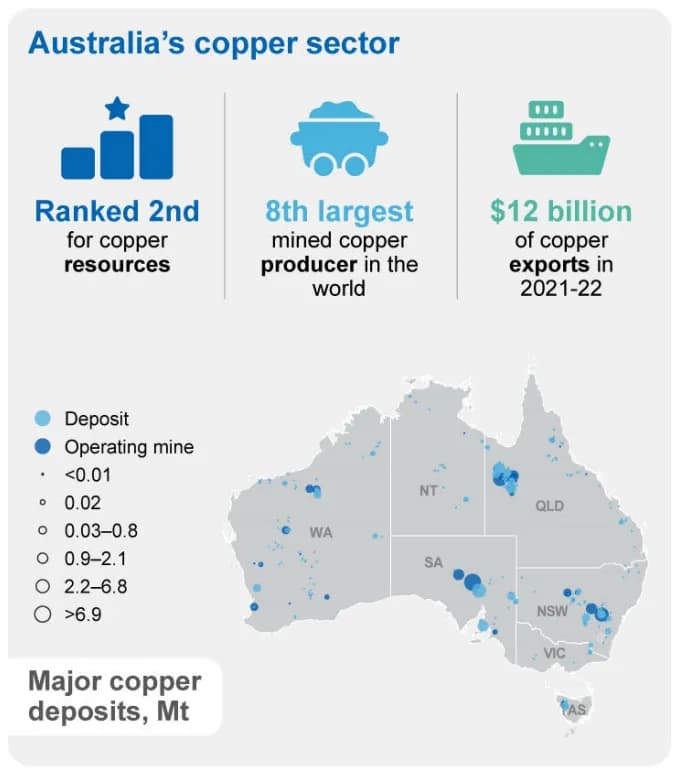
Australia is the eighth largest global producer of Cooper and holds significant mineral resources. That could position the country as a long-term supplier. Australia's mining industry contributes more than 12% to the Gross Domestic Product (GDP) and represents around the 70% of export earnings.
Source: Mining.com.au
By the end of 2024, Australia became concerned about the supply gap. Local mining major companies ramped up investment into expanding the country’s Copper projects amid surging global demand, yet focusing on boosting domestic supply chains rather than on further exploration. By that time, however, supply disruptions related to the Iran war were an unthinkable scenario.
According to a 2025 report from the Australian Department of Industry, Science and Resources, a total of 21 projects worth AU$11 billion were completed in the year, while multiple other projects, including expansions and reactivations, were added across all stages of development.
Regarding Copper, total capital expenditure reached AU$16.1 billion, matching 2024 investment, while a total of five new expansions and developments reached a value of AU$0.7 billion. The number of Copper projects also rose in 2025 to 32. Most projects currently committed and not only those related to Copper, are expected to be completed by late 2027.
Australia could have anticipated a supply gap, albeit not of the current magnitude. The modest growth in the mining sector does not match current market needs and is far from complete. The country is still far from relevant in the global Copper landscape and is likely to face unexpected challenges from the Iran war, but at least it seems better positioned to deal with them at a domestic level than other major economies, due to its continued investment in the mining sector.
Author

Valeria Bednarik
FXStreet
Valeria Bednarik was born and lives in Buenos Aires, Argentina. Her passion for math and numbers pushed her into studying economics in her younger years.