Central bank week ahead: seeing more in five rate decisions

In the foreign exchange (FX) markets, news is important, but the gap between market reality (actual news) and expectations (projected news) matters even more. Knowing expectations and understanding whether they are overly optimistic or pessimistic is often more valuable than the headlines themselves. This upcoming week is likely to be one of the most consequential in recent months. Important macroeconomic reports are on the horizon, including crucial inflation and Gross Domestic Product (GDP) readings across major economies. In addition, five central banks will announce their rate decisions. Because exchange rates respond directly to changes in relative monetary policy, these central bank meetings are the most critical events for traders. In this article, Elev8, a global CFD broker, focuses on these five decisions, explains the main themes that investors are watching, and provides an outlook for gold (XAUUSD).
Week ahead
This week brings five central bank decisions over the course of just three days, one of the most important periods in several months. The main theme that preoccupies investors and traders alike is a global shift toward tighter monetary policy driven by rising inflation and higher energy prices. However, each bank faces its own unique economic conditions. The Reserve Bank of New Zealand (RBNZ) and Bank of Canada (BOC) are expected to raise rates, the Federal Reserve (Fed) and European Central Bank (ECB) are expected to hold while signalling further tightening, and the Bank of Japan (BOJ) is expected to hold while upgrading inflation forecasts. Differences in actions and forward guidance will shape FX and gold into the end of the year.
Schedule at a glance
Day | Central Bank | Current Rate | Expected Decision | Time (GMT) |
Wed. 28 Oct. | RBNZ | 2.75% | +25 bp to 3.00% | 01:00 |
Wed. 28 Oct. | BOC | 2.25% | +25 bp to 2.50% | 13:45 |
Wed. 28 Oct. | Fed | 3.75–4.00% | Hold | 18:00 |
Thu. 29 Oct. | ECB | 2.50% | Hold | 12:45 |
Fri. 30 Oct. | BOJ | 1.25% | Hold | ~03:00 |
Source: Elev8 broker
The RBNZ is expected to raise rates by 25 basis points (bps) to 3.00%. Indeed, the macroeconomic conditions favour a rate hike. Inflation remains above target. Consumer Price Index (CPI) stood at 3.7% year on year (y-o-y) in the third quarter (Q3), and core inflation rose to 2.9%. Major commercial banks and institutional economists project New Zealand's inflation in Q4 to average between 4.5% and 4.7%, which is well above the RBNZ's official expectations. The likelihood of a further hike in December has risen, and all four major New Zealand banks expect rates to reach 3.25% by the end of the year. Markets fully price the Wednesday move and further tightening next year. Because the hike is fully priced into the market, any dovish surprises (either in rhetoric or in the monetary statement) pose downside risks for the New Zealand dollar (NZD). David Perk, financial analyst at Elev8 broker, notes: 'A dovish surprise would hurt NZDUSD more than a hike would lift it. In other words, we have an asymmetrical skew to the downside. 0.5760–0.5770 is the key resistance area to watch, while 0.5630 is a major support.'
On the same day RBNZ reports, the BOC is similarly expected to raise rates by 25 bps to 2.50%. This marks a sharp shift from earlier expectations of a hold. BOC Governor Macklem warned that inflation forecasts would be revised significantly higher due to high crude oil and petroleum prices. Indeed, the latest business outlook survey showed rising inflation expectations, and August retail sales rose 1.2%, pointing to solid third-quarter growth. Furthermore, Canada also benefits from high oil prices via a positive current account balance. Hawkish monetary policy expectations have already driven USDCAD to a one-month low. A hike is largely priced in, so the Monetary Policy Report and signals about the December meeting will matter more.
Later on Wednesday, the Fed is widely expected to hold rates at 3.75–4.00%. While market participants generally expect the Fed to hike in December, they still want clarity on the December path and terminal rate. Therefore, they will focus on Chair Kevin Warsh's press conference and any shifts in the Federal Open Market Committee's statement. The September U.S. Producer Price Index (PPI) came in significantly higher than forecasts, showing energy prices filtering more broadly. Nonfarm payrolls rose by only 29,000 with prior months revised lower, though the labour market remains relatively resilient. Most forecasters see rates peaking near 4.00–4.25%, but more now expect at least two further hikes. 'While Wednesday's policy hold is fully priced and any hawkish signals from Chair Warsh could support the dollar, incoming PCE inflation and third-quarter GDP data will ultimately matter more for market direction than the meeting itself,' said David Perk, financial analyst at Elev8 broker.
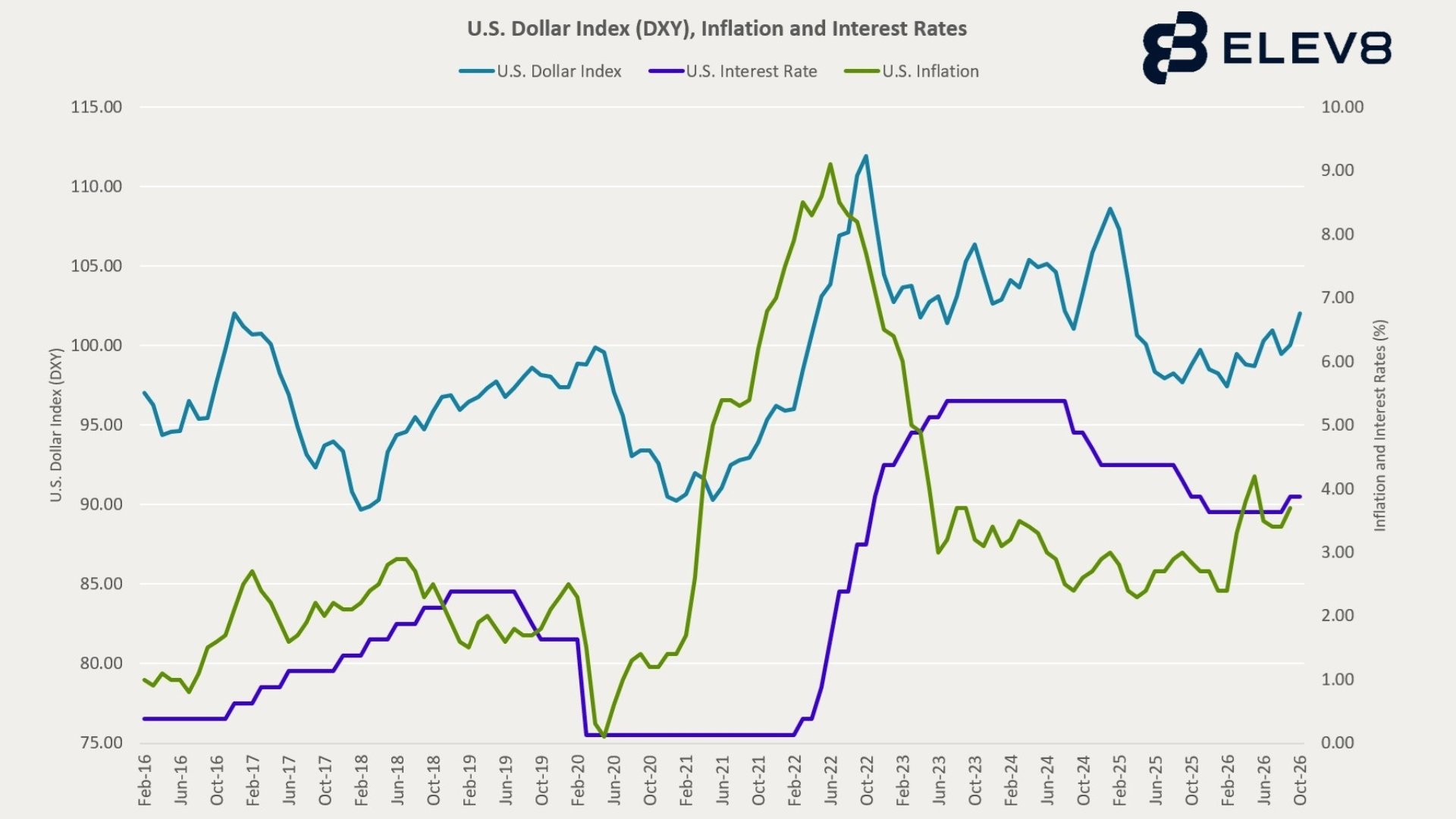
On Thursday, 29 October at 12:45 GMT, the ECB is expected to hold the deposit rate at 2.50%. French bond stress is the key issue. The 10-year yield rose above 5%, and the spread to German bonds widened sharply. The Governing Council appears more divided on the December path amid weaker Purchasing Managers' Indices (PMIs) reported last Friday, but markets generally price in further tightening by the end of 2027. The tone on future hikes versus financial stability will be decisive. David Perk notes: 'EURUSD is already under pressure with extreme net-short positioning. If President Lagarde fails to address the stress credibly, the pair could fall toward 1.10. At the same time, the positioning itself is now so crowded that it introduces its own risk of a sharp reversal. Any signal of a backstop could spark a short-covering rally.'
On Friday, 30 October, around 03:00 GMT, the Bank of Japan is expected to hold its benchmark rate at 1.25% but may raise its fiscal 2027 inflation forecast. September core CPI rose to 2.1% y-o-y, back above the 2% target, while the core measure excluding food and energy accelerated. Most analysts expect the next hike in December, with a terminal rate near 1.75–2.00%. A hold is almost fully priced, so the outlook report and Governor Ueda's press conference will drive the yen. An upgraded inflation forecast would support JPY, but high oil prices will limit gains as Japan remains a key energy importer.
Impact on Gold
Gold price plunged by 2.2% last Thursday and by another 1.3% last Friday. It is now trading near $4,030 per ounce (oz), a three-month low. David Perk, financial analyst at Elev8 broker notes: 'Gold is caught between tightening bias and safe haven demand. Traders must factor in strong interest rate pressures while at the same time saying mindful of persistent geopolitical and fiscal risks.'
Below is a summary of competing forces driving gold prices:
Bearish for Gold | Bullish for Gold |
Fed December hike near-certain; higher real yields | French fiscal crisis / eurozone stress = safe-haven bid |
BOC and RBNZ hiking = global tightening trend | Geopolitical risk: Houthi attacks on Saudi Arabia, Middle East |
Strong USD weighing on gold | Extremely crowded USD longs create short-covering risk |
PCE data Thursday could reinforce hawkish narrative | Labour market softening (29k payrolls) raises recession fears |
Source: Elev8 broker
On the bearish side, near certainty regarding a December Fed rate increase, higher real yields, and a strong U.S. dollar weigh on gold. On the bullish side, eurozone fiscal stress creates a safe-haven bid, while geopolitical tensions in the Middle East provide underlying support. Extremely crowded long positions in the dollar also introduce short-covering risks for gold if upcoming economic data softens. However, inflation persistence driven by oil prices near $120 per barrel is the common thread forcing central banks to stay hawkish even as growth softens.
Central bank actions from the upcoming decision will differ, but the overall direction is tighter policy. Forward guidance will drive markets more than the rate decisions themselves.
Disclaimer:This article does not contain or constitute investment advice or recommendations and does not consider your investment objectives, financial situation, or needs. Any actions taken based on this content are at your sole discretion and risk—Elev8 does not accept any liability for any resulting losses or consequences.
Elev8 is a licensed global broker serving 18+ million traders in 100+ countries. It offers market access through 3 platforms: Elev8Trader, MetaTrader 4, and MetaTrader 5. Operating under licences from Mauritius and Seychelles, Elev8 provides traders with the tools to help spot and capture more market opportunities. The broker received the 'Best Trading Experience Broker 2026' and the 'Best Trading Platform Provider 2026' awards from FxDailyInfo.
One of Elev8's key features is Space, an analytics hub within the Elev8Trader platform that helps traders expand their market horizons. With its personalised feed, daily expert analytics, and community content, Space facilitates faster access to information and market data.
Author