Bitcoin's selloff isn't coming from where most people think

Most of the money leaving US Bitcoin exchange-traded funds in November has come out of BlackRock's iShares Bitcoin Trust, while the largest Bitcoin wallets were buying. That points to stock-market investors cutting risk as rates rise, and their calendar decides when it stops.
Bitcoin (BTC) has fallen for six straight weeks and is down roughly 30% since October, and the usual picture of a slide like that is crypto's own crowd losing its nerve. The withdrawals from US Bitcoin exchange-traded funds (ETFs), which hold the coins and trade like shares, appear to fit that picture. Investors pulled $1.28 billion in the week to November 6 and another $1.07 billion in the week to November 13.
Trace the money to its source, though, and most of it came out of a single fund that people hold in ordinary brokerage accounts, while the largest holders of actual coins were adding to their wallets. The selling looks less like Bitcoin's holders panicking and more like stock-market investors cutting back on risk, with a Bitcoin fund among the things they cut.
One fund is doing nearly all the selling
Among the US funds that hold Bitcoin directly, only one has mattered for most of November. The iShares Bitcoin Trust (IBIT), run by BlackRock (BLK), lost $908.5 million in the week to November 13, about 85% of the group's total. Across the month's first eight sessions, it accounted for 94% of everything that left, and nine of the other funds were roughly flat in the latest week.
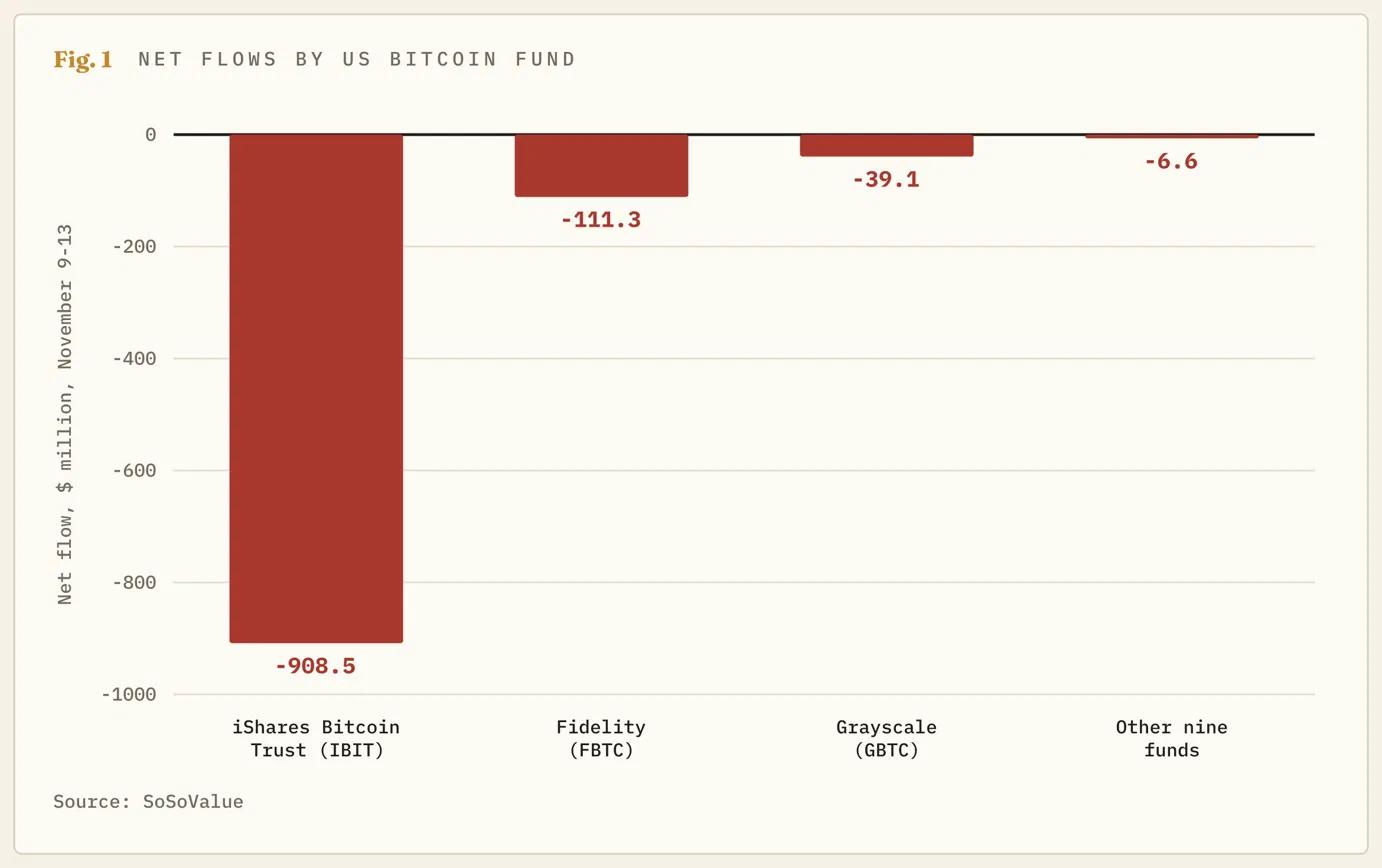
From October 30, IBIT went 11 sessions without a single day of net buying, and investors pulled about $2.35 billion along the way. Some of that reflects its size, since IBIT holds roughly three-fifths of the money in these funds, but its share of the withdrawals has run well ahead of its share of the assets.
Beyond the concentration, the money has moved fast. IBIT had taken in $410.6 million across four sessions in late October, and nearly all of it left in a single day on November 2.
It sold in the same weeks as the AI stocks
IBIT matters because of who holds it. Someone who buys Bitcoin on a crypto exchange owns coins, whereas someone who buys IBIT owns a share that sits in the same brokerage account as their Nvidia (NVDA) stock and their index funds. Large institutions reported owning about a quarter of the Bitcoin funds in CoinShares' September 2025 count, and most of the rest sits with individuals and smaller firms. When the owner of that account decides to take less risk, the Bitcoin fund is on the same screen as everything else.
Since early October, plenty has prompted that decision. Nvidia has lost about a third of its market value over six straight losing weeks. The NASDAQ-100, the index of the largest technology shares, fell for four weeks running to November 6 and was nearly 15% below its record at one point. Analysts at Bitfinex put the 30-day correlation between Bitcoin and that index, a measure of how closely two prices move together, at 0.72 in a November 9 report, on a scale where 1 means in step.
Over the same stretch, interest rates have been pushing the same way, and the 10-year Treasury yield, what the US government pays to borrow for a decade, is above 5%. Traders see the Federal Reserve (Fed) as certain to raise rates on December 9, with about a 92% chance of a quarter-point move and the rest on a half-point. A fund that pays no income is a hard thing to keep in a brokerage account that can earn 5% on a government bond. Bitcoin has now matched Nvidia's six losing weeks without an earnings report or an export rule of its own to blame.
Bitcoin's biggest holders have been buying
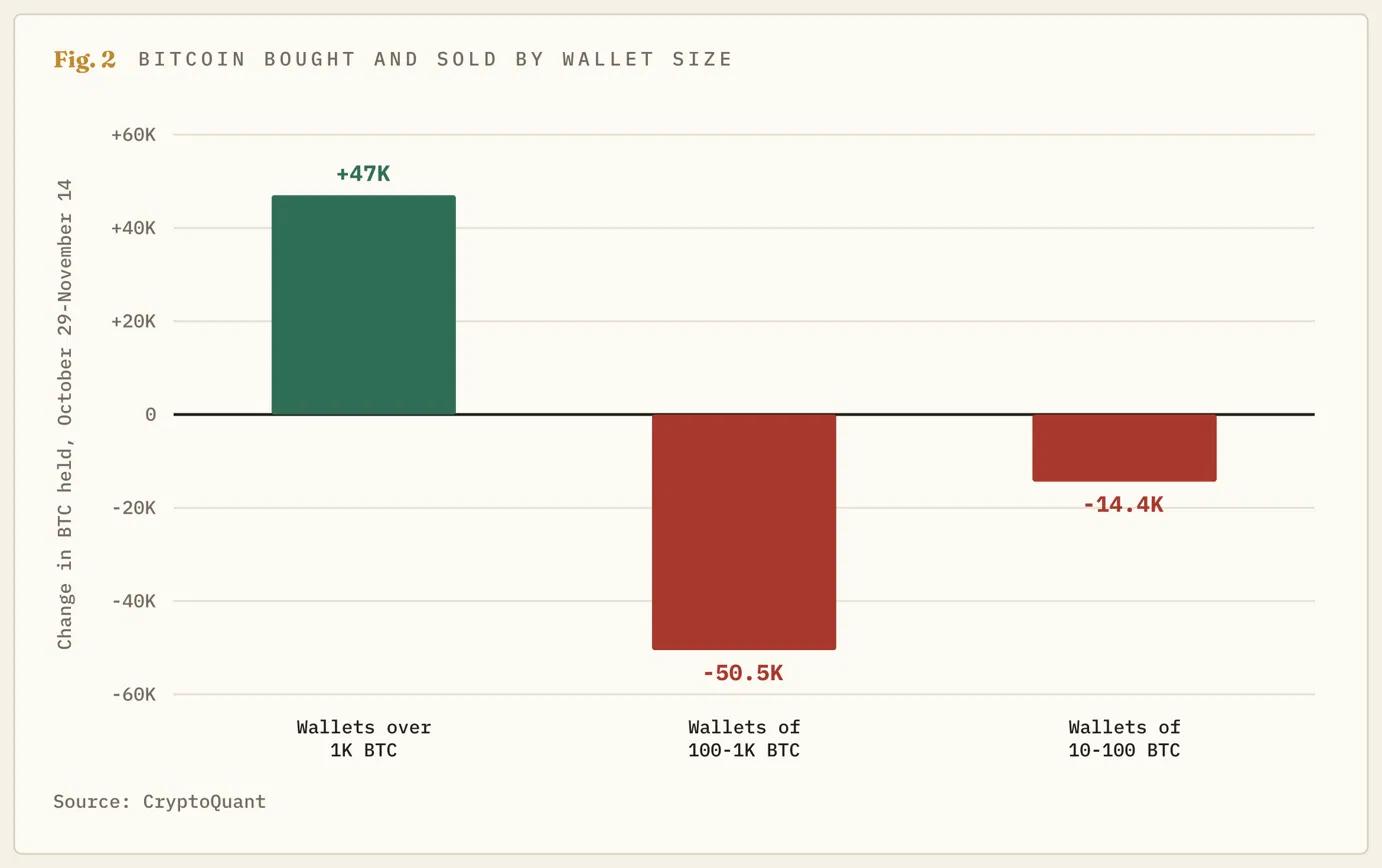
Meanwhile, the people who hold the most coins have been going the other way. On-chain data, the public record of which wallets hold which coins, is tracked by the research firm CryptoQuant. It found that wallets holding more than 1K Bitcoin (BTC) added about 47K BTC between October 29 and November 14, a stretch in which the price fell about 24%.
Among those wallets are the holders with the most to lose. Large holders who bought within the past 155 days are sitting on close to $8 billion of paper losses, meaning losses on coins they haven't sold, the most on record for that group. Even so, the firm's analysts say their transfers to exchanges, the usual step before selling, have risen without turning into a rush.
In September, the same group had a record paper gain of about $9.07 billion, so it has seen its best and worst positions on record two months apart. Put together, holders with thousands of coins and those with a record loss have mostly stayed put, and the most visible selling has come from people who have never held one.
Smaller holders are selling too
The best argument against all this is that the same data shows plenty of coin holders selling. Over the same stretch, CryptoQuant has wallets holding 100-1K BTC selling 50.5K BTC, slightly more than the largest wallets bought, and wallets holding 10-100 BTC selling another 14.4K BTC.
On top of that, a second firm reads the big wallets differently. Glassnode's November 15 report shows holders of 1K BTC or more sending about $55 million more a day to exchanges than they withdraw, which would normally point to selling ahead. The link to stocks isn't clean either, because the NASDAQ-100 rose 3.53% in the week to November 13, its best week since August, and IBIT lost $908.5 million anyway.
Even so, that week fits the argument once rates are counted. The 10-year yield jumped back above 5% on November 12, two days after traders fully priced in a December rate increase, so accounts selling IBIT had a second reason to cut risk even as chip stocks bounced. Nvidia itself fell 12.75% that week.
As for smaller coin holders, their selling is modest relative to the size of the market. The data firm Santiment counts 108.7K fewer wallets with coins than at October's peak of nearly 60 million, which works out to about one wallet in 550.
The stock market decides when it stops
If the selling is stock-market money cutting risk, then the stock market's calendar is what matters for Bitcoin. Nvidia's results arrive on Tuesday after regular trading ends, and the Fed decides on December 9. In between, the artificial intelligence (AI) company Anthropic is due to list by Friday after a share sale of up to $64.4 billion, which fund managers may fund by selling other holdings.
In the kinder version, Nvidia steadies technology shares, the Fed raises by a quarter-point and signals a wait, and the accounts that sold IBIT would likely start buying it back. Monday offered a first hint of that: IBIT took in $76.5 million, and the group ended a seven-session run of withdrawals with a net $7.9 million.
That same Monday also showed what the other branch would look like. While IBIT took in money, the Grayscale Bitcoin Trust (GBTC) and the Fidelity Wise Origin Bitcoin Fund (FBTC) kept losing it. If withdrawals spread across the group while the largest wallets turn from buying to selling, the slide would have become a Bitcoin problem as well as a stock-market one. That would likely mean a longer fall, because the buyers who have been taking the other side would be gone.
As things stand, the likelier path is that Bitcoin follows the stock and bond markets out of this slide, as it did on the way in. That reading fails if yields ease, technology shares steady and IBIT keeps losing money anyway, or if CryptoQuant's large wallets start to shrink. Either outcome would mean the sellers were where most people thought they were all along.
Author
Joshua Gibson
FXStreet
Joshua joins the FXStreet team as an Economics and Finance double major from Vancouver Island University with twelve years' experience as an independent trader focusing on technical analysis.

















