|

Brent Oil reversal confirmed: Elliott Wave analysis signals deeper correction

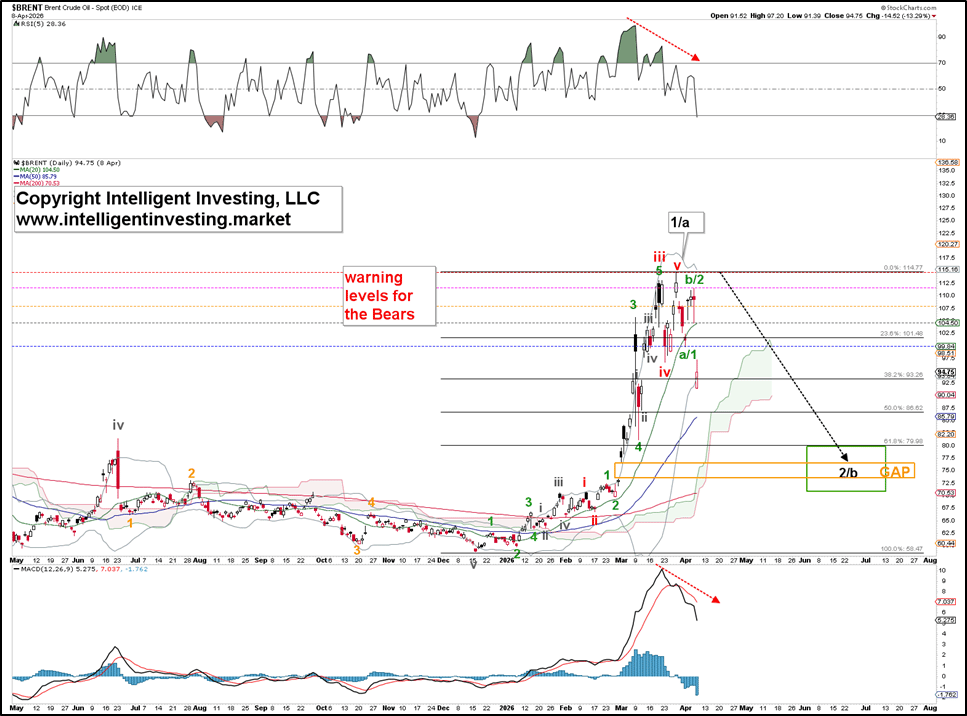
In our first update on Brent Oil, when it was trading around $112.7, we found, using the Elliott Wave Principle, that

“… [our analyses] reinforce the likelihood of a near-term top. Traders should be vigilant for reversal signals, as the completion of the 5th wave will usher in an ABC corrective phase, leading to lower prices in the weeks ahead. A break below the red W-iv low at $96.78 -the red warning level for the Bulls- will signal that the black W-2/b to ideally $77.50+/-5 is underway.

Fast-forward to today. Brent Oil topped out the same day at $114.81 and then dropped almost 20% intra-day yesterday, falling to $91.39 and breaking below the critical red warning level for the Bulls.

Figure 1. Elliott Wave Count of Brent Oil’s Advance Since Its December 2025 Low
Thus, thanks to the EWP, we were well ahead of the news in January about a pending rally and in late March about a pending steep decline. It is therefore a cornerstone of technical analysis, as it provides traders and investors, e.g., our premium members, with a framework for timely identification of reversals and new market trends.

Looking ahead, the corrective phase in Brent Oil is now expected to be underway and to unfold with significant volatility as market participants react to the rapid price decline. The ideal 50-76% retracement zone, based on Fibonacci analysis, typically serves as a strong support area where buyers may re-enter the market, potentially stabilizing prices. As always, we will monitor price action and other indicators daily for our premium members to confirm the end of the correction and the possible start of a new uptrend.

Author

Dr. Arnout Ter Schure

Dr. Arnout Ter Schure

Intelligent Investing, LLC

After having worked for over ten years within the field of energy and the environment, Dr.

More from Dr. Arnout Ter Schure
Share:

Editor's Picks

AUD/USD languishes near two-month low amid renewed Iran tensions

AUD/USD holds above 0.7000 during the Asian session on Wednesday, though it remains close to a nearly two-month low set the previous day. Fresh US strikes on Iran temper hopes for a peace deal and benefit the safe-haven US Dollar. Furthermore, inflationary concerns continue to fuel hawkish Fed expectations, lending additional support to the buck ahead of the US CPI report. Adding to this, reduced bets on an RBA rate hike in June cap the currency pair.


USD/JPY sits near 160.50 intervention zone as bulls shrug off Japan's strong PPI

USD/JPY consolidates just below mid-160.00s, or its highest level since late April, as economic concerns stemming from the Middle East conflict continue to undermine the Japanese Yen (JPY). Furthermore, a fresh wave of US strikes on Iran benefits the safe-haven US Dollar and acts as a tailwind for the currency pair, countering Japan's hotter-than-expected PPI report. However, intervention fears cap the upside as traders seem hesitant ahead of the US consumer inflation figures later this Wednesday.

Gold flirts with $4,200, lowest since March 23 on hawkish Fed bets

Gold drops to a fresh low since March 23, around the $4,200 mark during the Asian session on Wednesday, as fresh US strikes on Iran fuel inflationary concerns and bolster bets for more hawkish central banks, including the US Fed. Meanwhile, US Dollar bulls are turning cautious ahead of the US CPI report, which could limit bullion losses. However, the recent breakdown below the 200-day SMA suggests that the path of least resistance for the XAU/USD is to the downside.

Bitcoin sell-off pushes over 50% of circulating supply into loss, hinting at market bottom

Bitcoin dropped near $61,000 on Tuesday, with the latest sell-off pushing long-term market indicators toward levels historically associated with bear-market bottoms, according to a report by K33 Research.

When the chips are down, the AI tape starts to shake

The market came into Tuesday trying to sell investors the comforting ”Turnaround Tuesday” idea that Friday’s AI fracture was just another pothole on the road higher. By the close, that story had lost its bid. Monday’s dead cat bounce had done what dead cat bounces always do.

The US economy defies the rules: 100 days into the Oil shock and the recession signal is still missing

More than three months after the start of the Iran war and the resulting disruption to global energy markets, the US economy continues to display remarkable resilience. The conflict has triggered a sharp rise in Oil prices, reignited inflationary pressures and fueled widespread concerns about a potential economic slowdown.