BP and HSBC in focus, as Yen rally takes a break
The UK’s corporate sector is in focus this morning, for all the right reasons after AstraZeneca fell 8% on Monday. HSBC and BP have both reported stellar Q2 earnings, which may help the FTSE 100 today, after it lagged global peers on Monday and fell 0.1%, while other European and US indices posted strong gains.
HSBC reports stellar results
Looking at HSBC first, it exceeded analyst estimates and reported profits of $10.1bn for Q2, a 60% increase YoY. It benefitted from higher net interest income, which rose by 9% in Q2 as the HSBC capitalises on elevated global interest rates. Revenue also rose by 16% last quarter.
Some $2bn of the increase in profits were down to one off items, so investors may worry that this will not be repeated. However, profitability levels remain high, and the company expects its return on tangible equity, its main measure of profitability, to stay at 17% for this year.
Strong results could be clouded by calls for higher taxes
These results were also heavy on shareholder sweeteners, which may boost investor interest later today. HSBC announced a second dividend for this year and a share buyback of $1bn, to be completed in the next 3 months. The share price has risen by 10% in the past month, and a lot of good news may already be priced in.
The share price slipped in overnight trading in the US, and HSBC could be a victim of its own success. There is political pressure on PM Andy Burnham to tax banks more, and HSBC’s results and high profit levels could add to calls for a higher levy on the sector, which could act as a counterweight to banking stocks later on Tuesday.
BP’s results suggest new direction for firm is working
BP also reported results today. Markets were expecting a big report and they got one. Profits doubled in Q2 as oil price volatility surged. Replacement cost profit was $5.7bn last quarter, higher than the $5bn expected.
Meg gets a helping hand from market conditions
New CEO Meg O’Neil received a boost from overall market conditions, but these results are a vote of confidence in BP’s change in direction under O’Neil. She has simplified the business, made it refocus on hydrocarbons at the expense of renewables, and has navigated a period of internal volatility with the ousting of its chairman in May.
Big Oil criticism fails to highlight huge amounts of tax they already pay
The company is likely to face calls that it is profiting from a cost-of-living crisis. O’Neil addressed this issue in the earnings report, saying that they are focussing on boosting supply of critical fuels like diesel and jet fuel, to alleviate pressures. Since commodity prices are set on global markets, there is little that BP can do about this apart from manage supply.
There are already massive windfall taxes on oil and gas companies, and BP reported that its effective global tax rate is 33-37% for Q2. It also paid $1.2bn in UK tax last year and it is likely to pay significantly more this year due to rising revenues. This is unlikely to placate Big Oil’s critics, including from arch-capitalist Donald Trump, who said that US oil majors are making too much money. These comments from the President could mean that investors need to factor in trickier political waters for oil majors in the lead up to the UK Budget and the Midterms this autumn, which could stymie their share price gains.
Have we reached the high point for BP?
Overall, BP’s share price is already higher by 27% this year. Oil prices have been volatile in recent weeks but have generally been on a downwards trajectory in Q3, which means that profit levels may not be maintained for this quarter. This could thwart further meaningful gains in the share price on Tuesday, and any reaction to these results could be mild, as a lot of the good news for BP is already priced in.
Can the tech rally be replicated?
Stocks had a fantastic start to August, with the US leading the way on Monday as the tech rally continued. The question now is, how long will it last? Early on Tuesday, futures prices in Europe and the US are moderately higher, suggesting that the rally might be fading, but is yet to pause.
The deep tech sell off is over as we start a new month, and Magnificent 7 names soared on Monday, with large gains for Nvidia, Amazon, Alphabet and Microsoft. The latter has seen its share price rise 23% in the last 5 days, although it fell 0.3% in overnight trading, suggesting that the rally in tech may take a pause later today.
Oil prices rise again as negotiation confusion remains
The decline in the oil price was one of the drivers of animal spirits on Monday, however, Brent crude is higher by 1.5% this morning and is back above $85 per barrel after Donald Trump said that talks with Iran were going ahead, even thought Tehran has denied this is the case.
Although the US called off a major strike on Iran over the weekend, there is still confusion about the status of negotiations between the US and Iran, which makes it hard to predict where the oil price will go next. If we see oil prices rise in the coming days, then it may be harder for stocks to maintain their upward momentum.
Where do stocks go next?
For now, a short-term pause in the tech rally is to be expected. While valuations for US stocks have fallen to attractive levels in recent weeks, they are creeping higher. For example, Microsoft’s P/E ratio fell 42% compared to last year and was at 20 times earnings before the recent rally. Now, its share price is 26 times earnings, after the recent blistering rally.
Thus, while large cap growth stocks are riding a wave of enthusiasm, part of the drive higher was decent valuations. Can the rally persist in the medium term if tech stocks continue to get more expensive?
Yen weakens for first time since intervention
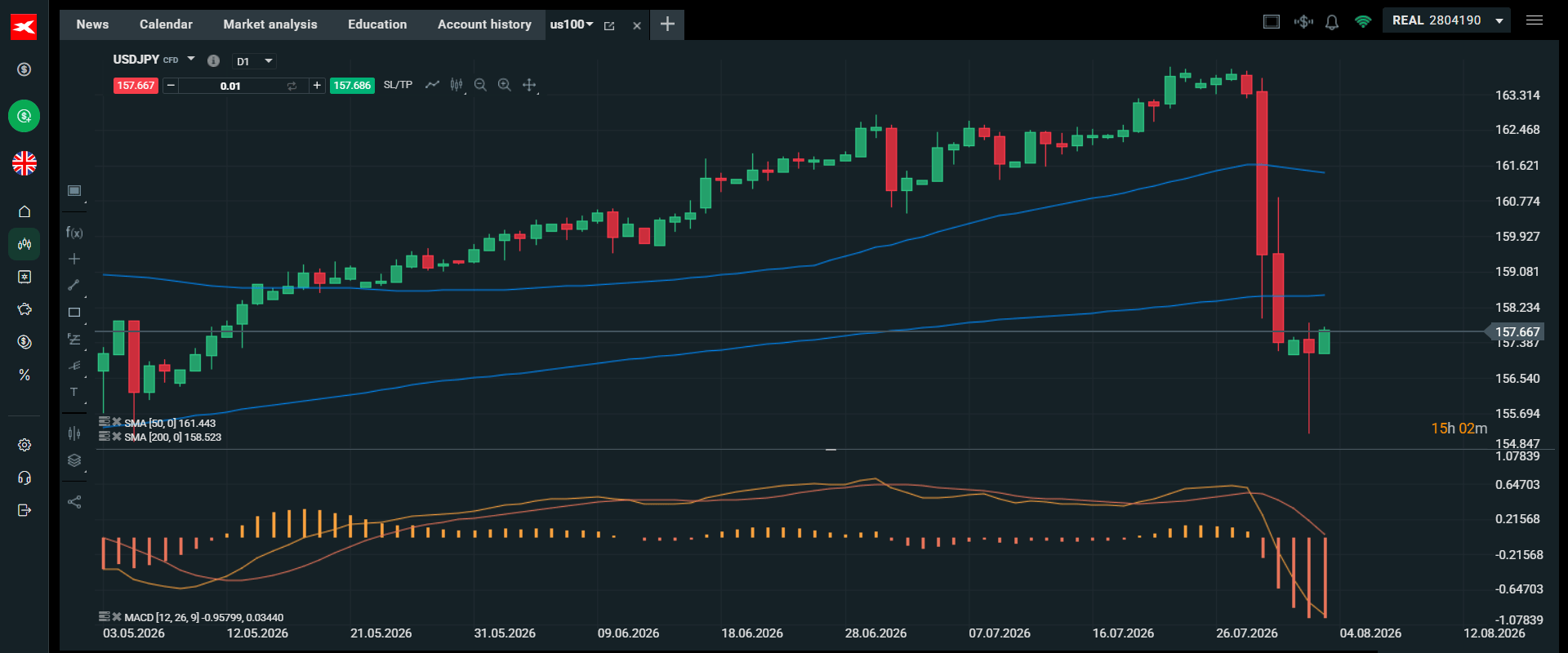
The yen is also in focus, after the unprecedented FX intervention to support Japan’s currency, The yen is lower by 0.3% on Tuesday morning after a 4% rally since Thursday. This pair is trading about 100 points from the low at 155.60 this morning.
This does not mean that the intervention has failed, far from it. In the past, when the US intervened in USD/JPY it has marked a turning point for the currency. The Japanese authorities have also said that they will tap the US’s FIMA repo liquidity facility, designed for central banks to access USD liquidity without the need to sell their Treasuries, to ‘promote foreign exchange stability’ in the future.
This is interesting, since it suggests that one reason why the US helped Japan is to protect its own Treasury market. If the yen became so weak that Japanese authorities had to sell assets like US Treasuries to raise cash to buy the yen, then it could have destabilized the entire financial system, pushing up Japanese and US sovereign bond yields.
This intervention puts a lid on that threat, but for how long? Japanese long end bond yields rose slightly on Tuesday, and at some stage Japanese interest rates will need to reflect the reality of inflation to keep the yen on a stable path for the long term.
SpaceX in focus
Ahead today, SpaceX results will be in focus. These will grab the headlines, since they are the first results after its mega IPO. However, they are not necessarily a read on the broader tech or AI sector, since SpaceX is another of Musk’s idiosyncratic businesses.
Chart: USD/JPY
Author

Kathleen Brooks
XTB UK
Kathleen has nearly 15 years’ experience working with some of the leading retail trading and investment companies in the City of London.